
Penny Dreadfuls, 1850 · page 292 of 394
The Mysteries of London; or, Lights and Shadows of London Life — page 292: what you’re looking at
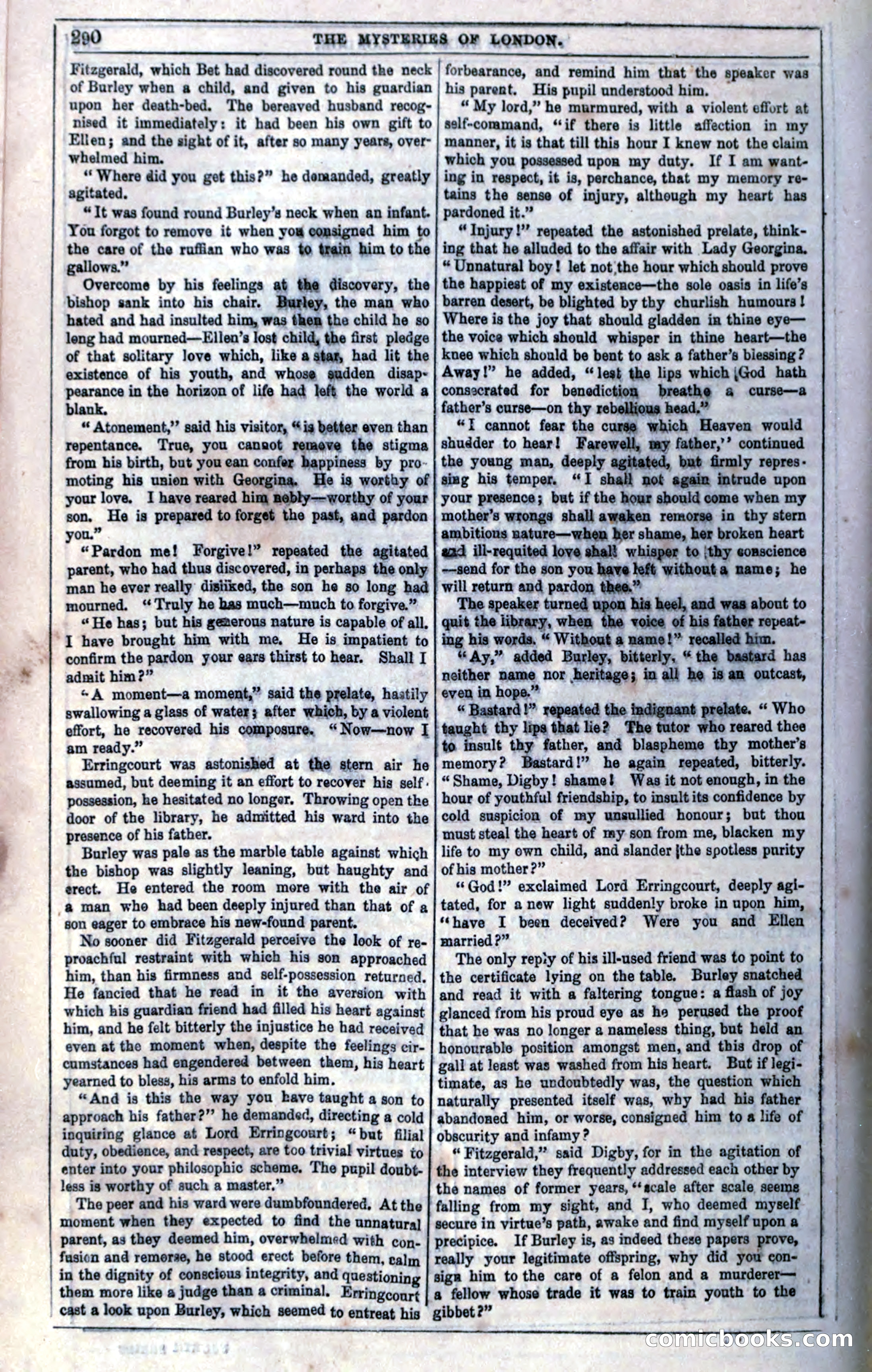
A restored page from Penny Dreadfuls, 1850. Page through the whole issue in the reader above.
📄 Transcribed text from this page (OCR, searchable)
Machine-transcribed from the original scan — historical spelling and the odd misread are preserved.
290 Fitzgerald, which Bet had discovered round the neck of Burley when a child, and given to his guardian upon her death-bed. The bereaved husband recog- nised it immediately: it had been his own gift to Elien; and the sight of it, after so many years, over- whelmed him. “Where did you get this?” he demanded, greatly agitated. “It was found round Burley’s neck when an infant. You forgot to remove it when you consigned him to the care of the ruffian who was to train him to the gallows.” Overcome by his feelings at the discovery, the bishop sank into his chair. Burley, the man who hated and had insulted him, was then the child he so leng had mourned—Ellen’s lost child, the first pledge of that solitary love which, like a stat, had lit the existence of his youth, and whose sudden disap~ pearance in the horizon of life had left the world a blank. “ Atonement,” said his visitor, “is better even than repentance. True, you canaot remeve the stigma from his birth, but you ean confer happiness by pro- moting his usien with Georgina, He is worthy of your love, I have reared him nebly-—worthy of your son, He is prepared to forget the past, and pardon you.” | “Pardon me! Forgive!” repeated the agitated parent, who had thus discovered, in perhaps the only man he ever really distiked, the son he so long had mourned. ‘“ Truly he has much—much to forgive.” “He has; but his generous nature is capable of all. 'I have brought him with me, He is impatient to confirm the pardon your ears thirst to hear. Shall I admit him?” «A moment—a moment,” said the prelate, hastily swallowing a glass of water; after which, by a violent effort, he recovered his composure. “Now—now I am ready.” Erringcourt was astonished at the stern air he assumed, but deeming it an effort to recover his self: possession, he hesitated no longer. Throwing open the door of the library, he admitted his ward into the presence of his father. Burley was pale as the marble table against which the bishop was slightly leaning, but haughty and erect. He entered the room more with the air of -@ man who had been deeply injured than that of a son eager to embrace his new-found parent. No sooner did Fitzgerald perceive the look of re- proachful restraint with which his son approached him, than his firmness and self-possession returned, He fancied that he read in it the aversion with which his guardian friend had filled his heart against him, and he felt bitterly the injustice he had received even at the moment when, despite the feelings cir- cumstances had engendered between them, his heart yearned to bless, his arms to enfold him, “And is this the way you have taught a son to approach his father?” he demanded, directing a cold inquiring glance at Lord Erringcourt; “but filial duty, obedience, and respect, are too trivial virtues to enter into your philosophic scheme. The pupil doubt- less is worthy of such a master,” The peer and his ward were dumbfoundered, At the moment when they expected to find the unnatural] parent, as they deemed him, overwhelmed with con- fusion and remorse, he stood erect before them, calm in the dignity of conscious integrity, and questioning | them more like a judge than a criminal. Erringconrt cast a look upon Burley, which seemed to entreat his . rene CORIGOOOKS.CO THE MYSTERIES OF LONDON. forbearance, and remind him that the speaker was his parent. His pupil understood him. “ My lord,” he murmured, with a violent effort at self-comamand, “if there is little affection in my manner, it is that till this hour I knew not the claim which you possessed upon my duty. If I am want- ing in respect, it is, perchance, that my memory re- tains the sense of injury, although my heart has pardoned it.” “Injury!” repeated the astonished prelate, think- ing that he alluded to the affair with Lady Georgina. “Unnatural boy! let not'the hour which should prove the happiest of my existence—the sole oasis in life’s barren desert, be blighted by thy churlish humours! Where is the joy that should gladden in thine eye— the voice which should whisper in thine heart—the knee which should be bent to ask a father’s biessing ? Away!” he added, “lest the lips which {God hath consecrated for benediction breathe a curse—a father’s curse—on thy rebellious head,” @ which Heaven would father,’’ continued ed, but firmly repres- not egain intrude upon “f cannot fear the c shudder to hear! Farew the young man, deeply sing his temper. “I sha your presence; but if the hour should come when my mother’s wrongs shall awaken remorse in thy stern ambitions nature—when her shame, her broken heart aad ill-requited love shal! whisper to {thy conscience heft without a name; he --send for the son you h will return and Ay,” added B » bitterly, “the bastard has neither name nor heritage; in all he is am outcast, even in hopes.” Pe a rr lie? Fhe tutor who reared thee i tenght thy lips . to insult thy father, and blaspheme thy mother’s memory ? tard!” he again repeated, bitterly. “Shame, Digby! shame! Was it not enough, in the hour of youthful friendship, to insult its confidence by cold suspicion of my unsullied honour; but thou must steal the heart of my son from me, blacken my life to my own child, and slander jthe spotless purity of his mother?” — “God!” exclaimed Lord Erringcourt, deeply agi- tated, for a new light suddenly broke in upon him, ‘(have I been deceived? Were you and Ellen married ?” The only repty of his ill-used friend was to point to the certificate lying on the table. Burley snatched and read it with a faltering tongue: a flash of joy glanced from his proud eye as he perused the proof that he was no longer a nameless thing, but held an honourable position amongst men, and this drop of gall at least was washed from his heart. But if legi- timate, as he undoubtedly was, the question which naturally presented itself was, why had his father abandoned him, or worse, consigned him to a life of obscurity and infamy ? “ Fitzgerald,” said Digby, for in the agitation of the interview they frequently addressed each other by the names of former years, “scale after scale seems — falling from my sight, and I, who deemed myself secure in virtue’s path, awake and find myself upon a precipice. If Burley is, as indeed these papers prove, really your legitimate offspring, why did you con- signa him to the care of a felon and a murderer— a fellow whose trade it was to train youth to the gibbet 2?”