
Penny Dreadfuls, 1850 · page 294 of 394
The Mysteries of London; or, Lights and Shadows of London Life — page 294: what you’re looking at
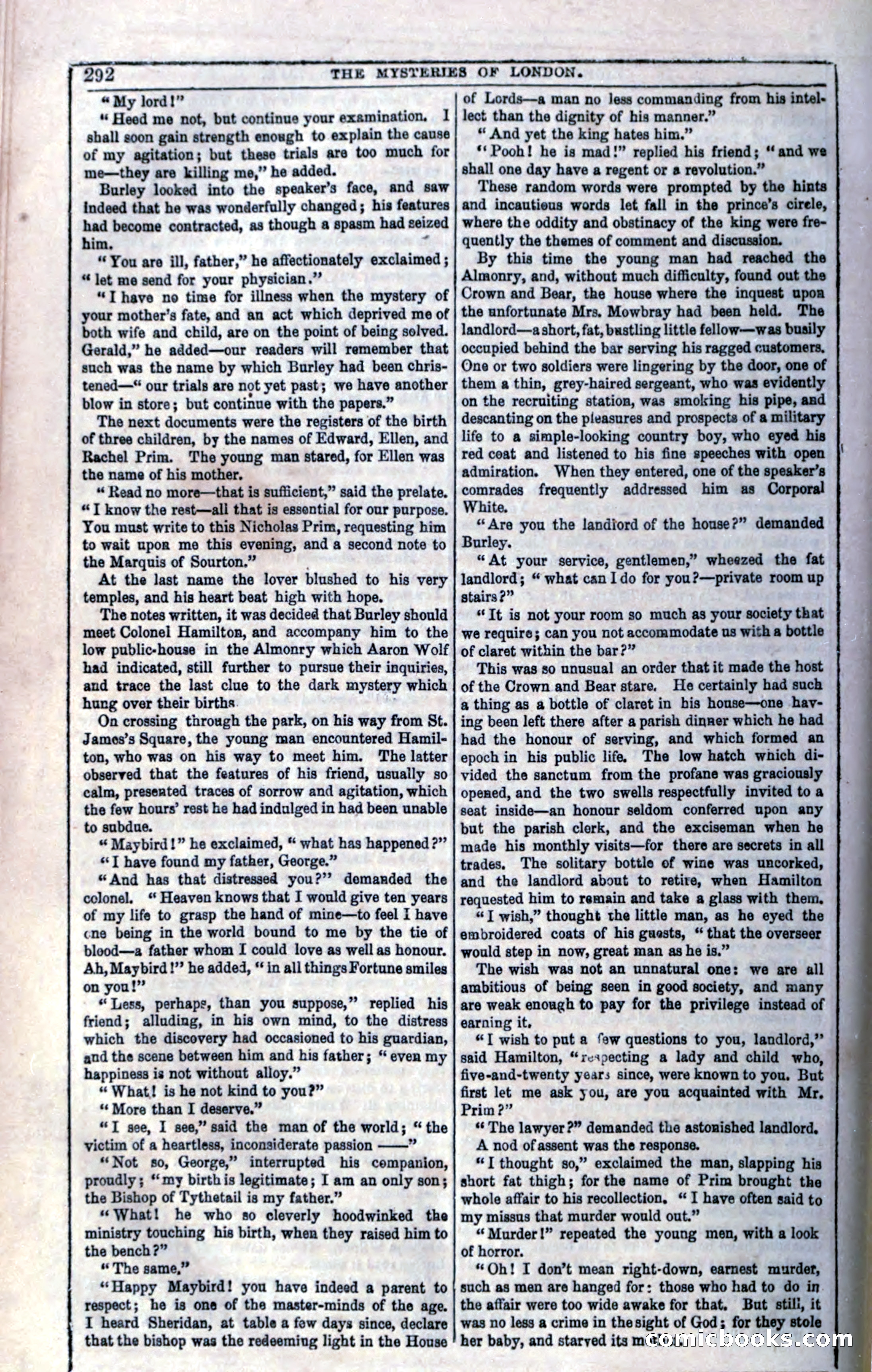
A restored page from Penny Dreadfuls, 1850. Page through the whole issue in the reader above.
📄 Transcribed text from this page (OCR, searchable)
Machine-transcribed from the original scan — historical spelling and the odd misread are preserved.
ee NE TL TT AN MYSTERIES OF LONDON. 292 THE “ My lord!” of Lords—a man no less commanding from his intel- “ Heed me not, but continue your examination. 1) lect than the dignity of his manner.” shall soon gain strength enough to explain the cause of my agitation; but these trials are too much for me—they are killing me,” he added. Burley looked into the speaker’s face, and saw indeed that he was wonderfully changed; his features had become contracted, as though a spasm had seized him, “You are ill, father,” he affectionately exclaimed ; “ Jet me send for your physician.” “T have no time for illness when the mystery of your mother’s fate, and an act which deprived me of both wife and child, are on the point of being solved. Gerald,” he added—our readers will remember that such was the name by which Burley had been chris- tened—* our trials are not yet past; we have another blow in store; but continue with the papers.” The next documents were the registers of the birth of three children, by the names of Edward, Ellen, and Rachel Prim. The young man stared, for Ellen was the name of his mother, “ Read no more—that is sufficient,” said the prelate. “T know the rest—alli that is essential for our purpose. You must write to this Nicholas Prim, requesting him to wait upon me this evening, and a second note to the Marquis of Sourton.” At the last name the lover blushed to his very temples, and his heart beat high with hope. The notes written, it was decided that Burley should meet Colonel Hamilton, and accompany him to the low public-house in the Almonry which Aaron Wolf had indicated, still further to pursue their inquiries, and trace the last clue to the dark mystery which hung over their births. On crossing through the park, on his way from St. James’s Square, the young man encountered Hamil- ton, who was on his way to meet him. The latter observed that the features of his friend, usually so calm, presented traces of sorrow and agitation, which the few hours’ rest he had indulged in had been unable to subdue. “ Maybird!” he exclaimed, “ what has happened 2?” *‘T have found my father, George.” “And has that distressed you?’ demanded the colonel, “ Heaven knows that I would give ten years of my life to grasp the hand of mine—to feel i have cne being in the world bound to me by the tie of bleod—a father whom I could love as well as honour. Ah, Maybird!’’ he added, “ in all things Fortune smiles on you!” “Less, perhaps, than you suppose,” replied his friend; alluding, in his own mind, to the distress which the discovery had occasioned to his guardian, and the scene between him and his father; “ even my happiness is not without alloy.” “ What! is he not kind to you?” “* More than I deserve.” “T see, I see,” said the man of the world; “ the victim of a heartless, inconsiderate passion ——” “Not so, George,” interrupted his companion, proudly; “my birthis legitimate; I am an only son; the Bishop of Tythetail is my father.” “What! he who so cleverly hoodwinked the ministry touching his birth, when they raised him to the bench ?” “The same,” “‘Happy Maybird! you have indeed a parent to respect; he is one of the master-minds of the age. I heard Sheridan, at table a few days since, declare that the bishop was the redeeming light in the House “ And yet the king hates him.” ** Pooh! he is mad!” replied his friend; “and we shall one day have a regent or a revolution.” These random words were prompted by the hints and incautieus words let fall in the prince’s cirele, where the oddity and obstinacy of the king were fre- quently the themes of comment and discussion. By this time the young man had reached the Almonry, and, without much difficulty, found out the Crown and Bear, the house where the inquest upon the unfortunate Mrs. Mowbray had been held. The landlord—a short, fat, bustling little fellow—was busily occupied behind the bar serving his ragged customers, One or two soldiers were lingering by the door, one of them a thin, grey-haired sergeant, who was evidently on the recruiting station, was smoking his pipe, and descanting on the pleasures and prospects of a military life to a simple-looking country boy, who eyed his red coat and listened to his fine speeches with open admiration. When they entered, one of the speaker’s comrades frequently addressed him as Corporal White. “Are you the landiord of the house?” demanded Burley. “At your service, gentlemen,” wheezed the fat landlord; “ what can 1 do for you?—private room up stairs?” “It is not your room so much as your society that we require; can you not accommodate us with a bottle of claret within the bar?” This was so unusual an order that it made the host of the Crown and Bear stare. He certainly had such a thing as a bottle of claret in his honse—one hay- ing been left there after a parish dinner which he had had the honour of serving, and which formed an epoch in his public life. The low hatch which di- vided the sanctum from the profane was graciously opened, and the two swells respectfully invited to a seat inside—an honour seldom conferred upon any but the parish clerk, and the exciseman when he made his monthly visits—for there are secrets in all trades. The solitary bottle of wine was uncorked, and the landlord about to retire, when Hamilton requested him to remain and take a glass with them, “J wish,” thought the little man, as he eyed the embroidered coats of his guests, “ that the overseer would step in now, great man as he is,” The wish was not an unnatural one: we are all ambitious of being seen in good society, and many are weak enough to pay for the privilege instead of earning it, “T wish to put a few questions to you, landlord,” said Hamilton, “respecting a lady and child who, 4 five-and-twenty years since, were known to you. But first let me ask you, are you acquainted with Mr, | Prim ?” “The lawyer?” demanded the astonished landlord, A nod ofassent was the response. “T thought so,” exclaimed the man, slapping his | short fat thigh; for the name of Prim brought the whole affair to his recollection, “ I have often said to my missus that murder would out.” “Murder!” repeated the young men, with a look of horror. “Oh! I don’t mean right-down, earnest murder, such as men are hanged for: those who had to do in. the affair were too wide awake for that, But still, it was no less a crime in thesight of God; for they stole her baby, and starved its m(¢[o) (|| eboo SS sicom al ;