
Penny Dreadfuls, 1850 · page 296 of 394
The Mysteries of London; or, Lights and Shadows of London Life — page 296: what you’re looking at
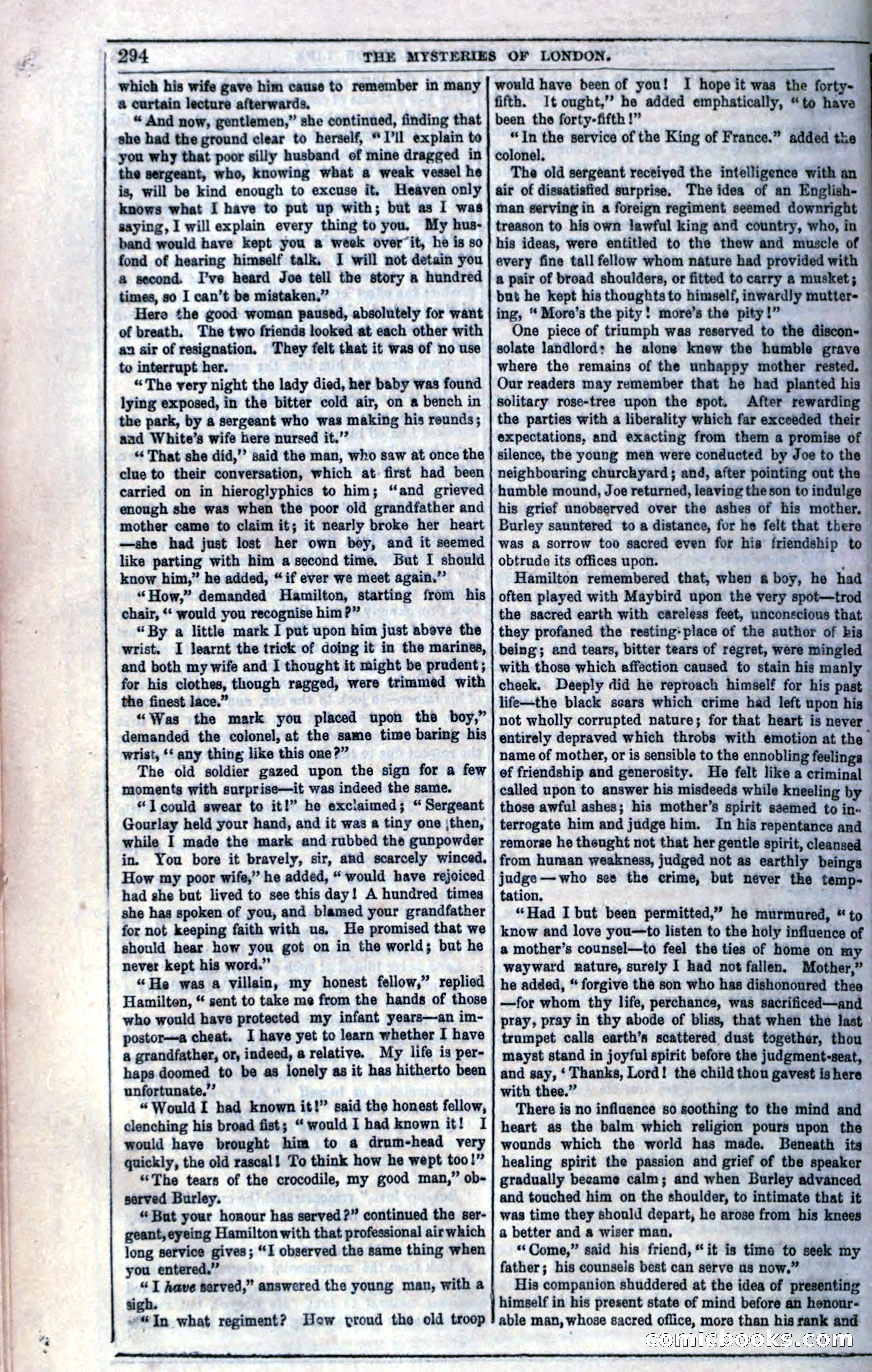
A restored page from Penny Dreadfuls, 1850. Page through the whole issue in the reader above.
📄 Transcribed text from this page (OCR, searchable)
Machine-transcribed from the original scan — historical spelling and the odd misread are preserved.
| 294 THE MYSTERIES OF LONDON, \ which his wife gave him cause to remember in many | would have been of you! I hope it was the oer a curtain lecture afterwards. “ And now, gentlemen,” she continued, finding that she had the ground clear to herself, “I'll explain to you why that poor silly husband of mine dragged in the sergeant, who, knowing what a weak vessel he is, will be kind enough to excuse it. Heaven only knows what I have to put up with; but as I was saying, I will explain every thing to you. My hus- band would have kept you a week over’it, he is so fond of hearing himself talk, I will not detain you a second. I’ve heard Joe tell the story a hundred times, so I can’t be mistaken.” Here the good woman paused, absolutely for want of breath, The two friends looked at each other with an air of resignation. They felt that it was of no use to interrupt her. “The very night the lady died, her baby was found lying exposed, in the bitter cold air, on a bench in the park, by a sergeant who was making his reunds; and White’s wife here nursed it.’ “ That she did,’’ said the man, who saw at once the clue to their conversation, which at first had been carried on in hieroglyphics to him; “and grieved enough she was when the poor old grandfather and mother came to claim it; it nearly broke her heart —she had just lost her own boy, and it seemed like parting with him a second time, But I shonld know him,” he added, “if ever we meet again.” “How,” demanded Hamilton, starting from his chair, ‘* would you recognise him ?” “By a little mark I put upon him just above the wrist. I learnt the trick of doing it in the marines, and both my wife and I thought it might be prudent; for his clothes, though ragged, were trimmed with the finest lace.” “Was the mark you placed upon the boy,” demanded the colonel, at the same time baring his wrist, ‘‘ any thing like this one?” The old soldier gazed upon the sign for a few moments with surprise—it was indeed the same. “J could swear to it!” he exclaimed; “ Sergeant Gourlay held your hand, and it was a tiny one |then, while I made the mark and rubbed the gunpowder in. You bore it bravely, sir, amd scarcely winced. How my poor wife,” he added, “ would have rejoiced had she but lived to see this day! A hundred times _ she has spoken of you, and blamed your grandfather for not keeping faith with us, He promised that we should hear how you got on in the world; but he never kept his word.” “He was a villain, my honest fellow,” replied Hamilten, “ sent to take me from the hands of those who would have protected my infant years—an im- postor—a cheat. I have yet to learn whether I have a grandfather, or, indeed, a relative. My life is per- haps doomed to be as lonely as it has hitherto been unfortunate.’’ “Would I had known it!” said the honest fellow, clenching his broad fist; “ would I had known it! I would have brought him to a drum-head very quickly, the old rascal! To think how he wept too!” “The tears of the crocodile, my good man,” ob- served Burley. « But your honour has served?” continued the ser- geant,eyeing Hamilton with that professional air which long service gives; “I observed the same thing when you entered,” “I have sorved,” answered the young man, with a sigh. %In what regiment? How proud the old troop fifth. It ought,” he added emphatically, “to have been the forty-fifth !” | . “In the service of the King of France.” added the colonel. | The old sergeant received the intelligence with an air of dissatisfied surprise, The idea of an English- man serving in a foreign regiment seemed downright treason to his own lawful king and country, who, in his ideas, were entitled to the thew and muscle of every fine tall fellow whom nature had provided with a pair of broad shoulders, or fitted to carry a musket; but he kept his thoughts to himself, inwardly mutter- ing, “ More’s the pity! more’s the pity!” One piece of triumph was reserved to the discon- solate landlord: he alone knew the humble grave where the remains of the unhappy mother rested, Our readers may remember that he had planted his solitary rose-tree upon the spot. After | the parties with a liberality which far exceeded their expectations, and exacting from them a promise of | silence, the young men were conducted by Joe to the neighbouring churchyard; and, after pointing out the humble mound, Joe returned, leaving the son to indulge his grief unobserved over the ashes of his mother, Burley sauntered to a distance, for he felt that there — was a sorrow too sacred even for his friendship to obtrude its offices upon. ee Hamilton remembered that, when @ boy, he had often played with Maybird upon the very spot—trod the sacred earth with careless feet, unconscious that, they profaned the resting:place of the author of bis being; and tears, bitter tears of regret, were mingled with those which affection caused to stain his manly cheek. Deeply did he reproach himself for his past life—the black scars which crime had left upon his not wholly corrupted nature; for that heart is never entirely depraved which throbs with emotion at the” name of mother, or is sensible to the ennobling feelings ef friendship and generosity. He felt like a criminal — called upon to answer his misdeeds while kneeling by _ those awful ashes; his mother’s spirit seemed to in. terrogate him and judge him. In his repentance and remorse he thenght not that her gentle spirit, cleansed _ from human weakness, judged not as earthly beings judge—who see the crime, but never the temp= tation. . | “Had I but been permitted,” he murmured, “to know and love you—to listen to the holy influence of a mother’s counsel—to feel the ties of home on wayward nature, surely | had not fallen, Mother.” he added, “ forgive the son who has dishonoured thee —for whom thy life, perchance, was sacrificed—and pray, pray in thy abode of bliss, that when the last | trumpet calls earth’s scattered dust together, thou mayst stand in joyful spirit before the judgment-seat, and say, ‘ Thanks, Lord! the child thon gavest is here with thee.” There is no influence so soothing to the mind and heart as the balm which religion pours upon the wounds which the world has made. Beneath its healing spirit the passion and grief of the speaker gradually beeame calm; and when Burley advanced and touched him on the shoulder, to intimate that it was time they should depart, he arose from his knees a better and a wiser man, “Come,” said his friend, “it is time to seek m father; his counsels best can serve as now.” His companion shuddered at the idea of presenting himself in his present state of mind before an henour- able man, whose sacred office, more than his rank and Gomicdooksscom t ;