
Penny Dreadfuls, 1850 · page 298 of 394
The Mysteries of London; or, Lights and Shadows of London Life — page 298: what you’re looking at
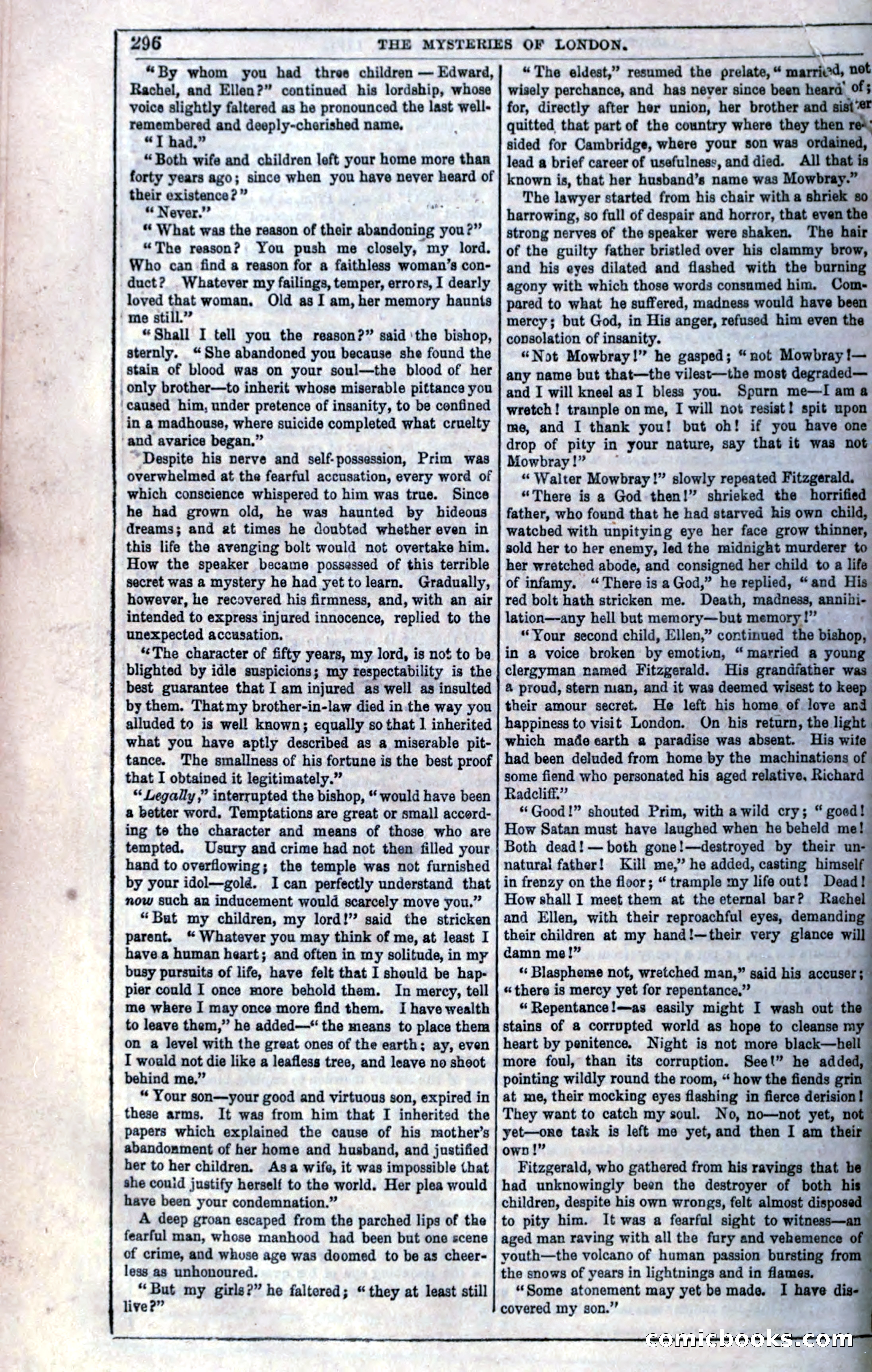
A restored page from Penny Dreadfuls, 1850. Page through the whole issue in the reader above.
📄 Transcribed text from this page (OCR, searchable)
Machine-transcribed from the original scan — historical spelling and the odd misread are preserved.
296 “By whom you had three children — Edward, Rachel, and Ellen?” continued his lordship, whose voice slightly faltered as he pronounced the last well- remembered and deeply-cherished name, “ I had,” “Both wife and children left your home more than forty years ago; since when you have never heard of their existence?” “ Never.” “ What was the reason of their abandoning you?” “The reason? You push me closely, my lord. Who can find a reason for a faithless woman’s con- duct? Whatever my failings, temper, errors, I dearly loved that woman, Old as I am, her memory haunts ‘me still.” “Shall I tell you the reason?” said ‘the bishop, sternly. “She abandoned you because she found the stain of blood was on your soul—the blood of her only brother—to inherit whose miserable pittance you caused him, under pretence of insanity, to be confined in a madhouse, where suicide completed what cruelty ‘and avarice began.” Despite his nerve and self-possession, Prim was overwhelmed at the fearful accusation, every word of which conscience whispered to him was true. Since he had grown old, he was haunted by hideous dreams; and at times he doubted whether even in this life the avenging bolt would not overtake him. How the speaker became possessed of this terrible secret was a mystery he had yettolearn. Gradually, however, he recovered his firmness, and, with an air intended to express injured innocence, replied to the unexpected accusation. “The character of fifty years, my lord, is not to ba blighted by idle suspicions; my respectability is the best guarantee that I am injured as well as insulted by them. That my brother-in-law died in. the way you alluded to is well known; equally so that | inherited what you have aptly described as a miserable pit- tance. The smallness of his fortune is the best proof that I obtained it legitimately.” “ Legally ,” interrupted the bishop, “ would have been a better word. Temptations are great or small accerd- ing te the character and means of those who are tempted. Usury and crime had not then filled your hand to overflowing; the temple was not furnished by your idol—gold. I can perfectly understand that now such an inducement would scarcely move you,” “But my children, my lord!” said the stricken parent. “ Whatever you may think of me, at least I have a human heart; and often in my solitude, in my busy pursuits of life, have felt that I should be hap- pier could I once more behold them. In mercy, tell me where I may once more find them. I have wealth to leave them,” he added—“ the means to place them on a level with the great ones of the earth; ay, even I would not die like a leafless tree, and leave no shoot behind me,” “ Your son—your good and virtuous son, expired in these arms. It was from him that I inherited the papers which explained the cause of his mother’s abandonment of her home and husband, and justified her to her children. Asa wife, it was impossible (hat she couid justify herself to the world. Her plea would have been your condemnation.” A deep groan escaped from the parched lips of the fearful man, whose manhood had been but one scene of crime, and whuse age was doomed to be as cheer- less as unhonoured. , ne o my girls?” he faltered; “they at least still ve?’ Sr eanenennn UR eenneeeneeeeeeeeneeeeneeeeeeeecennnennneenennememnmnmenmnemenstanictolalaidlclaelsliahital THE MYSTERIES OF LONDON, ————— a ee ee a ee «The eldest,” resumed the prelate,“ married, not wisely perchance, and has never since been * of 5 for, directly after her union, her brother and et quitted that part of the country where they then sided for Cambridge, where your son was lead a brief career of usefulness, and died. All that is known is, that her husband’s name was Mowbray.” The lawyer started from his chair with a shriek 80 harrowing, so full of despair and horror, that even the strong nerves of the speaker were shaken. The hair of the guilty father bristled over his clammy brow, and his eyes dilated and flashed with the burning agony with which those words consumed him. Com- pared to what he suffered, madness would have been mercy; but God, in His anger, refused him even the consolation of insanity. “Not Mowbray!” he gasped; “not Mowbray !— any name but that—the vilest—the most degraded— and I will kneel asI bless you. Spurn me—l ama wretch! trample on me, I will not resist! spit upon me, and I thank you! but oh! if you have one drop of pity in your nature, say that it was not Mowbray!” — “ Walter Mowbray!” slowly repeated Fitzgerald. — “There is a God then!” shrieked the horrified father, who found that he had starved his own child, watcbed with unpitying eye her face grow thinner, sold her to her enemy, led the midnight murderer to her wretched abode, and consigned her child to a life of infamy. “There is a God,” he replied, “and His red bolt hath stricken me. Death, madness, annihi- lation—-any hell but memory—but memory!” . “Your second child, Ellen,” continued the bishop, | in a@ voice broken by emotion, “ married a young clergyman named Fitzgerald. His grandfather was & proud, stern man, and it was deemed wisest to k their amour secret. He left his home of love and happiness to visit London. On his return, the | which made earth a paradise was absent. His wite had been deluded from home by the mene some fiend who personated his aged relative, F Radcli Gaui shouted Prim, with a wild cry; Base. How Satan must have laughed when he beheld r Both dead! — both gone!—destroyed by their w a natural father! Kill me,” he added, casting himself in frenzy on the floor; “ trample my life out! Dead! How shall I meet them at the eternal bar? Racha and Ellen, with their reproachful eyes, demandi their children at my hand!—their very glance damn me!” ‘‘ Blaspheme not, wretched man,” said his acct «there is mercy yet for repentance,” “ Repentance!—as easily might I wash out the stains of a corrupted world as hope to cleanse my heart by penitence. Night is not more black—hel 1 more foul, than its corruption. See!” he vag pointing wildly round the room, “ how the fiends g at me, their mocking eyes flashing in fierce der They want to catch my soul. No, no—not wil yet—one task is left me yet, and then I am own !” Fitzgerald, who gathered from his ravings that he had unknowingly been the destroyer of both his children, despite his own wrongs, felt almost disy to pity him. It was a fearful sight to witr n aged man raving with all the fury and vehemence o youth—the volcano of human passion bursting fron the snows of years in lightnings and in flames. “Some atonement may yet be made. I have ¢ covered my son.” om