
Penny Dreadfuls, 1850 · page 308 of 394
The Mysteries of London; or, Lights and Shadows of London Life — page 308: what you’re looking at
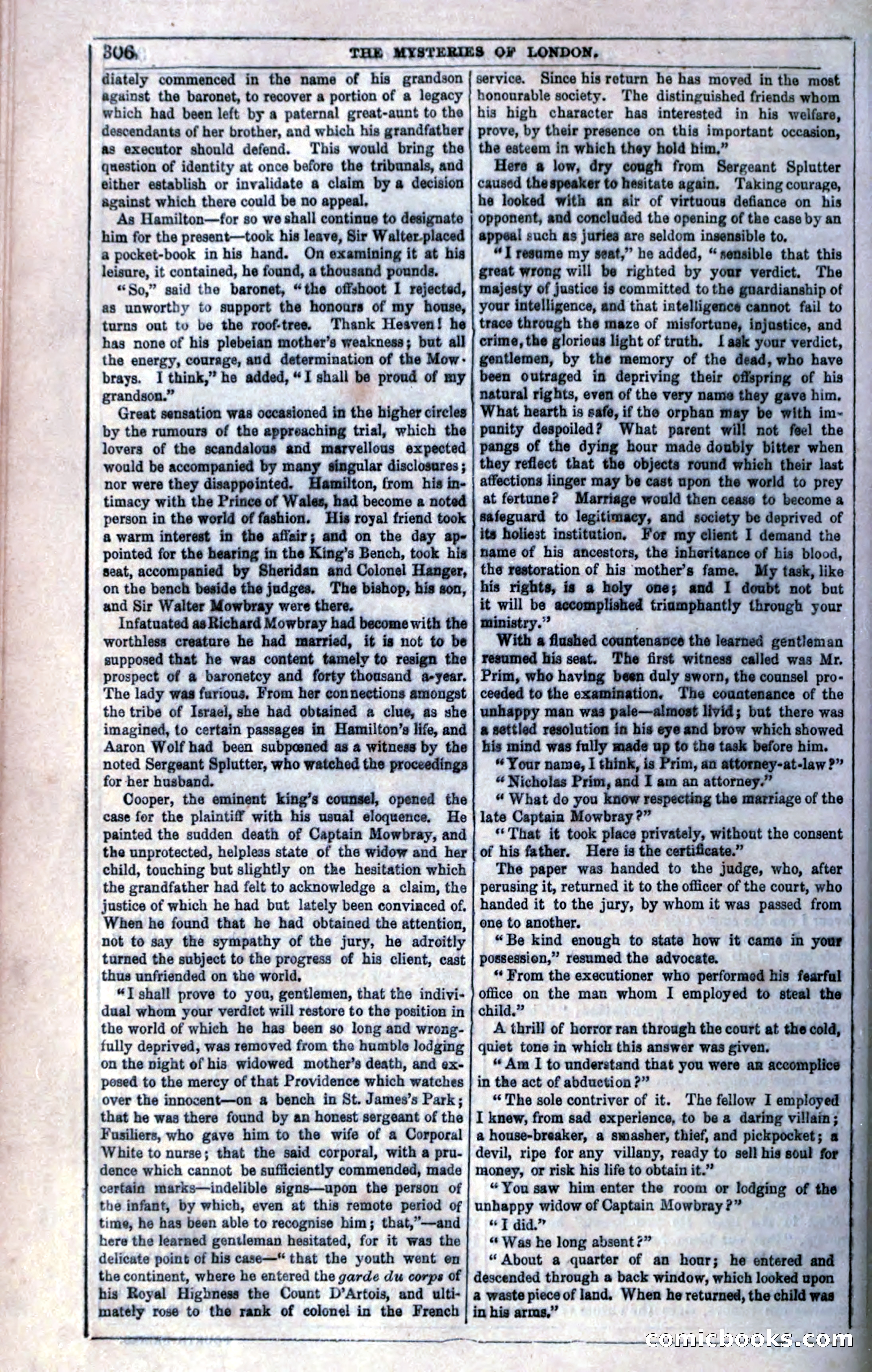
A restored page from Penny Dreadfuls, 1850. Page through the whole issue in the reader above.
📄 Transcribed text from this page (OCR, searchable)
Machine-transcribed from the original scan — historical spelling and the odd misread are preserved.
BOG, diately commenced in the name of his grandson against the baronet, to recover a portion of a legacy which had been left by a paternal great-aunt to the descendants of her brother, and which his grandfather as executor should defend. This would bring the question of identity at once before the tribunals, and either establish or invalidate a claim by a decision against which there could be no appeal, As Hamilton—for so we shall continue to designate him for the present—took his leave, Sir Walter.placed a pocket-book in his hand. On examining it at his leisure, it contained, he found, a thousand pounds. “So,” said the baronet, “the offshoot I rejected, as unworthy to support the honours of my house, turns out to be the roof-tree. Thank Heaven! he has none of his plebeian mother’s weakness; but all the energy, courage, aud determination of the Mow- brays. I think,” he added, “I shall be proud of my grandson.” Great sensation was occasioned in the higher circles by the rumours of the appreaching trial, which the lovers of the scandalous and marvellous expected would be accompanied by m disclosures ; nor were they disappointed. n, from his in- timacy with the Prince of Wales, had become a noted person in the world of fashion. His royal friend took a warm interest in the affair; and on the day ap- pointed for the hearing in the King’s Bench, took his seat, accompanied by Sheridan and Colonel Hanger, on the bench beside the judges. The bishop, his son, and Sir Walter Mowbray were there. Infatuated as Richard Mowbray had become with the worthless creature he had married, it is not to be supposed that he was content tamely to resign the prospect of @ baronetcy and forty thousand a-year. The lady was furious, From her connections amongst the tribe of Israel, she had obtained a clue, as she imagined, to certain passages in Hamilton’s life, and Aaron Wolf had been subpooned as a witness by the noted Sergeant Splutter, who watched the proceedings for her husband. Cooper, the eminent king’s counsel, opened the case for the plaintiff with his usual eloquence, He painted the sudden death of Captain Mowbray, and the unprotected, helpless state of the widow and her child, touching but slightly on the hesitation which the grandfather had felt to acknowledge a claim, the justice of which he had but lately been convinced of. When he found that he had obtained the attention, not to say the sympathy of the jury, he adroitly turned the subject to the progress of his client, cast thus unfriended on the world, “I shall prove to you, gentlemen, that the indivi- dual whom your verdict will restore to the position in the world of which he has been so long and wrong- fully deprived, was removed from the humble lodging on the night of his widowed mother’s death, and ex- posed to the mercy of that Providence which watches over the innocent—on a bench in St. James’s Park; that he was there found by an honest sergeant of the Fusiliers, who gave him to the wife of a Corporal White to nurse; that the said corporal, with a pru- dence which cannot be sufficiently commended, made certain marks—indelible signs—upon the person of the infant, by which, even at this remote period of time, he has been able to recognise him; that,”—and here the learned gentleman hesitated, for it was the delicate point of his case—* that the youth went en the continent, where he entered the garde du corps of his Royal Highness the Count D’Artois, and ulti- mately rose to the rank of colonel in the French —= en ee ee we THE MYSTERIES OF LONDON, service. Since his return he has moved in the most honourable society. The distinguished friends whom his high character has interested in his welfare, prove, by their presence on this important occasion, the esteem in which they hold him,” Here a low, dry cough from Sergeant Splutter caused the speaker to hesitate again. Taking courage, he looked with an air of virtuous defiance on his opponent, and concluded the opening of the case by an appeal such as juries are seldom insensible to, “] resume my seat,” he added, “sensible that this great wrong will be righted by your verdict. The majesty of justice is committed to the guardianship of your intelligence, and that intelligence cannot fail to trace through the maze of misfortune, injustice, and crime, the glories light of trath. Lagk your verdict, gentlemen, by the memory of the dead, who have been outraged in depriving their offspring of his natural rights, even of the very name they gave him, What hearth is safe, if the orphan | be with im~ punity despoiled? What parent not feel the pangs of the d hour made doubly bitter when they reflect that objects round their last affections linger may be cast upon the world to prey at fertune? Marriage would then cease to become a safeguard to legitimacy, and society be deprived of its holiest institution, For my client I demand the name of his ancestors, the inheritance of his blood, the restoration of his mother’s fame, task, like his rights, is a holy one; and I not but it will be accomplished triamphantly through your 33 . With a flushed countenancé the learned gentleman resumed his seat. The first witness called was Mr. Prim, who having been duly sworn, the counsel pro- ceeded to the examination. The countenance of the unhappy man was pale—almost livid; but there was a settled resolution in his eye and brow which showed his mind was fully made up to the task before him. “Your name, I think, is , an attorney-at-law ?” “ Nicholas Prim, and I am an attorney,” “ What do you know respecting the marriage of the late Captain Mowbray ?” ‘‘That it took place privately, without the consent of his father. Here is the certificate.” The paper was handed to the judge, who, after perusing it, returned it to the officer of the court, who handed it to the jury, by whom it was passed from one to another. | “Be kind enough to state how it came in your possession,” resumed the advocate. * From the executioner who performed his fearfal office on the man whom I employed to steal the child.” A thrill of horror ran through the court at the cold, quiet tone in which this answer was given. “ Am I to understand that you were am accomplice in the act of abduction ?” “The sole contriver of it. The fellow I employed I knew, from sad experience, to be a daring villain; a house-breaker, a smasher, thief, and pickpocket; a devil, ripe for any villany, ready to sell his soul for money, or risk his life to obtain it.” “You saw him enter the room or lodging of the unhappy widow of Captain Mowbray?” “T did.” “Was he long absent 7” “About a quarter of an hour; he entered and descended through a back window, which looked upon a waste piece of land. When he returned, the child was in his arras,” OM CHOOKS.COM | .