
Penny Dreadfuls, 1850 · page 312 of 394
The Mysteries of London; or, Lights and Shadows of London Life — page 312: what you’re looking at
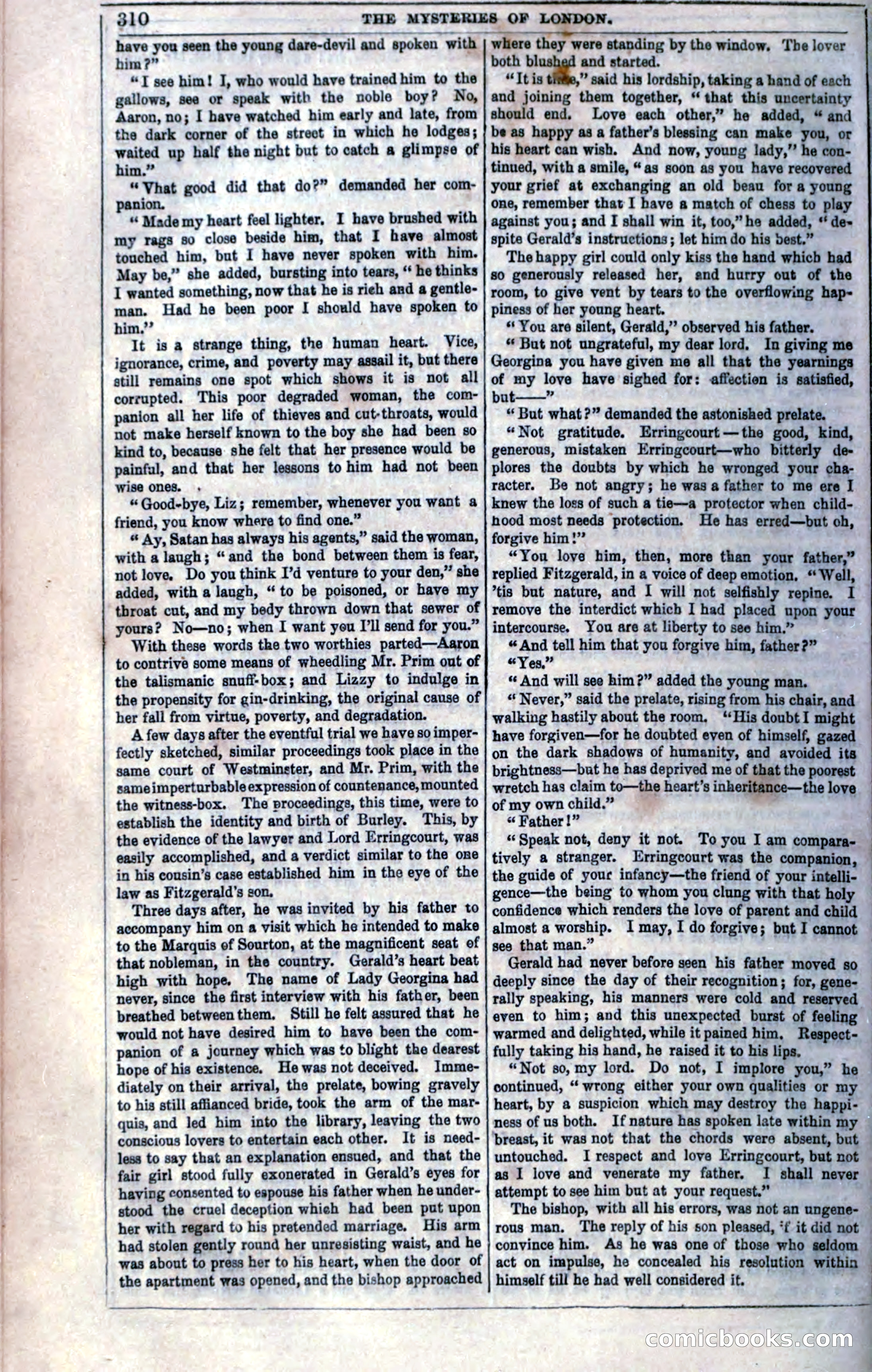
A restored page from Penny Dreadfuls, 1850. Page through the whole issue in the reader above.
📄 Transcribed text from this page (OCR, searchable)
Machine-transcribed from the original scan — historical spelling and the odd misread are preserved.
— Sree oe oe mee. le FI I ~—— a ee ~ . _ a « eee ' 310 THE MYSTERIES OF N. have you seen the young dare-devil and spoken with | where they were standing by the window. The lover him ?” “T see him! J, who would have trained him to the gallows, see or speak with the noble boy? No, Aaron, no; I have watched him early and late, from the dark corner of the street in which he lodges; waited up half the night but to catch a glimpse of him.” “Vhat good did that do?” demanded her com- on. “ Made my heart feel lighter, I have brushed with my rags so close beside him, that I have almost touched him, but I have never spoken with him. May be,” she added, bursting into tears, “ he thinks I wanted something, now that he is rieh and a gentle- man. Had he been poor I should have spoken to him.’’ It is a strange thing, the human heart. Vice, ignorance, crime, and poverty may assail it, but there still remains one spot which shows it is not all corrupted. This poor degraded woman, the com- panion all her life of thieves and cut-throats, would not make herself known to the boy she had been so kind to, because she felt that her presence would be painful, and that her lessons to him had not been wise ones. . “ -bye, Liz; remember, whenever you want a friend, you know where to find one.” “ Ay, Satan has always his agents,” said the woman, with a laugh; “and the bond between them is fear, not love. Do you think I’d venture to your den,” she added, with a laugh, “to be poisoned, or have my throat cut, and my bedy thrown down that sewer of yours? No—no; when I want you I'll send for you.” With these words the two worthies parted—Aagron to contrive some means of wheedling Mr. Prim out of the talismanic snufi-box; and Lizzy to indulge in the propensity for gin-drinking, the original cause of her fall from virtue, poverty, and degradation. A few days after the eventful trial we have so imper- fectly sketched, similar proceedings took place in the same court of Westminster, and Mr. Prim, with the same imperturbable expression of countenance, mounted the witness-box. The proceedings, this time, were to establish the identity and birth of Burley. This, by the evidence of the lawyer and Lord Erringcourt, was easily accomplished, and a verdict similar to the one | in his cousin’s case established him in the eye of the law as Fitzgerald’s son. Three days after, he was invited by his father to accompany him on a visit which he intended to make _ to the Marquis ef Sourton, at the magnificent seat of - that nobleman, in the country. Gerald’s heart beat | high with hope, The name of Lady Georgina had "never, since the first interview with his father, been breathed betweenthem. Still he felt assured that he would not have desired him to bave been the com- panion of a journey which was to blight the dearest hope of his existence. He was not deceived. Imme- | diately on their arrival, the prelate, bowing gravely | to his still affianced bride, took the arm of the mar- | quis, and led him into the library, leaving the two conscious lovers to entertain each other. It is need- less to say that an explanation ensued, and that the fair girl stood fully exonerated in Gerald’s eyes for having consented to espouse his father when he under- stood the cruel deception which had been put upon her with regard to his pretended marriage. His arm had stolen gently round her unresisting waist, and he | was about to press her to his heart, when the door of the apartment was opened, and the bishop approached a ——— | —— - — -——- eee ee ee both bl and started. “Itis ” said his lordship, taking a hand of each and joining them together, “that this uncertainty should end. Love each other,” he added, “ and be as happy as a father’s blessing can make or his heart can wish. And now, young lady,” he con- tinued, with a smile, “as soon as you have recovered your grief at exchanging an old beau for a young one, remember that I have a match of chess to play against you; and I shall win it, too,” he added, dee spite Gerald’s instructions; let him do his best.” The happy girl could only kiss the hand which had 80 geeerery eee her, and hurry out of the room, to give vent by tears to the overflowing hs piness of her young whee das ** You are silent, Gerald,” observed his father. “ But not ungrateful, my dear lord, In giving me Georgina you have given me all that the of my love have sighed for: affection is satisfied, but-——” “ But what?” demanded the astonished prelate. “Not gratitude. Erringcourt —the kind, generous, mistaken Erringcourt—who bitterly de- plores the doubts by which he wronged your racter. Be not angry; he was a father to me ere knew the loss of such a tie—~a protector when child- hood most needs protection. He has erred—but oh, forgive him!” “You love him, then, more than your ‘ replied Fitzgerald, in a voice of deep emotion, “Well, tis but nature, and I will not selfishly repine. I remove the interdict which I had placed upon your intercourse. You are at liberty to see him.” . « And tell him that you forgive him, father?” “Ves,” “ And will see him?” added the young man. “Never,” said the prelate, rising from his Pr a: and walking hastily about the room, “His doubt might have forgiven—for he doubted eyen of himself, gazed on the dark shadows of humanity, and avoided its brightness—but he has deprived me of that the poorest wretch has claim to—the heart’s inheritance—the love of my own child.” ” ) “ Father!” ‘Speak not, deny it not. To you I am compara- — tively a stranger. LErringcourt was the companion, the guide of your infancy—the friend of your intelli- gence—the being to whom you clung with that holy confidence which renders the love of parent and child — almost a worship. I may, I do forgive; but I cannot — seo that man.” He, — Gerald had never before seen his father moyed so deeply since the day of their recognition; for. gene- rally speaking, his manners were cold nd reserved even to him; and this unexpected burst of feeling warmed and delighted, while it pained him, Respect- fully taking his hand, he raised it to his lips, _ “Not so, my lord. Do not, I implore you,” he continued, “ wrong either your own qualities or my heart, by a suspicion which may destroy the happi- — ness of us both. If nature has spoken late within my © breast, it was not that the chords were absent, but | untouched. I respect and love Erringcourt, but not — as I love and venerate my father, I shall never attempt to see him but at your request.” by The bishop, with all his errors, was not an ungene- _ rous man. The reply of his son pleased, ‘f it not ! convince him. As he was one of those who act on impulse, he concealed his resolution wm himself till he had well considered if, 7 Gomichbooks,com