
Penny Dreadfuls, 1850 · page 329 of 394
The Mysteries of London; or, Lights and Shadows of London Life — page 329: what you’re looking at
A restored page from Penny Dreadfuls, 1850. Page through the whole issue in the reader above.
📄 Transcribed text from this page (OCR, searchable)
Machine-transcribed from the original scan — historical spelling and the odd misread are preserved.
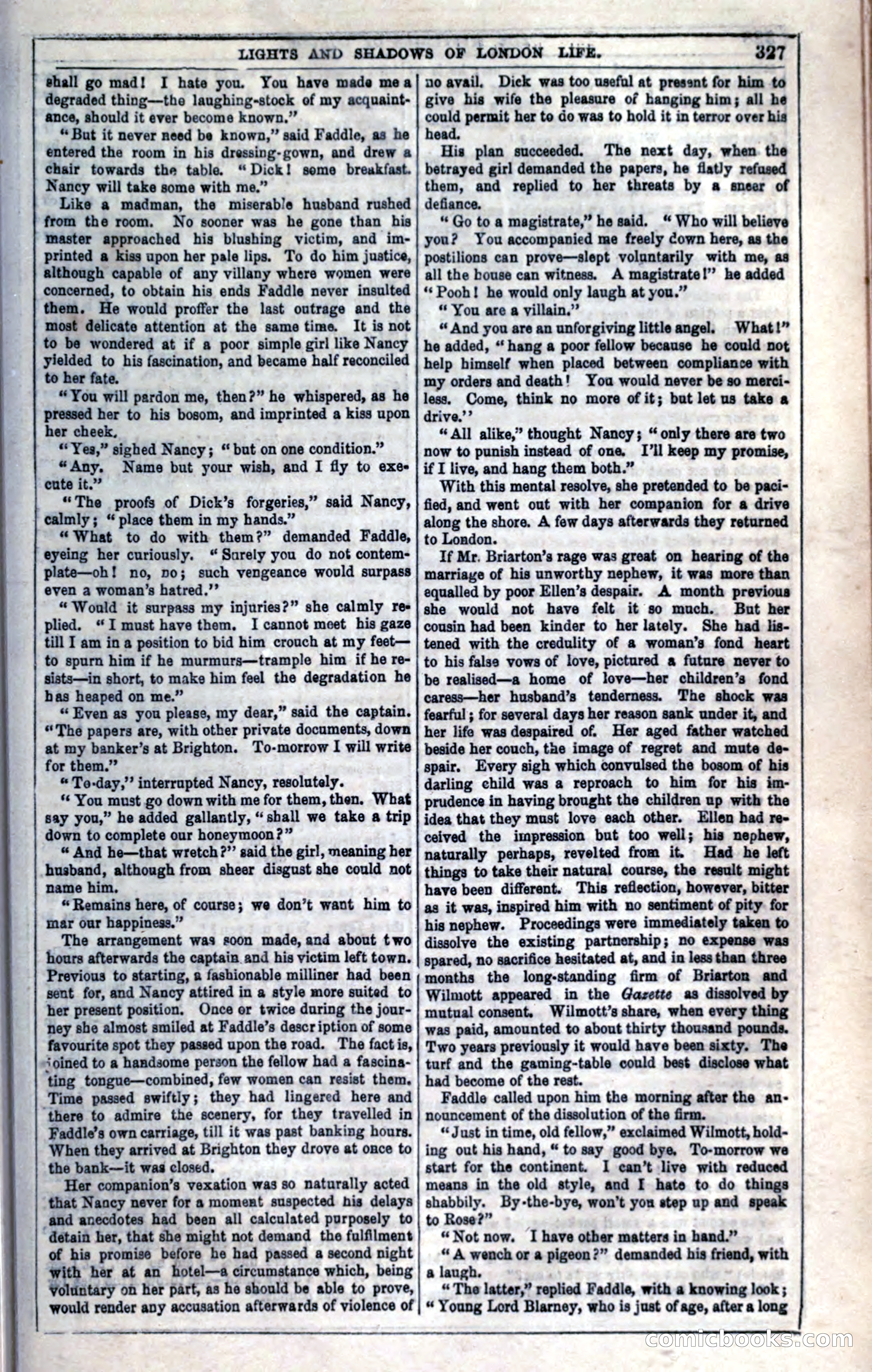
. ~~» et & * => ee - : - — LIGHTS AND SHADOWS OF LONDON LIFE. - . - shall go mad! I hate you. You have made mea degraded thing—the laughing-stock of my acquaint- ance, should it ever become known.” “ But it never need be known,” said Faddle, as he entered the room in his dressing-gown, and drew a chair towards the table. “Dick! seme breakfast. Nancy will take some with me.” Like a madman, the miserable husband rushed from the room. No sooner was he gone than his master approached his blushing victim, and im- printed a kiss upon her pale lips. To do him justice, although capable of any villany where women were concerned, to obtain his ends Faddle never insulted them. He would proffer the last outrage and the most delicate attention at the same time. It is not to be wondered at if a poor simple girl like Nancy yielded to his fascination, and became half reconciled to her fate. “You will pardon me, then?” he whispered, as he pressed her to his bosom, and imprinted a kiss upon her cheek, “Yes,” sighed Nancy; “ but on one condition.” “Any. Name but your wish, and I fly to exee cute it.” “The proofs of Dick’s forgeries,” said Nancy, calmly; “place them in my hands.” “What to do with them?” demanded Faddle, eyeing her curiously. “Surely you do not contem- plate—oh! no, no; such vengeance would surpass even a woman’s hatred.’’ “Would it surpass my injuries?” she calmly res plied. “I must have them, I cannot meet his gaze till I am in a position to bid him crouch at my feet— to spurn him if he murmurs—trample him if he re- sists—in short, to make him feel the degradation he bas heaped on me.” “ Even as you please, my dear,” said the captain. “The papers are, with other private documents, down at my banker’s at Brighton. To-morrow I will write for them.” “To-day,” interrupted Nancy, resolutely. * You must go down with me for them, then. What say you,” he added gallantly, “shall we take a trip down to complete our honeymoon?” “ And he—that wretch ?”’ said the girl, meaning her husband, although from sheer disgust she could not name him. * Remains here, of course; we don’t want him to mar our happiness.” The arrangement was soon made, and about two hours afterwards the captain and his victim left town. Previous to starting, a fashionable milliner had been sent for, and Nancy attired in a style more suited to her present position. Once er twice during the jour- ney she almost smiled at Faddle’s description of some favourite spot they passed upon the road. The fact is, “joined to a handsome person the fellow had a fascina- ting tongue—combined, few women can resist them. Time passed swiftly; they had lingered here and ‘there to admire the scenery, for they travelled in Faddle’s own carriage, till it was past banking hours. When they arrived at Brighton they drove at once to the bank—it was closed. Her companion’s vexation was so naturally acted that Nancy never for a moment suspected his delays _and anecdotes had been all calculated purposely to detain her, that she might not demand the fulfilment of his promise before he had passed a second night ' her at an hotel—a circumstance which, being tary on her part, as he should be able to prove, would render any accusation afterwards of violence of ——_— $27 no avail. Dick was too useful at present for him to give his wife the pleasure of hanging him; all he could permit her to do was to hold it in terror over his head, His plan succeeded. The next day, when. the betrayed girl demanded the papers, he flatly refused them, and replied to her threats by a sneer of defiance. * Go to a magistrate,” he said. “ Who will believe you? You accompanied me freely cown here, as the postilions can prove—slept voluntarily with me, as all the bouse can witness. A magistrate!” he added ‘* Pooh! he would only laugh at you.” * You are a villain.” “ And you are an unforgiving little angel. What!” he added, “ hang a poor fellow because he could not help himself when placed between compliance with my orders and death! You would never be so merci- less. Come, think no more of it; but let us take a drive.’’ “ All alike,” thought Nancy; “ only there are two now to punish instead of one, I’ll keep my promise, if I live, and hang them both.” With this mental resolve, she pretended to be paci- fied, and went out with her companion for a drive along the shore. A few days afterwards they returned to London. If Mr. Briarton’s rage was great on hearing of the marriaye of his unworthy nephew, it was more than equalled by poor Ellen’s despair. A month previous she would not have felt it so much. But her cousin had been kinder to her lately. She had lis- tened with the credulity of a woman’s fond heart to his false vows of love, pictured a future never to be realised—a home of love—her children’s fond caress—her husband’s tenderness. The shock was fearful ; for several days her reason sank under it, and her life was despaired of. Her aged father watched beside her couch, the image of regret and mute de- spair. Every sigh which convulsed the bosom of his darling child was a reproach to him for his im- prudence in having brought the children up with the idea that they must love each other. Ellen had re- ceived the impression but too well; his nephew, naturally perhaps, revelted from it. Had he left things to take their natural course, the result might have been different. This reflection, however, bitter as it was, inspired him with no sentiment of pity for his nephew. Proceedings were immediately taken to dissolve the existing partnership; no expense was spared, no sacrifice hesitated at, and in less than three months the long-standing firm of Briarton and Wilmott appeared in the Gazette as dissolved by mutual consent, Wilmott’s share, when every thing was paid, amounted to about thirty thousand pounds. Two years previously it would have been sixty. The turf and the gaming-table could best disclose what had become of the rest. Faddle called upon him the morning after the an- nouncement of the dissolution of the firm. “ Just in time, old fellow,” exclaimed Wilmott, hold- ing out his hand, “ to say good bye, To-morrow we start for the continent. I can’t live with reduced means in the old style, and I hate to do things shabbily. By-the-bye, won’t you step up and speak to Rose?” “Not now. I have other matters in hand.” “ A wench or a pigeon?” demanded his friend, with a laugh. “ The latter,” replied Faddle, with a knowing look ; “ Young Lord Blarney, who is just of age, after a long oniiGcbook (CO)