
Penny Dreadfuls, 1850 · page 334 of 394
The Mysteries of London; or, Lights and Shadows of London Life — page 334: what you’re looking at
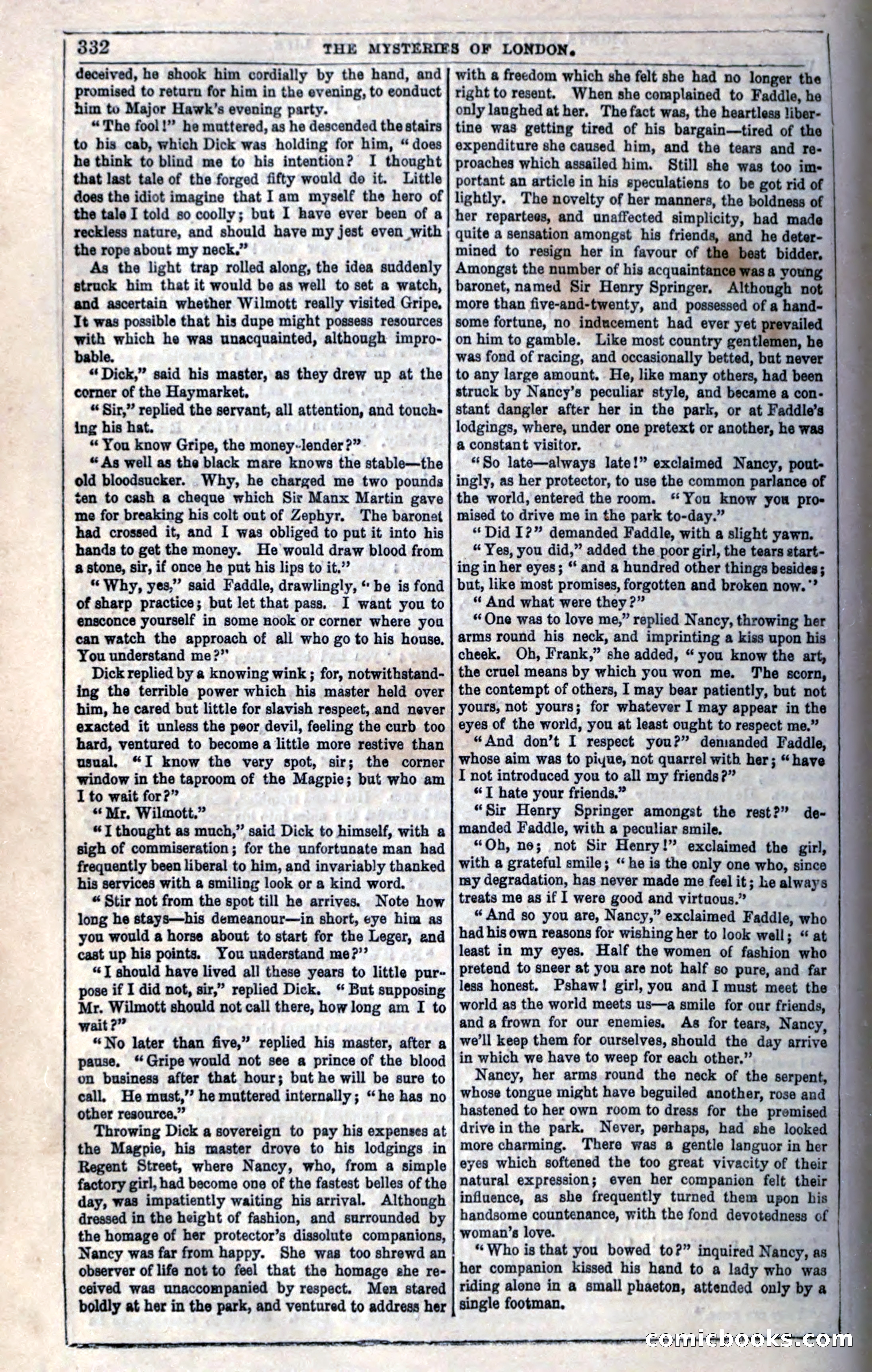
A restored page from Penny Dreadfuls, 1850. Page through the whole issue in the reader above.
📄 Transcribed text from this page (OCR, searchable)
Machine-transcribed from the original scan — historical spelling and the odd misread are preserved.
reo ee deceived, he shook him cordially by the hand, and promised to return for him in the evening, to eonduct him to Major Hawk's evening party. “The fool!” he muttered, as he descended the stairs to his cab, which Dick was holding for him, “ does he think to blind me to his intention? I thought that last tale of the forged fifty would de it. Little does the idiot imagine that Iam myself the hero of the tale I told so coolly; but 1 have ever been of a reckless nature, and should have my jest even with the rope about my neck.” As the light trap rolled along, the idea suddenly struck him that it would be as well to set a watch, and ascertain whether Wilmott really visited Gripe, It was possible that his dupe might possess resources with which he was unacquainted, although impro- bable. “ Dick,” said his master, as they drew up at the corner of the Haymarket, “ Sir,” replied the servant, all attention, and touch- ing his hat. “ You know Gripe, the money-~lender ?” “ As well as the black mare knows the stable—the old bloodsucker. Why, he charged me two pounds ten to cash a cheque which Sir Manx Martin gave me for breaking his colt out of Zephyr. The baronet had crossed it, and I was obliged to put it into his hands to get the money. He would draw blood from a stone, sir, if once he put his lips to it.’ 7 “ Why, yes,” said Faddle, drawlingly, “ he is fond of sharp practice; but let that pass. I want you to ensconce yourself in some nook or corner where you can watch the approach of all who go to his house, You understand me?” : Dick replied by a knowing wink ; for, notwithstand- ing the terrible power which his master held over him, he cared but little for slavish respeet, and never exacted it unless the peor devil, feeling the curb too hard, ventured to become a little more restive than usual, “I know the very spot, sir; the corner window in the taproom of the Magpie; but who am I to wait for?” “ Mr, Wilmott.” “JT thought as much,” said Dick to himself, with a sigh of commiseration; for the unfortunate man had frequently been liberal to him, and invariably thanked his services with a smiling look or a kind word. “ Stir not from the spot till he arrives. Note how long he stays—his demeanour—in short, eye him as you would a horse about to start for the Leger, and cast up his points. You uaderstand me?’’ “J should have lived all these years to little pur- pose if I did not, sir,” replied Dick. “ But supposing Mr. Wilmott should not call there, how long am I to wait ?” “No later than five,” replied his master, after a pause, “Gripe would not see a prince of the blood on business after that hour; but he will be sure to call, He must,’”’ he muttered internally; “he has no other resource,” Throwing Dick a sovereign to pay his expenses at the Magpie, his master drove to his lodgings in Regent Street, where Nancy, who, from a simple factory girl, had become one of the fastest belles of the day, was impatiently waiting his arrival. Although dressed in the height of fashion, and surrounded by the homage of her protector’s dissolute companions, Nancy was far from happy. She was too shrewd an observer of life not to feel that the homage she re- ceived was unaccompanied by respect. Men stared boldly at her in the park, and ventured to address her a LL THE MYSTERIES OF LONDON, ee ee et EE ee - — with a freedom which she felt she had no longer the right to resent. When she complained to Faddle, he only laughed at her. The fact was, the heartless liber- tine was getting tired of his bargain—tired of the expenditure she caused him, and the tears and re- proaches which assailed him. Still she was too im- portant an article in his speculations to be got rid of | lightly. The novelty of her manners, the boldness of | her repartees, and unaffected simplicity, had made quite a sensation amongst his friends, and he deter- mined to resign her in favour of the best bidder, Amongst the number of his acquaintance was a young baronet, named Sir Henry Springer. Although not | more than five-and-twenty, and possessed of a hand- | some fortune, no inducement had ever yet pre’ ; on him to gamble. Like most country gentlemi was fond of racing, and occasionally betted, but never to any large amount. He, like many others, had been struck by Nancy’s peculiar style, and became a con- stant dangler after her in the park, or at Faddle’s lodgings, where, under one pretext or another, he was a constant visitor. — | “So late—always late!” exclaimed Nancy, pout- ingly, as her protector, to use the common parlance of the world, entered the room. “You know you pro- mised to drive me in the park to-day.” “Did 12” demanded Faddle, with a slight yawn. Yes, you did,” added the poor girl, the tears start- ing in her eyes; “ and a hundred other things besides; but, like most promises, forgotten and broken now.”’ * And what were they?” “One was to love me,” replied Nancy, throwing her arms round his neck, and imprinting a kiss upon his cheek. Oh, Frank,” she added, “ you know the art, the cruel means by which you won me. The scorn, the contempt of others, I may bear patiently, but not yours, not yours; for whatever I may appear in the eyes of the world, you at least ought to respect me,” “And don’t I respect you?” demanded Faddle, whose aim was to piyue, not quarrel with her; “have I not introduced you to all my friends?” “T hate your friends.” “Sir Henry Springer amongst the rest?” de- manded Faddle, with a peculiar smile. “Oh, ne; not Sir Henry!” exclaimed the girl, with a grateful smile; “he is the only one who, since my degradation, has never made me feel it; he always treats me as if 1 were good and virtuous.” “And so you are, Nancy,” exclaimed Faddle, who had his own reasons for wishing her to look well; “ at least in my eyes. Half the women of fashion who pretend to sneer at you are not half so pure, and far less honest. Pshaw! girl, you and I must meet the world as the world meets us—a smile for our friends, and a frown for our enemies, As for tears, Nancy, we'll keep them for ourselves, should the day arrive in which we have to weep for each other,” Nancy, her arms round the neck of the serpent, whose tongue might have beguiled another, rose and hastened to her own room to dress for the premised drive in the park. Never, perhaps, had she looked more charming. There was a gentle languor in her eyes which softened the too great vivacity of their natural expression; even her companion felt their influence, as she frequently turned them upon his handsome countenance, with the fond devotedness of woman’s love. “Who is that you bowed to?” inquired Nancy, as her companion kissed his hand to a lady who was riding alone in a@ small phaeton, attended only by a single footman, om