
Penny Dreadfuls, 1850 · page 336 of 394
The Mysteries of London; or, Lights and Shadows of London Life — page 336: what you’re looking at
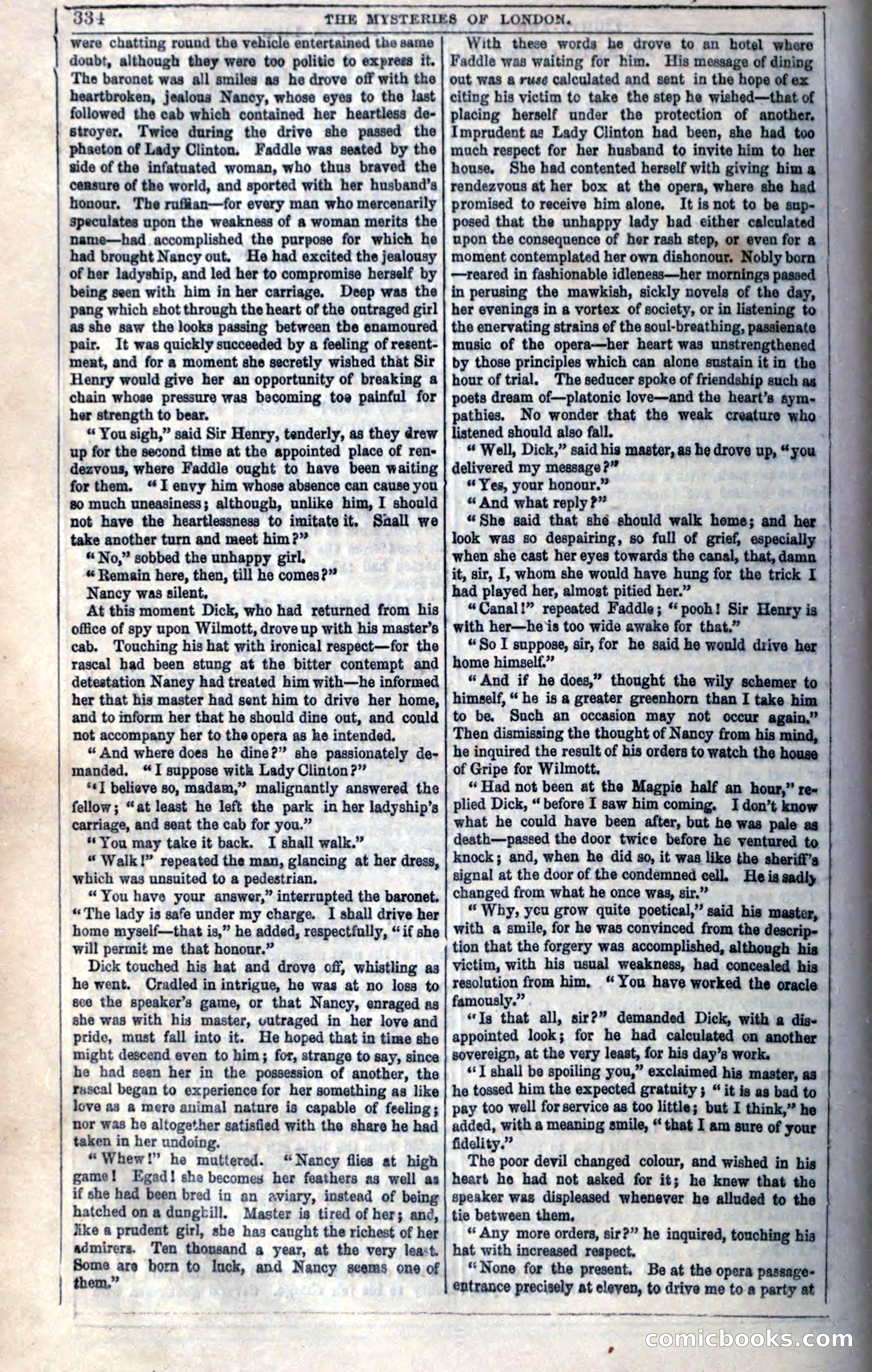
A restored page from Penny Dreadfuls, 1850. Page through the whole issue in the reader above.
📄 Transcribed text from this page (OCR, searchable)
Machine-transcribed from the original scan — historical spelling and the odd misread are preserved.
wd i ce ee a Rn A LT — a 334 Were chatting round the vehicle entertained the same doubt, although they were too politic to express it. The baronet was all smiles as he drove off with the heartbroken, jealous Nancy, whose eyes to the last followed the cab which contained her heartless de- stroyer. Twice during the drive she passed the phaeton of Lady Clinton. Faddle was seated by the side of the infatuated woman, who thus braved the censure of the world, and sported with her husband’s honour. The rufian—for every man who mercenarily speculates upon the weakness of a woman merits the name—had accomplished the purpose for which he had brought Nancy out. He had excited the jealousy of her ladyship, and led her to compromise herself by being seen with him in her carriage. Deep was the pang which shot through the heart of the outraged girl as she saw the looks passing between the enamoured pair. It was quickly succeeded by a feeling of resent- ment, and for a moment she secretly wished that Sir Henry would give her an opportunity of breaking a chain whose pressure was becoming toe painful for her strength to bear. “ You sigh,” said Sir Henry, tenderly, as they drew up for the second time at the appointed place of ren- dezvous, where Faddle ought to have been waiting for them. “I envy him whose absence can cause you 80 much uneasiness; although, unlike him, I should not have the heartlessness to imitate it. Snall we take another turn and meet him?” *“ No,” sobbed the unhappy girl. “ Remain here, then, till he comes?” Nancy was silent, At this moment Dick, who had returned from his office of spy upon Wilmott, drove up with his master’s cab. Touching his hat with ironical respect—for the rascal had been stung at the bitter contempt and detestation Naney had treated him with—he informed her that his master had sent him to drive her home, and to inform her that he should dine out, and could not accompany her to the opera as he intended. “ And where does he dine?” she passionately de- manded, “I suppose with Lady Clinton?” **] believe so, madam,” malignantly answered the fellow; “at least he left the park in her ladyship’s carriage, and seat the cab for you.” “You may take it back. I shall walk.” “ Walk!” repeated the man, glancing at her dress, which was unsuited to a pedestrian. “You have your answer,” interrupted the baronet. “The lady is safe under my charge. I shall drive her home myself—that is,” he added, respectfully, “if she will permit me that honour.” Dick touched his hat and drove off, whistling as he went. Cradled in intrigue, he was at no loss to see the speaker’s game, or that Nancy, enraged as she was with his master, vutraged in her love and pride, must fall into it. He hoped that in time she might descend even to him; for, strange to say, since he had seen her in the possession of another, the rascal began to experience for her something as like love as a mere animal nature is capable of feeling; nor was he altogether satisfied with the share he had taken in her undoing. “Whew!” he muttered. “Nancy flies at high game! Egad! she becomes her feathers as well as if she had been bred in an aviary, instead of being hatched on a dungbill. Master is tired of hers and, jike a prudent girl, she has caught the richest of her admirers. Ten thousand a year, at the very least, a are born to luck, and Nancy seems one of em,’ THE MYSTERIES OF LONDON, With these words he drove to an hotel where Faddle was waiting for him. His message of dini out was a ruse calculated and sent in the hope of ex citing his victim to take the step he wished—that of placing herself under the protection of another, Imprudent as Lady Clinton had been, she had too much respect for her husband to invite him to her house. She had contented herself with giving hima rendezvous at her box at the opera, where she had promised to receive him alone, It is not to be sup- posed that the unhappy lady had either calculated upon the consequence of her rash step, or even for a moment contemplated her own dishonour., Nobly born —reared in fashionable idleness—her mornings passed in perusing the mawkish, sickly novels of the day, her evenings in a vortex of society, or in listening to the enervating strains ef the soul-breathing, passienate music of the opera—her heart was unstren by those principles which can alone sustain it in the hour of trial. The seducer spoke of friendship such as poets dream of—platonic love—and the heart’s sym- pathies. No wonder that the weak creature who listened should also fall. “ Well, Dick,” said his master, as he drove up, “you delivered my message?” “Yes, your honour.” “ And what reply ?” “She said that shé should walk heme; and her look was so despairing, so full of grief, especially when she cast her eyes towards the canal, that, damn it, sir, I, whom she would have hung for the trick I had played her, almost pitied her.” “Canal!” repeated Faddle; “ pooh! Sir Henry is with her—he is too wide awake for that,” “So I suppose, sir, for he said he would drive her home himself.” “And if he does,” thought the wily schemer to — himself, “he is a greater greenhorn than I take him to be. Such an occasion may not occur again,” Then dismissing the thought of Nancy from his mind, he inquired the result of his orders to watch the houge of Gripe for Wilmott. | “Had not been at the Magpie half an hour,” re« plied Dick, “ before I saw him coming. I don’t know what he could have been after, but he was pale as death—passed the door twice before he ventured to knock; and, when he did so, it was like the sheriff’s signal at the door of the condemned cell, He is sadly changed from what he once was, sir.” “Why, yeu grow quite poetical,” said his master, with a smile, for he was convinced from the descrip- tion that the forgery was accomplished, although his victim, with his usual weakness, had concealed his resolution from him, “ You have worked the oracle famously.” . “Ts that all, sir?” demanded Dick, with a dis- appointed look; for he had caleulated on another sovereign, at the very least, for his day’s work. ‘‘] shall be spoiling you,” exclaimed his master, as he tossed him the expected gratuity; “ it is ag bad to pay too well for service as too little; but I think,” he added, with a meaning smile, “that I am sure of your fidelity.” The poor devil changed colour, and wished in his heart he had not asked for it; he knew that the speaker was displeased whenever he alluded to the | tie between them, : “Any more orders, sir?” he inquired, touching his | hat with increased respect, “None for the present. Be at the opera passage- entrance precisely at eleyen, to drive me to a party at --— --- << —— — --e = et eee oe (Efe) Gomichboo cS