
Penny Dreadfuls, 1850 · page 338 of 394
The Mysteries of London; or, Lights and Shadows of London Life — page 338: what you’re looking at
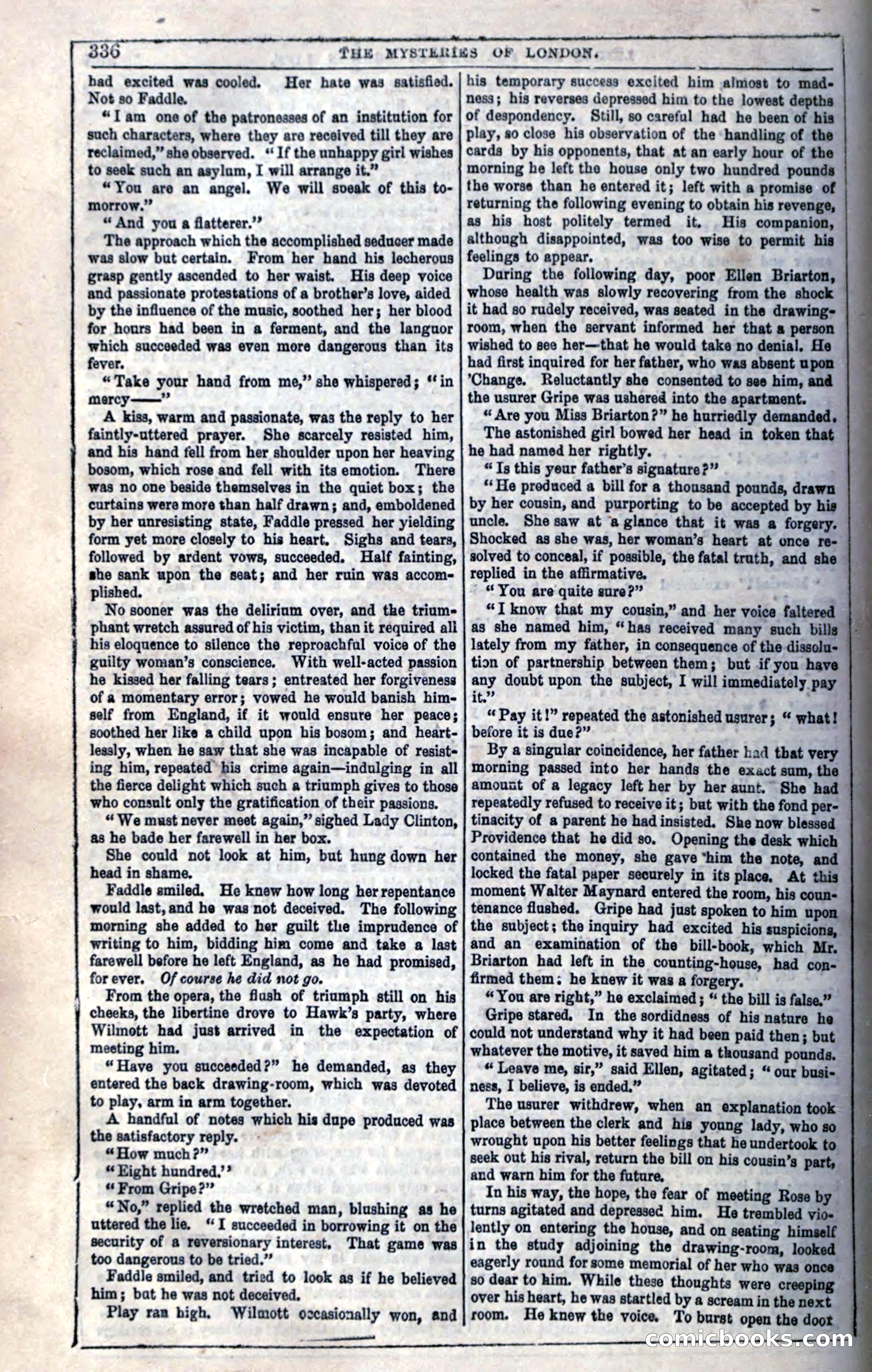
A restored page from Penny Dreadfuls, 1850. Page through the whole issue in the reader above.
📄 Transcribed text from this page (OCR, searchable)
Machine-transcribed from the original scan — historical spelling and the odd misread are preserved.
336 had excited was cooled. Her hate was satisfied. Not so Faddle. “Tam one of the patronesses of an institution for such characters, where they are received till they are reclaimed,” she observed. “If the unhappy girl wishes to seek such an asylum, I will arrange it.” “You are an angel. We will sveak of this to- morrow.” “And you a flatterer.”’ The approach which the accomplished seducer made was slow but certain. From her hand his lecherous grasp gently ascended to her waist. His deep voice and passionate protestations of a brother’s love, aided by the influence of the music, soothed her; her blood for hours had been in a ferment, and the languor which succeeded was even more dangerous than its fever. “Take your hand from me,” she whispered; * in mercy—”’ A kiss, warm and passionate, was the reply to her faintly-uttered prayer. She scarcely resisted him, and his hand fell from her shoulder upon her heaving bosom, which rose and fell with its emotion. There was no one beside themselves in the quiet box; the curtains were more than half drawn; and, emboldened by her unresisting state, Faddle pressed her yielding form yet more closely to his heart, Sighs and tears, followed by ardent vows, succeeded. Half fainting, she sank upon the seat; and her ruin was accom- plished. No sooner was the delirium over, and the trium- phant wretch assured of his victim, than it required ali his eloquence to silence the reproachful voice of the guilty woman’s conscience. With well-acted passion he kissed her falling tears; entreated her forgiveness of a momentary error; vowed he would banish him- self from England, if it would ensure her peace; soothed her like a child upon his bosom; and heart- lessly, when he saw that she was incapable of resist- ing him, repeated his crime again—indulging in all the fierce delight which such a triumph gives to those who consult only the gratification of their passions. “ We must never meet again,” sighed Lady Clinton, as he bade her farewell in her box. She could not look at him, but hung down her head in shame. Faddle smiled. He knew how long her repentance would last,and he was not deceived. The following morning she added to her guilt the imprudence of writing to him, bidding him come and take a last farewell before he left England, as he had promised, forever. Of course he did not go. From the opera, the flush of triumph still on his ¥ cheeks, the libertine drove to Hawk’s party, where Wilmott had just arrived in the expectation of meeting him. “Have you succeeded?” he demanded, as they entered the back drawing-room, which was devoted to play, arm in arm together. A handful of notes which his dupe produced was the satisfactory reply. “How much ?” “ Eight hundred,’’ “ From Gripe?” “No,” replied the wretched man, blushing as he uttered the lie. “I succeeded in borrowing it on the security of a reversionary interest, That game was too dangerous to be tried.” Faddle smiled, and tried to look as if he believed him; bat he was not deceived. Play ran high. Wilmott occasionally won, and nna THE MYSTERI“CS OF LONDON, his temporary success excited him almost to made ness; his reverses depressed him to the lowest depths of despondency. Still, so careful had he been of his play, so close his observation of the ‘handling of the cards by his opponents, that at an early hour of the morning he left the house only two hundred pounds the worse than he entered it; left with a promise of returning the following evening to obtain his revenge, | as his host politely termed it. His companion, although disappointed, was too wise to permit his feelings to appear. . During the following day, poor Ellen Briarton, whose health was slowly recovering from the shock | it had so rudely received, was seated in the drawing- | room, when the servant informed her that a person | wished to see her—that he would take no denial. He had first inquired for her father, who was absent upon | ‘Change. Reluctantly she consented to see him, and the usurer Gripe was ushered into the apartment. | “ Are you Miss Briarton?” he hurriedly demanded, The astonished girl bowed her head in token that he had named her rightly. “Ts this your father’s signature?” “He produced a bill for a thousand pounds, drawn by her cousin, and purporting to be accepted by his | uncle. She saw at a glance that it was a forgery. | © Shocked as she was, her woman’s heart at once re- solved to conceal, if possible, the fatal truth, and she replied in the affirmative. “You are quite sure?” i We i “TT know that my cousin,” and her voice faltered | as she named him, “has received many such bills | lately from my father, in consequence of the dissolu- tion of partnership between them; but if you have | any doubt upon the subject, I will immediately pay | it.”? ‘ , “Pay it!” repeated the astonished usurers “ what! | before it is due?” * By a singular coincidence, her father had that very morning passed into her hands the exact sum, the | amount of a legacy left her by her aunt.” She had | repeatedly refused to receive it; but with the fond per- | tinacity of a parent he had insisted. She now blessed Providence that he did so. Opening the desk which contained the money, she gave “him the note, and locked the fatal paper securely in its place, At this moment Walter Maynard entered the room, his coun- | tenance flushed. Gripe had just spoken to him upon the subject; the inquiry had excited his suspicions, and an examination of the bill-book, which Mr, Briarton had left in the counting-house, had con- firmed them; he knew it was a forgery. “You are right,” he exclaimed ; “ the bill is false.” Gripe stared, In the sordidness of his nature he could not understand why it had been paid then; but whatever the motive, it saved him a thousand pounds. “ Leave me, sir,” said Ellen, agitated; “our busi- ness, I believe, is ended,” | The usurer withdrew, when an explanation took | ” place between the clerk and his young lady, who so wrought upon his better feelings that he undertook to seek out his rival, return the bill on his cousin’s part, and warn him for the future, a In his way, the hope, the fear of meeting Rose by. turns agitated and depressed him. He trembled vio-e | lently on entering the house, and on seating himself in the study adjoining the drawing-room, looked eagerly round for some memorial of her who was once _ so dear to him. While these thoughts were creeping over his heart, he was startled by a scream in the next room. He knew the voice. To burst open the doot — KOM CHOOKS.COIr f