
Penny Dreadfuls, 1850 · page 345 of 394
The Mysteries of London; or, Lights and Shadows of London Life — page 345: what you’re looking at
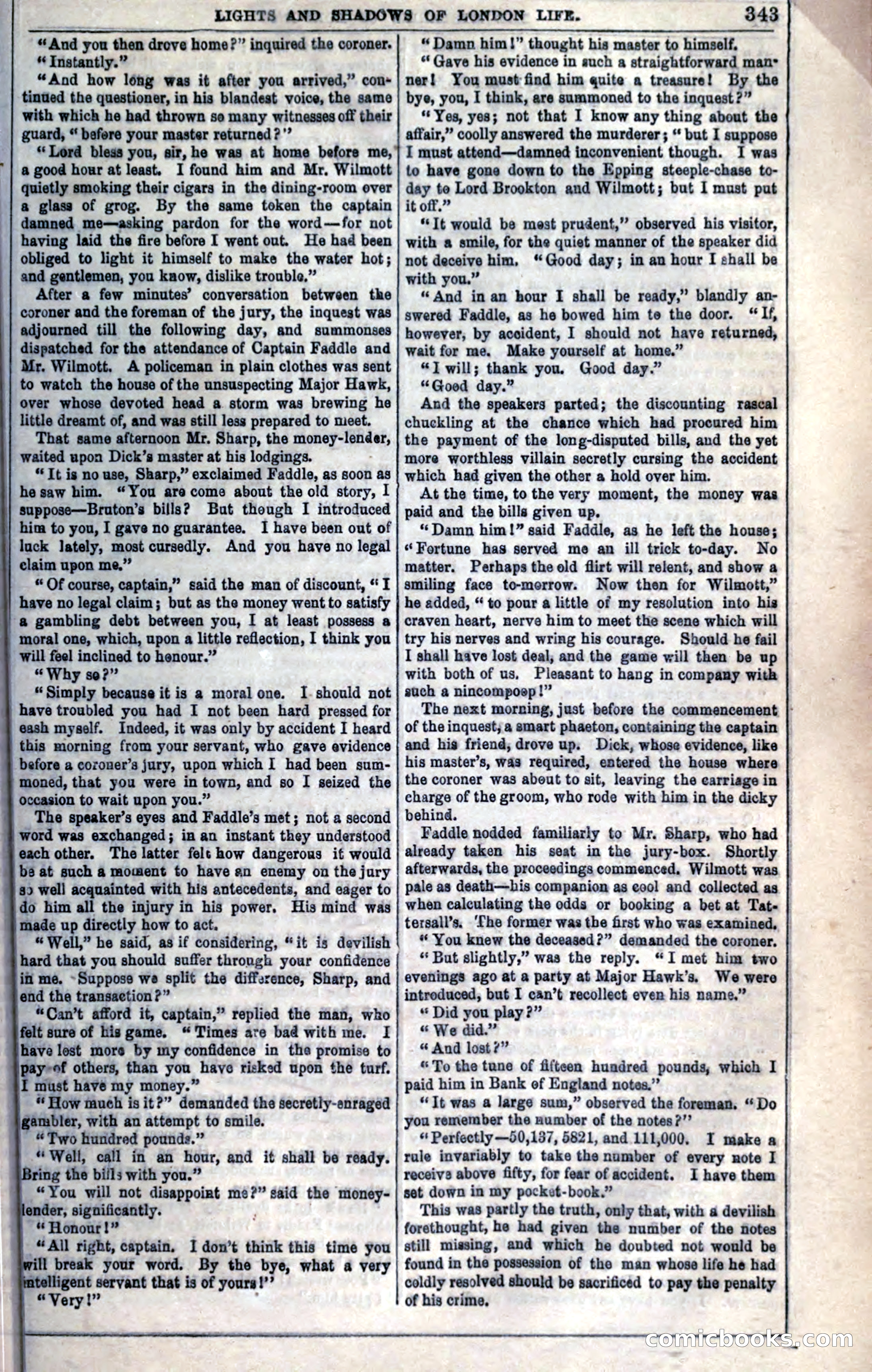
A restored page from Penny Dreadfuls, 1850. Page through the whole issue in the reader above.
📄 Transcribed text from this page (OCR, searchable)
Machine-transcribed from the original scan — historical spelling and the odd misread are preserved.
LIGHTS AND SHADOWS OF LONDON LIFE. “And you then drove home?” inquired the coroner. “And how long was it after you arrived,” con tinted the questioner, in his blandest voice, the same with which he had thrown so many witnesses off their guard, “ befere your master returned ?"’ | Leora bless you, sir, he was at home before me, "| a good hour at least. I found him and Mr. Wilmott | quietly smoking their cigars in the dining-room over a glass of grog. By the same token the captain damned me—asking pardon for the word—for not having laid the fire before I went out. He had been obliged to light it himself to make the water hot; and gentlemen, you kaow, dislike trouble,” After a few minutes’ conversation between the coroner and the foreman of the jury, the inquest was ‘| adjourned till the following day, and summonses | dispatched for the attendance of Captain Faddle and Mr. Wilmott. A policeman in plain clothes was sent to watch the house of the unsuspecting Major Hawk, over whose devoted head a storm was brewing he little dreamt of, and was still less prepared to meet. That same afternoon Mr. Sharp, the noney-lnder, waited upon Dick’s master at his lodgings. “Tt is no use, Sharp,” exclaimed Faddle, as soon as he saw him. “You are come about the old story, I suppose—Bruton’s bills? But though I introduced him to you, I gave no guarantee. I have been out of luck lately, most cursedly. And you have no legal claim upon me,” “ Of course, captain,” said the man of discount, “I have no legal claim; but as the money went to satisfy @ gambling debt between you, I at least possess a moral one, which, upon a little reflection, I think you will feel inclined to henour.” “Why se?” “Simply because it is a moral one. I-.should not have troubled you had I not been hard pressed for eash myself. Indeed, it was only by accident I heard this morning from your servant, who gave evidence before a coroner’s jury, upon which I had been sum- moned, that you were in town, and so I seized the Occasion to wait upon you.” The speaker’s eyes and Faddle’s met; not a second word was exchanged; in an instant they understood each other. The latter felt how dangerous if would be at such a moment to have an enemy on the jury 89 well : ted with his antecedents, and eager to do him all the injury in his power. His mind was made up directly how to act. “ Well,” he said, as if considering, “it is devilish hard that you should suffer through your confidence in me. ~Suppose we split the difference, Sharp, and end the transaetion ?” “Can’t afford it, captain,” replied the man, who elt sure of his game. “Times are bad with me. I have lost more by my confidence in the promise to vf others, than you have risked upon the turf. st havé my money.” much is it?” demanded the secretly-enraged gambler, with an attempt to smile. © huridred pounds.” “Wall, in an hour, and it shall be ready. 2 the bills with you.” “You will not disappoint me?” said the mioney- * ee right, captain. I don’t think this time you ; I break your word. By the bye, what a very nt servant that is of yours!’’ “Very!” “ Damn him!” thought his master to himself. “‘ Gave his evidence in such a straightforward man ner! You must find him quite a treasure! By the bye, you, I think, are summoned to the inquest?” ** Yes, yes; not that I know any thing about the affair,” coolly answered the murderer; “ but I suppose I must attend—damned inconvenient though. I was to have gone down to the Epping steeple-chase to- day te Lord Brookton and Wilmott; but I must put it off.” “It would be mest prudent,” observed his visitor, with a smile, for the quiet manner of the speaker did not deceive him, “Good day; in an hour I shall be with you.” “And in an hour I shall be ready,” blandly an- swered Faddle, as he bowed him te the door. “If, however, by accident, I should not have returned, wait for me. Make yourself at home.” “J will; thank you. Good day.” “Goed day.” And the speakers parted; the discounting rascal chuckling at the chance which had procured him the payment of the long-disputed bills, and the yet more worthless villain secretly cursing the accident which had given the other a hold over him. At the time, to the very moment, the money was paid and the bills given up. “Damn him!” said Faddle, as he left the house; “Fortune has served me an ill trick to-day. No matter. Perhaps the eld flirt will relent, and show a smiling face to-merrow. Now then for Wilmott,” he added, “ to pour a little of my resolution into his craven heart, nerve him to meet the scene which will try his nerves and wring his courage. Should he fail I shall have lost deal; and the game will then be up with both of us, Pleasant to hang in company with such a nincompoep !” The next morning, just before the commencement | of the inquest, a smart phaeton, containing the captain and his friend; drove up. Dick, whose evidence, like his master’s, was required, entered the house where the coroner was about to sit, leaving the earriage in charge of the groom, who rode with him in the dicky behind. Faddle nodded familiarly to Mr. Sharp, who had already taken his seat in the jury-box. Shortly } afterwards, the proceedings commenced, Wilmott was pale as death—his companion as cool and collected as | when calculating the odds or booking a bet at Tat- tersall’s. “ You knew the deceased?” demanded the coroner. ‘* But slightly,” was the reply. “I met him two evenings ago at a party at Major Hawk’s, We were | introduced, but I can’t recollect even his name,” “ Did you play?” «“ We did.” “ And lost?” “To the tune of fifteen hundred pounds, which I paid him in Bank of England notes.” “It was a large sum,” observed the foreman, “Do you remember the uumber of the notes ?’’ * Perfectly —50,137, 5821, and 111,000. I make a rule invariably to take the number of every note I receivs above fifty, for fear of accident. I have them set down in my pocket-book.” This was partly the truth, only that, with a devilish forethought, he had given the number of the fotes still missing, and which he doubted not would be found in the possession of the man whose life he had coldly resolved should be sacrificed to pay the penalty of his crime, Conn DOO 343 | ‘fhe former was the first who was examined, | S)5(GO)