
Penny Dreadfuls, 1850 · page 357 of 394
The Mysteries of London; or, Lights and Shadows of London Life — page 357: what you’re looking at
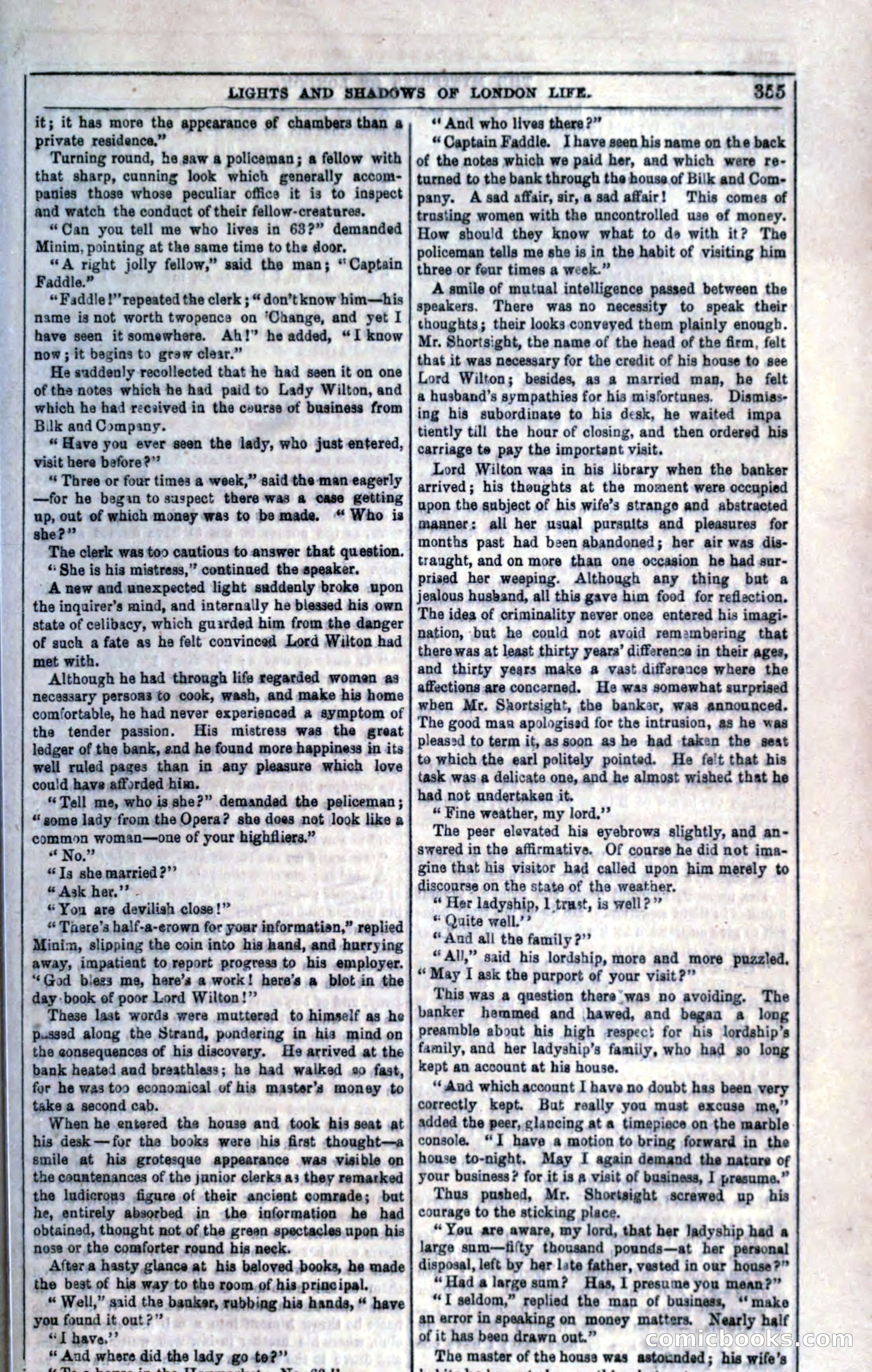
A restored page from Penny Dreadfuls, 1850. Page through the whole issue in the reader above.
📄 Transcribed text from this page (OCR, searchable)
Machine-transcribed from the original scan — historical spelling and the odd misread are preserved.
a a ec LIGHTS AND SHADOWS OF LONDON LIFE. it; it has more the appearance ef chambers than a private residence,” Turning round, he saw a policeman; a fellow with that sharp, cunning look which generally accom- patiies those whose peculiar office it is to inspect and watch the conduct of their fellow-creatures. “Can you tell me who lives in 63?” demanded Minim, pointing at the same time to the door. “A right jolly fellow,” said the man; “Captain Faddle.” “Faddle!”’ repeated the clerk ; “ don’t know him—his name is not worth twopence on ‘Change, and yet I have seen it somewhere. Ah!” he added, “I know now ; it begins to grow clear.” He suddenly recollected that he had seen it on one of the notes which he had paid to Lady Wilton, and which he had received in the course of business from Bilk and Company. “ Have you ever seen the lady, who just entered, visit here before?” “ Three or four times a week,” said the man eagerly —for he began to suspect there was a case getting up, out of which money was to be made. “ Who is she?” “ She is his mistress,” continued the speaker. A new and unexpected light saddenly broke upon the inquirer’s mind, and internally he blessed his own state of celibacy, which guarded him from the danger of such a fate as he felt convinced Lord Wilton had met with. Although he had through life regarded women as necessary persoms to cook, wash, and make his home comfortable, he had never experienced a symptom of the tender passion. His mistress was the great ledger of the bank, gnd he found more happiness in its well ruled pages than in any pleasure which love could have afforded him. Tell me, who is she?” demanded the peliceman ; | “some lady from the Opera? she does net look like a common woman—one of your highfliers.” oft No.” “Ts she married?” “ Ask her.’’ - “You are devilish close!” | “There’s half-a-erown for your informatien,” replied Minim, slipping the coin into his hand, and hurrying away, impatient to report progress to his employer. “*God blegs me, here’s a work! here’s a blot in the day book ef poor Lord Wilton!” These last words were muttered to himself as he pussed along the Strand, pondering in his mind on the consequences of his discovery. He arrived at the bank heated and breathless; he had walked a0 fast, for he was too economical of his master’s money to take a second cab. When he entered the house and took his seat at his desk—for the books were his first thought—a smile at his grotesque appearance was visible on the countenances of the janior clerks a3 they remarked the ludicrous figure of their ancient comrade; but he, entirely absorbed in the information he had obtained, thought not of the grean spectacles upon his nose or the comforter round his neck. __Aftera hasty glance at his beloved books, he made the best of his way to the room of his principal. “ Well,” said the banker, rubbing his hands, “ have you found it out?” “JI have,’’ “ And where did the lady go te?” a eee RS le ee wee 86 3E5 ** And who lives there?” “Captain Faddle. I have seen his name on the back of the notes which we paid her, and which were re- turned to the bank through the house of Bilk and Com- pany. A sad affair, sir, asad affair! This comes of trusting women with the uncontrolled use ef money. How should they know what to de with it? The policeman tells me she is in the habit of visiting him three or four times a week.” A smile of mutual intelligence passed between the speakers, There was no necessity to speak their thoughts; their looks conveyed them plainly enough. Mr. Shortsight, the name of the head of the firm, felt that it was necessary for the credit of his house to see Lord Wilton; besides, as a married man, he felt a husband’s sympathies for his misfortunes. Dismigs- ing his subordinate to his desk, he waited impa tiently till the hour of closing, and then ordered his carriage te pay the important visit. Lord Wilton was in his library when the banker arrived; his thoughts at the moment were occupied upon the subject of his wife’s strange and abstracted manner: all her usual pursnits and pleasures for months past had been abandoned; her air was dis- traught, and on more than one occasion he had sur- prised her weeping. Although any thing but a jealous husband, all this gave him food for reflection. The idea of criminality never onee entered his imagi- nation, but he could not avoid remambering that there was at least thirty years’ difference in their ages, and thirty years make a vast difference where the affections are concerned. He was somewhat surprised when Mr. Shortsight, the banker, was announced. The good maa apologised for the intrusion, as he was pleased to term it, as soon as he had taken the seat to which the earl politely pointed. He felt that his task was a delicate one, and he almost wished that he had not undertaken it. “ Fine weather, my lord,’’ The peer elevated his eyebrows slightly, and an- swered in the affirmative. Of course he did not ima- gine that his visitor had called upon him merély to discourse on the state of the weather. “ Her ladyship, 1 trust, is well?” “ Quite well.’’ “And all the family?” “All,” said his lordship, more and more puzzled, “May I ask the purport of your visit?” This was a question there’was no avoiding. The banker hemmed and hawed, and began a long preamble about his high respect for his lordghip’s family, and her ladyship’s family, who had so long kept an account at his house. ‘And which account I have no doubt has been very correctly kept. But really you must excuse me,” added the peer, glancing at a timepiece on the marble console. “I have a motion to bring forward in the house to-night. May I again demand the nature of your business? for it is a visit of business, I presume.” Thus pushed, Mr. Shortsight screwed up his courage to the sticking place. “You are aware, my lord, that her Jadyship had a large sum—fifty thousand pounds—at her personal disposal, left by her late father, vested in our house?” “Hada large som? Has, I presume you mean?” “T seldom,” replied the man of business, “make an error in speaking on money matters. Nearly half of it has been drawn out.” EOmMmiGcbdooks. ico The master of the houses was astounded; his wife’s