
Penny Dreadfuls, 1850 · page 364 of 394
The Mysteries of London; or, Lights and Shadows of London Life — page 364: what you’re looking at
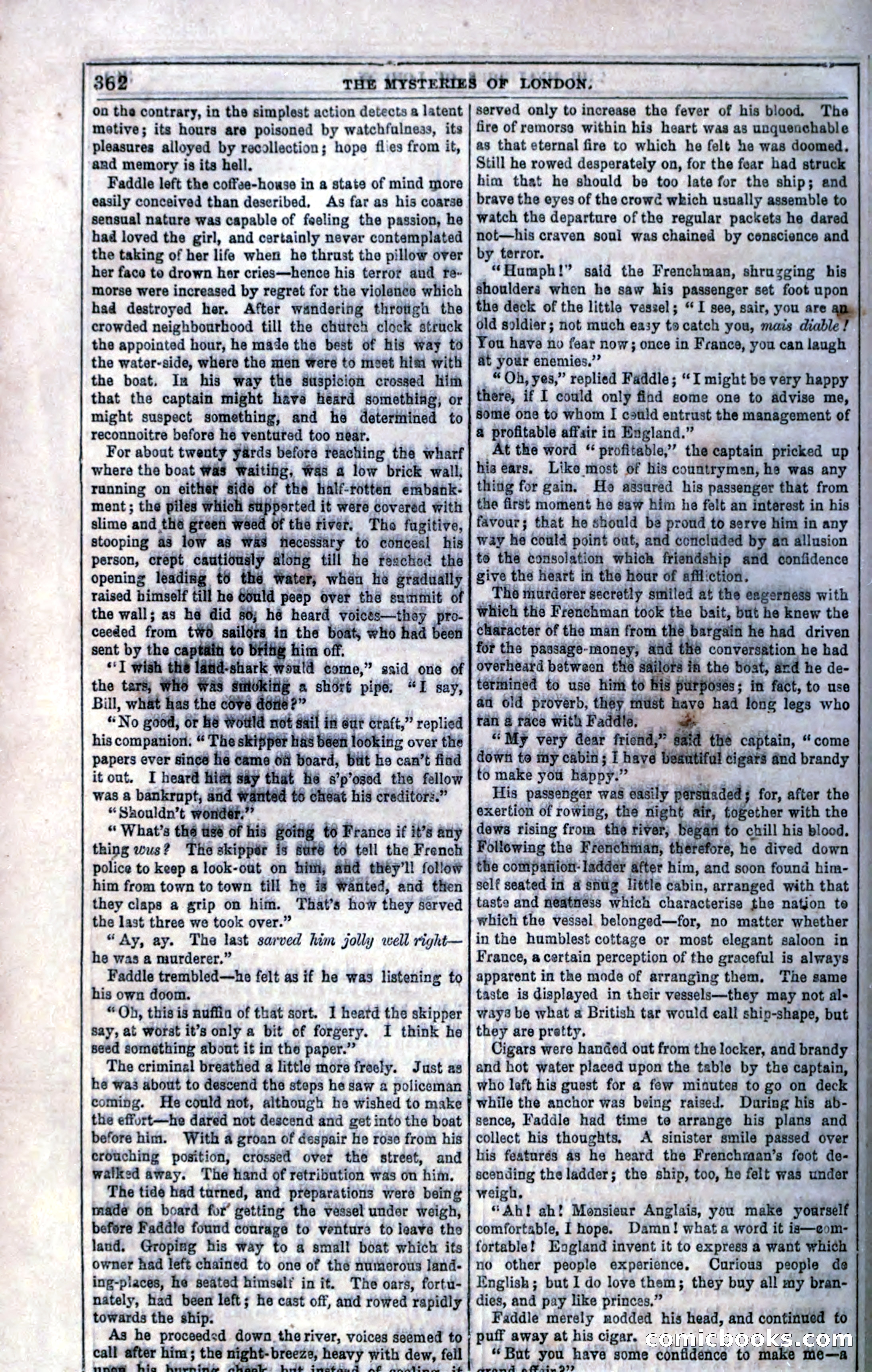
A restored page from Penny Dreadfuls, 1850. Page through the whole issue in the reader above.
📄 Transcribed text from this page (OCR, searchable)
Machine-transcribed from the original scan — historical spelling and the odd misread are preserved.
EE ee -——- — - - 7 862 THE on the contrary, in the simplest action detects a latent metive; its hours are poisoned by watchfulness, its pleasures alloyed by recollection; hope flies from it, and memory is its hell. Faddle left the coffse-house in a state of mind more easily conceived than deseribed, As far as his coarse sensual nature was capable of feeling the passion, he had loved the girl, and certainly never contemplated the taking of her life when he thrust the pillow over her face te drown her cries—hence his terror and fa- morse were increased by regret for the violence which had destroyed her. After wandering throtigh the crowded neighbourhood till the church clock struck the appointed hour, he made the best of his Way to the water-side, where the men were to moet him with the boat. Im his way the Suspicion crossed him that the captain might hava heard rime or might suspect something, and he deterinined to reconnoitre before he ventured too near. For about twenty yards before reaching the wharf where the boat Was Waiting, Was a low brick wall; ranning on eithét sidé of thé half-rotten embank- ment ; the piles whi Soot ike it were coveréd with slime and thé green | Of the river, Tho fugitive, stooping a3 low a8 Was fhecossary to conceal his person, crept cautiously along till he fteached the opening leading, té the Water; whén he gradually raised himself till he Gould peép ovet thé sainmit of the wall; as ha did a heard voicts—they pro- ceeded from two sailérs in the boat; who had beet sent by the captaiti to _ him off, | “] wish thé latid-shark would come,” ssid one of the tars; was za short pipe; “I say, Bill, what has the cOve adie?” “No good, or Hé Would not sail 18 Git Ctatt,” replied his companion: “ The skipper has béet looking over the papers ever sineé lie Game Of board, biit ho can’t find itout. I heard Hitt sdy thdt ie s’p’osed the fellow was 3 bankrupt, and wanted t6 cheat his creditors.” “Skouldn’t wondér”” “ What’s a 1188 of his Boia to Franca if it’s any thing wus? The skipper is Bure to tell the French police to keep a look-out on bith, aiid théy’ll follow him from town to town till he i# Wanted, and then they claps a grip on him. That’s how they sérved the last three we took over.” “ Ay, ay. The last sarved him jolly well right— he was a murderer.” Faddle trembled—he felt as if he was listening to his own doom. “Qh, this is nuffin of that sort. I heatd the skipper say, at worst it’s only a bit of forgery. I think he seed something about it in the paper.” The criminal breathed a little more freely. Just as he wa3 about to descend the steps he saw a policeman coming. He could not, although he wished to make the effurt—he dared not descend and get into the boat before him. With a groan of despair he rose from his crouching position; crossed over the street, and walked away. The hand of retribution was on him. The tide had turned, and preparations werd being made on board for’ getting the vessel under weigh, before Faddle found courage to venture to leave tho laud. Groping his way to a small boat which its owner had left chained to one of the numerous Jand- ing-places, he seated himself in if. The oars, fortu- nately, had been left; he cast off, and rowed rapidly towards the ship. call after him; the night-breeze, h ith dew, fell SA. tise 4 Soeatels © Lie 1) eee | ae MYSTERIES OF LONDON: es as 99 served only to increase the fever of his blood, The fire of remorse within his heart was as unquenchable as that eternal fire to which he felt he was doomed, Still he rowed desperately on, for the fear had struck him that he should be too late for the ship; and brave the eyes of the crowd which usually assemble to watch the departure of the regular packets he dared not—his craven soul was chained by conscience and by terror. “Humph!” said the Frenchman, shrugging his Shoulders when he saw his passenger set foot upon the déck of the little vessel; “I see, sair, you are : old soldier; not much easy tocatch you, mais diable You have no fear now; once in France, you can laugh at your enemies,” “ Oh, yes,” replied Faddle; “I might be very happy there; if I could only find some one to advise me, some one to whom I could entrust the management of @ profitable affair in England.” At the word “ profitable,” the captain pricked up his éars, Like most of his countrymen, he was any thing for gain. Ho aasuréd his passenger that from the first moment he saw him he felt an favour; that he should ba protd to serve him in any way he could point out, and coticluded by an allusion to the consolation which friendship and confidence give the heart in the hour of affliction, Tho murderer secretly smiled at the eagerness with which the Frenchman took the bait, bit he knew the character of the man from thé bargaifi he had driven for the Seman thie : to overheard between termined to use him to h ati old proverb, they must tan @ race with Faddle; “ My very dear fri ii the at, ard he de- purposes; in fact, to use have had long legs who dowt to my cabin; I hay cigars and brandy to make you happy.” His passenger was easily parstia ed; for, after the air sagsthes with the exertion of rowitig, the night dews rising from the i i eg Following the Frenchitian, ther after him, and soon found him- je compariion: ladder at self seated in a shitig little cabin, arranged with that taste and néatness which characterise the natjon te which the vessel belonged—for, no matter whether in the humblest cottage or most elegant saloon in to chill his blood. France, a certain perception of the graceful is always | apparent in the mode of arranging them, The same taste is displayed in their vessels—they may not al- | ways be what a British tar would call ship-shape, but | they are pretty. Cigars were handed out from the locker, and brandy and hot water placed upon the table by the ee who left his guest for a few minutes to go on dec while the anchor was being raised. During his ab- sence, Faddle had time te arrange his plans and collect his thoughts, A sinister smile passed over | his featurés as he heard the Frenchraan’s foot de- scending the ladder; the ship, too, he felt was under weigh, ) “Ah! ah! Monsieur Anglais, you make yourself comfortable, I hope. Damn! what a word it is—eom- fortable! England invent it to express a want which no other people experience, _ de English; but 1 do love them; they buy all my bran- dies, and pay like princes,” Faddle merely nodded his head, and continued fo | As he proceeded down the river, voices seemed to ; puff away at his cigar. Coy p) C6 ‘ , : cigar. book “But you have some confidence to . —A thé conversation he had | iptain, “come | re, he dived down | Curious people dé | - — | d , ‘ i 7 f f 3 i