
Penny Dreadfuls, 1850 · page 37 of 394
The Mysteries of London; or, Lights and Shadows of London Life — page 37: what you’re looking at
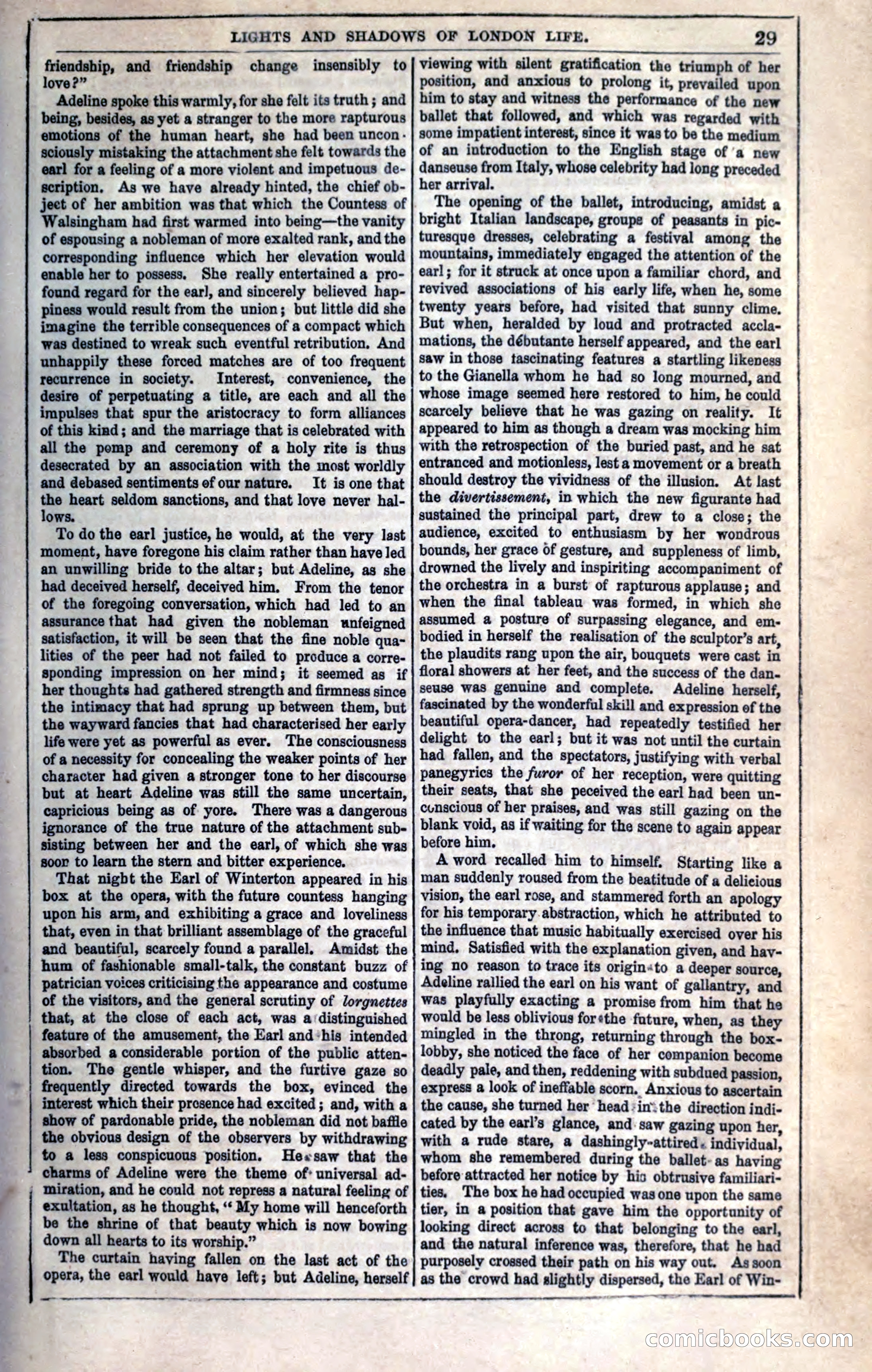
A restored page from Penny Dreadfuls, 1850. Page through the whole issue in the reader above.
📄 Transcribed text from this page (OCR, searchable)
Machine-transcribed from the original scan — historical spelling and the odd misread are preserved.
— a ee friendship, and friendship change insensibly to love?” | Adeline spoke this warmly, for she felt its truth ; and being, besides, as yet a stranger to the more rapturous emotions of the human heart, she had been uncon- sciously mistaking the attachment she felt towards the earl for a feeling of a more violent and impetuous de- scription, As we have already hinted, the chief ob- ject of her ambition was that which the Countess of Walsingham had first warmed into being—the vanity of espousing a nobleman of more exalted rank, and the corresponding influence which her elevation would enable her to possess. She really entertained a pro- found regard for the earl, and sincerely believed hap- piness would result from the union; but little did she imagine the terrible consequences of a compact which was destined to wreak such eventful retribution. And unhappily these forced matches are of too frequent recurrence in society. Interest, convenience, the desire of perpetuating a title, are each and all the impulses that spur the aristocracy to form alliances of this kind; and the marriage that is celebrated with all the pomp and ceremony of a holy rite is thus desecrated by an association with the most worldly and debased sentiments ef our nature. It is one that the heart seldom sanctions, and that love never hal- lows. To do the earl justice, he would, at the very last moment, have foregone his claim rather than have Jed an unwilling bride to the altar; but Adeline, as she had deceived herself, deceived him. From the tenor of the foregoing conversation, which had led to an assurance that had given the nobleman unfeigned satisfaction, it will be seen that the fine noble qua- lities of the peer had not failed to produce a corre- sponding impression on her mind; it seemed as if her thoughts had gathered strength and firmness since the intimacy that had sprung up between them, but the wayward fancies that had characterised her early life were yet as powerful as ever. The consciousness of a necessity for concealing the weaker points of her character had given a stronger tone to her discourse but at heart Adeline was still the same uncertain, capricious being as of yore. There was a dangerous ignorance of the true nature of the attachment sub- sisting between her and the earl, of which she was soor to learn the stern and bitter experience. That night the Earl of Winterton appeared in his box at the opera, with the future countess hanging upon his arm, and exhibiting a grace and loveliness that, even in that brilliant assemblage of the graceful and beautiful, scarcely found a parallel. Amidst the hum of fashionable small-talk, the constant buzz of patrician voices criticising the appearance and costume of the visitors, and the general scrutiny of lorgnettes that, at the close of each act, was a distinguished feature of the amusement, the Earl and:his intended absorbed a considerable portion of the public atten- tion. The gentle whisper, and the furtive gaze so frequently directed towards the box, evinced the interest which their presence had excited ; and, with a show of pardonable pride, the nobleman did not baffle the obvious design of the observers by withdrawing to a less conspicuous position. Hessaw that the charms of Adeline were the theme of? universal ad- | Miration, and he could not repress a natural feeling of exultation, as he thought, ‘“‘ My home will henceforth be the shrine of that beauty which is now bowing down all hearts to its worship.” The curtain haying fallen on the last act of the opera, the earl would have left; but Adeline, herself — es , LIGHTS AND SHADOWS OF LONDON LIFE, 29 viewing with silent gratification the triumph of her position, and anxious to prolong it, prevailed upon him to stay and witness the performance of the new ballet that followed, and which was regarded with some impatient interest, since it was to be the medium of an introduction to the English stage of ‘a new danseuse from Italy, whose celebrity had long preceded her arrival. The opening of the ballet, introducing, amidst a bright Italian landscape, groupe of peasants in pic- turesque dresses, celebrating a festival among the mountains, immediately engaged the attention of the earl; for it struck at once upon a familiar chord, and revived associations of his early life, when he, some twenty years before, had visited that sunny clime. But when, heralded by loud and protracted accla- mations, the débutante herself appeared, and the earl saw in those tascinating features a startling likeness to the Gianella whom he had so long mourned, and whose image seemed here restored to him, he could scarcely believe that he was gazing on reality. It appeared to him as though a dream was mocking him with the retrospection of the buried past, and he sat entranced and motionless, lest a movement or a breath should destroy the vividness of the illusion. At last the divertissement, in which the new figurante had sustained the principal part, drew to a close; the audience, excited to enthusiasm by her wondrous bounds, her grace of gesture, and suppleness of limb, drowned the lively and inspiriting accompaniment of the orchestra in a burst of rapturous applause; and when the final tableau was formed, in which she assumed a posture of surpassing elegance, and em- bodied in herself the realisation of the sculptor’s art, the plaudits rang upon the air, bouquets were cast in floral showers at her feet, and the success of the dan- seuse was genuine and complete. Adeline herself, fascinated by the wonderful skill and expression of the beautiful opera-dancer, had repeatedly testified her delight to the earl; but it was not until the curtain had fallen, and the spectators, justifying with verbal panegyrics the furor of her reception, were quitting their seats, that she peceived the earl had been un- cunscious of her praises, and was still gazing on the blank void, as if waiting for the scene to again appear before him. A word recalled him to himself. Starting like a man suddenly roused from the beatitude of a delicious vision, the earl rose, and stammered forth an apology for his temporary. abstraction, which he attributed to the influence that music habitually exercised over his mind, Satisfied with the explanation given, and hav- ing no reason to trace its origin«to a deeper source, Adeline rallied the earl on his want of gallantry, and was playfully exacting a promise from him that he would be less oblivious forethe future, when, as they mingled in the throng, returning through the box- lobby, she noticed the face of her companion become deadly pale, and then, reddening with subdued passion, express & look of ineffable scorn. Anxious to ascertain the cause, she turned her head:in:the direction indi- cated by the earl’s glance, and saw gazing upon her, with a rude stare, a dashingly-attired. individual, whom she remembered during the ballet-as having before attracted her notice by his obtrusive familiari- ties. The box he had occupied was one upon the same tier, in a position that gave him the opportunity of looking direct across to that belonging to the earl, and the natural inference was, therefore, that he had purposely crossed their path on his way out. As soon as the crowd had slightly dispersed, the Earl of Win- — ———— —_— CORNICLOO SS (E) im