
Penny Dreadfuls, 1850 · page 370 of 394
The Mysteries of London; or, Lights and Shadows of London Life — page 370: what you’re looking at
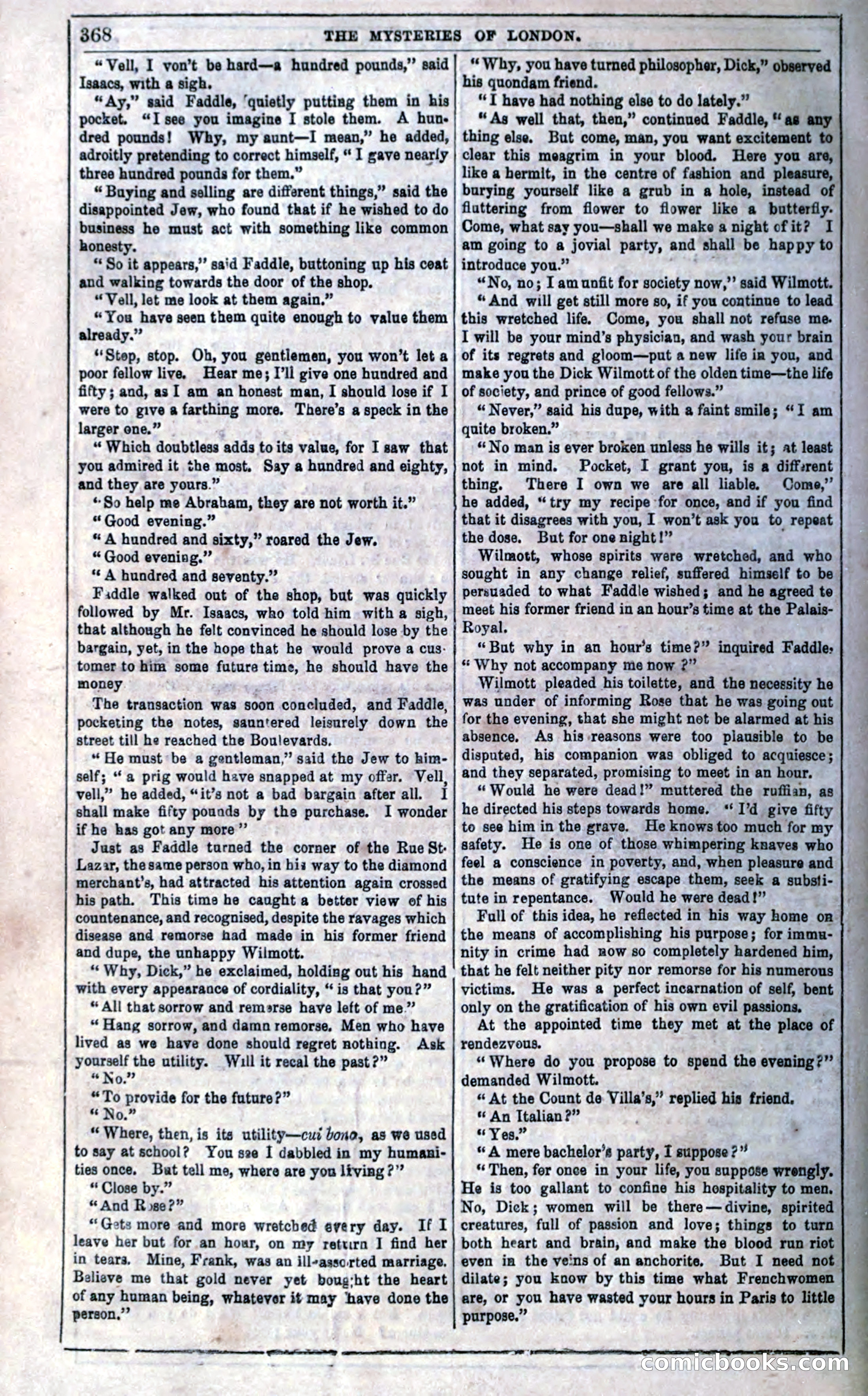
A restored page from Penny Dreadfuls, 1850. Page through the whole issue in the reader above.
📄 Transcribed text from this page (OCR, searchable)
Machine-transcribed from the original scan — historical spelling and the odd misread are preserved.
—_—_—_—— — _-_-_ 368 “Vell, I von’t be hard—a hundred pounds,” said Isaacs, with a sigh. “Ay,” said Faddle, ‘quietly putting them in his pocket. “I see you imagine I stole them. A hun- dred pounds! Why, my aunt—I mean,” he added, adroitly pretending to correct himself, “ I gave nearly three hundred pounds for them.” “ Buying and selling are different things,” said the disappointed Jew, who found that if he wished to do business he must act with something like common honesty. ** So it appears,’’ said Faddle, buttoning up his ceat and walking towards the door of the shop. “Vell, let me look at them again.” “You have seen them quite enough to value them already.” “Step, stop. Oh, you gentlemen, you won’t let a poor fellow live. Hear me; I'll give one hundred and fifty; and, as I am an honest man, I should lose if I were to give a farthing more. There’s a speck in the larger one.” “ Which doubtless adds to its value, for I saw that you admired it the most. Say a hundred and eighty, and they are yours.” *-So help me Abraham, they are not worth it.” “Good evening.” *“ A hundred and sixty,” roared the Jew. “ Good evening.” ** A hundred and seventy.” Fiddle walked out of the shop, but was quickly followed by Mr. Isaacs, who told him with a sigh, that although he felt convinced he should lose by the bargain, yet, in the hope that he would prove a cus: tomer to him some future time, he should have the money The transaction was soon concluded, and Faddle, pocketing the notes, sauntered leisurely down the street till he reached the Boulevards, “He must be a gentleman,” said the Jew to him- self; “a prig would have snapped at my offer. Vell, vell,” he added, “it’s not a bad bargain after all. j shall make fifty pounds by the purchase. I wonder if he has got any more” Just as Faddle tarned the corner of the Rue St- Lazar, the same person who, in his way to the diamond merchant’s, had attracted his attention again crossed his path. This time he caught a better view of his countenance, and recognised, despite the ravages which disease and remorse had made in his former friend and dupe, the unhappy Wilmott. “Why, Dick,” he exclaimed, holding out his hand with every appearance of cordiality, “is that you?” “ All that sorrow and remarse have left of me.” “ Hang sorrow, and damn remorse, Men who have lived as we have done should regret nothing. Ask yourself the utility. Wall it recal the past?” “ N 0.”? “To provide for the future?” * No.” “Where, then, is its utility—cui bono, as we used to say at school? You see I dabbled in my humani- ties once. But tell me, where are you living ?” * Close by.” “And Rose?” “Gets more and more wretched every day. If I leave her but for an hour, on my return IJ find her in tears, Mine, Frank, was an ill-assorted marriage. Believe me that gold never yet boug’ht the heart of any human being, whatever it may have done the person,”’ eT THE MYSTERIES OF LONDON, “Why, you have turned philosopher, Dick,” observed his quondam friend. “T have had nothing else to do lately.” “As well that, then,” continued Faddle, “as any thing else. But come, man, you want excitement to clear this meagrim in your blood. Here you are, like a hermit, in the centre of fashion and pleasure, burying yourself like a grub in a hole, instead of fluttering from flower to flower like a butterfly. Come, what say you—shall we make a night of it? I am going to a jovial party, and shall be happy to introduce you.” “No, no; Iam unfit for society now,”’ said Wilmott. “ And will get still more so, if you continne to lead this wretched life. Come, you shall not refuse me. I will be your mind’s physician, and wash your brain of its regrets and gloom—put a new life in you, and make you the Dick Wilmott of the olden time—the life of society, and prince of good fellows.” “ Never,” said his dupe, with a faint smile; “I am quite broken.” “No man is ever broken unless he wills it; at least not in mind. Pocket, I grant you, is a different thing. There I own we are all liable. Come,” he added, “try my recipe for once, and if you find that it disagrees with you, I won’t ask you to repeat the dose. But for one night!” Wilmott, whose spirits were wretched, and who sought in any change relief, suffered himself to be | persuaded to what Faddle wished; and he agreed te meet his former friend in an hour’s time at the Palais- Royal. “But why in an hie time?” inquired Faddle: * Why not accompany me now ?” Wilmott pleaded his toilette, and the necessity he was under of informing Rose that he was going out for the evening, that she might net be alarmed at his absence. As his reasons were too plausible to be disputed, his companion was obliged to acquiesce; and they separated, promising to meet in an hour, “ Would he were dead!” muttered the roffian, as he directed his steps towards home. “I'd give fifty | to see him in the grave. He knows too much for my safety. He is one of those whimpering knaves who | feel a conscience in poverty, and, when pleasure and | the means of gratifying escape them, seek a substi- tute in repentance. Would he were dead!” Full of this idea, he reflected in his way home on the means of accomplishing his purpose; for immu- nity in crime had now so completely hardened him, that he felt neither pity nor remorse for his numerous | victims. He was a perfect incarnation of self, bent only on the gratification of his own evil passions, _ At the appointed time they met at the place of rendezvous. “Where do you propose to spend the evening?” demanded Wilmott. “ At the Count de vee replied his friend. * An Italian?” | 6s Yeas. ”? > “ A mere bachelor’s party, I suppose?” “ Then, fer once in your life, you suppose wrongly. | He is too gallant to confine his hospitality to men. No, Dick; women will be there—divine, spirited creatures, ‘fall of passion and love; things to turn both heart and brain, and make the blood run riot | even in the veins of an anchorite, But I need not dilate; you know by this time what Frenchwomen are, or you have wasted your hours in Paris to little purpose.” (ECO NAIICE OOKS com