
Penny Dreadfuls, 1850 · page 374 of 394
The Mysteries of London; or, Lights and Shadows of London Life — page 374: what you’re looking at
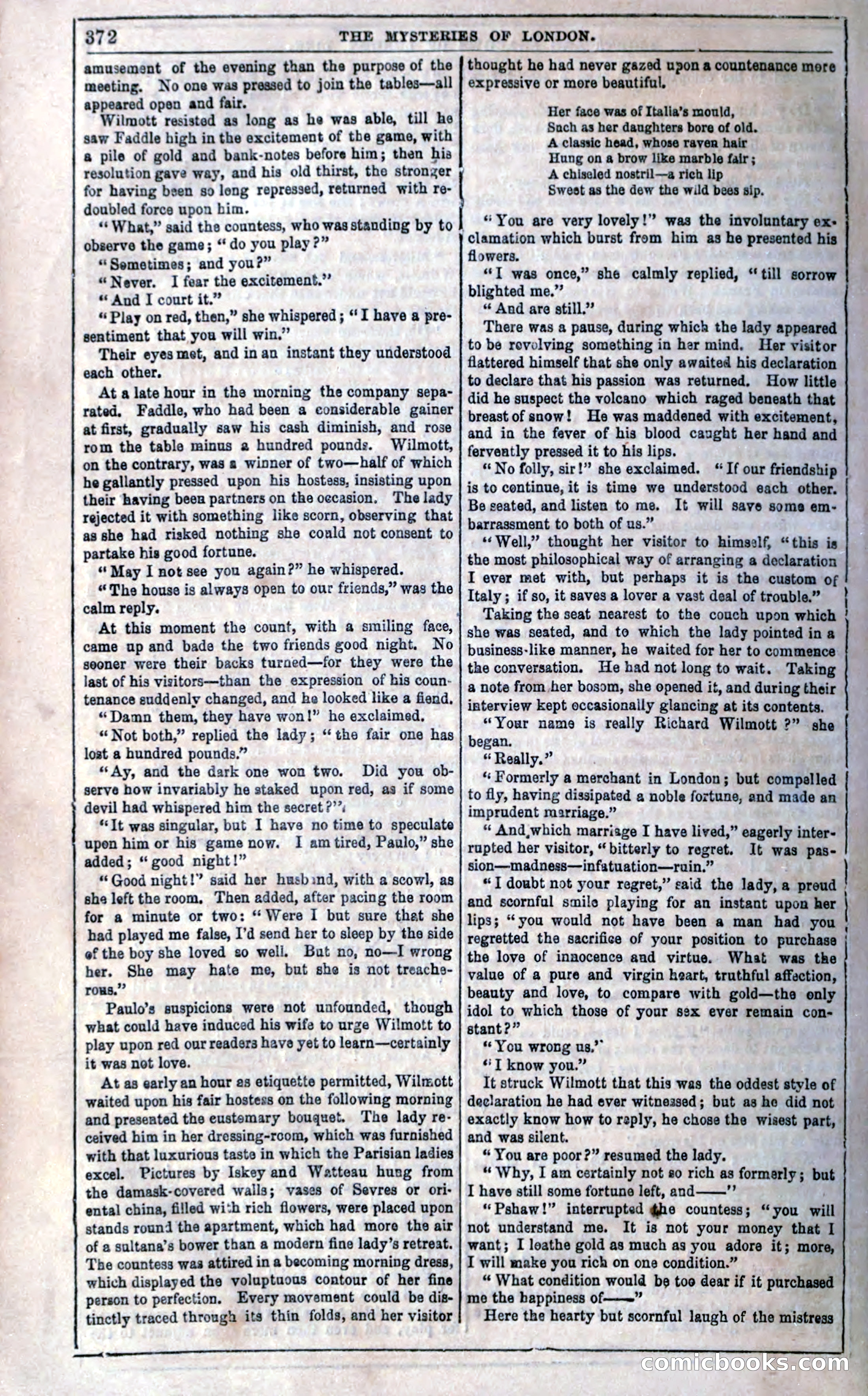
A restored page from Penny Dreadfuls, 1850. Page through the whole issue in the reader above.
📄 Transcribed text from this page (OCR, searchable)
Machine-transcribed from the original scan — historical spelling and the odd misread are preserved.
372 amusement of the evening than the purpose of the meeting. No one was pressed to join the tables—all appeared open and fair. Wilmott resisted as long as he was able, till he saw Faddle high in the excitement of the game, with a pile of gold and bank-notes before him; then hia resolution gave way, and his old thirst, the stronger for having been so long repressed, returned with re- doubled force upon him. ‘« What,” said the countess, who was standing by to observe the game; “ do you play?” “Semetimes; and you?” “Never. I fear the excitement.” “ And I court it.” “Play on red, then,” she whispered ; “I have a pre- sentiment that you will win.” Their eyes met, and in an instant they understood each other. At a late hour in the morning the company sepa- rated. Faddle, who had been a considerable gainer at first, gradually saw his cash diminish, and rose rom the table minus a hundred pounds. Wilmott, on the contrary, was a wioner of two—half of which he gallantly pressed upon his hostess, insisting upon their having been partners on the oecasion, The lady rejected it with something like scorn, observing that as she had risked nothing she could not consent to partake his good fortune. “May I not see you again?” he whispered. “The house is always open to our friends,” was the calm reply. At this moment the count, with a smiling face, came up and bade the two friends good night. No seoner were their backs turned—for they were the last of his visitors—than the expression of his coun- tenance suddenly changed, and he looked like a fiend, “Damn them, they have won!” he exclaimed, “Not both,” replied the lady; “the fair one has lost a hundred pounds.” “‘Ay, and the dark one won two. Did you ob- serve how invariably he staked upon red, as if some devil had whispered him the secret ?’’, ‘It was singular, but I have no time to speculate upen him or his game now. I am tired, Paulo,” she added; “good night!” “ Good night!” said her husbind, with a scowl, as she left the room, Then added, after pacing the room for a minute or two: “ Were I but sure that she had played me false, I’d send her to sleep by the side ef the boy she loved so well. But no, no—I wrong her. She may hate me, but she is not treache- rous.”’ Paulo’s suspicions were not unfounded, though what could have induced his wife to urge Wilmott to play upon red our readers have yet to learn—certainly it was not love. At as early an hour as etiquette permitted, Wilmott waited upon his fair hostess on the following morning and presented the eustemary bouquet. The lady re- ceived him in her dressing-rcom, which was furnished with that luxurious taste in which the Parisian ladies excel. Pictures by Iskey and Watteau hung from the damask-covered walls; vases of Sevres or ori- ental china, filled with rich flowers, were placed upon stands round the apartment, which had more the air of a sultana’s bower than a modern fine lady’s retreat. The countess was attired in a becoming morning dress, which displayed the voluptuous contour of her fine person to perfection. Every movement could be dis- tinctly traced through its thin folds, and her visitor en i ea THE MYSTERIES OF LONDON. thought he had never gazed upon a countenance more expressive or more beautiful. Her face was of Italia’s mould, 42 Sach as her daughters bore of old. ¥ A classic head, whose raven hair P Hung on a brow like marble fair; A chiseled nostril—a rich lip Swest as the dew the wild bees sip. “You are very lovely!” was the involuntary ex: j /clamation which burst from him as he presented his flowers. ‘“‘T was once,” she calmly replied, “till sorrow blighted me.” “ And are still,” There was a pause, during which the lady appeared to be revolving something in her mind. Her visitor flattered himself that she only awaited his declaration to declare that his passion was returned, How little did he suspect the volcano which raged beneath that breast of snow! He was maddened with excitement, and in the fever of his blood caught her hand and fervently pressed it to his lips. “No folly, sir!” she exclaimed. “If our friendship is to continue, it is time we understood each other. Be seated, and listen to me. It will save some em- barrassment to both of us.” ‘‘ Well,” thought her visitor to himsalf, “this is the most philosophical way of arranging a declaration I ever met with, but perhaps it is the custom of Italy ; if so, it saves a lover a vast deal of trouble.” Taking the seat nearest to the couch upon which she was seated, and to which the lady pointed ina business-like manner, he waited for her to commence | the conversation. He had not long to wait. Taking a note from her bosom, she opened it, and during their ( interview Kept occasionally glancing at its contents. “Your name is really Richard Wilmott ?” she began. “ Really.” “ Formerly a merchant in London; but compelled to fly, having dissipated a noble fortune, and made an imprudent marriage.” “ And which marriage I have lived,” eagerly inter- rupted her visitor, “bitterly to regret. It was pas- sion—madness—infatuation—ruin.” “T doubt not your regret,” said the lady, a preud | and scornful smile playing for an instant upon her | — lips; “you would not have been a man had you regretted the sacrifice of your position to purchase { the love of inaocencs and virtue. What was the ) value of a pure and virgin heart, truthful affection, beauty and love, to compare with gold—the only idol to which those of your sex ever remain con- stant?” ‘You wrong us,” “TI know you.” It struck Wilmott that this was the oddest style of declaration he had ever witnessed; but as he did not exactly know how to reply, he chose the wisest part, | and was silent. “ You are poor?” resumed the lady. “ Why, I am certainly not so rich as formerly; but {| I have still some fortune left, and-——”’ i “Pshaw!” interrupted @he countess; “you will not understand me. It is not your money that I want; I loathe gold as much as you adore it; more, I will make you rich on one condition.” | “ What condition would be too dear if it purchased me the happiness of——” Oe Here the hearty but scornful laugh of the mistress GoM com