
Penny Dreadfuls, 1850 · page 386 of 394
The Mysteries of London; or, Lights and Shadows of London Life — page 386: what you’re looking at
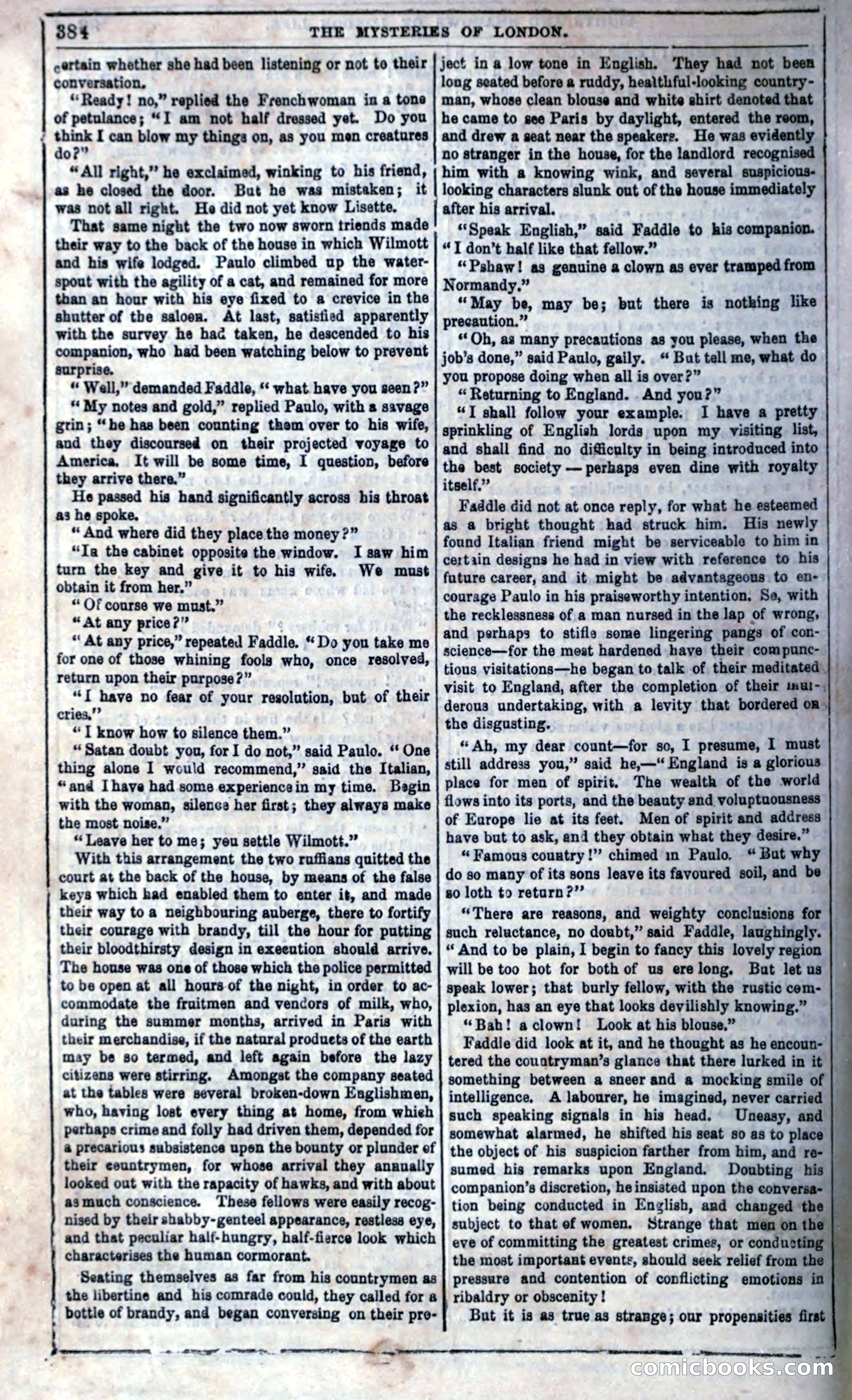
A restored page from Penny Dreadfuls, 1850. Page through the whole issue in the reader above.
📄 Transcribed text from this page (OCR, searchable)
Machine-transcribed from the original scan — historical spelling and the odd misread are preserved.
884 certain whether she had been listening or not to their conversation, “Ready! no,” replied the Frenchwoman in a tone of petulance; “I am not half dressed yet. Do you 5 I can blow my things on, as you men creatures do?" “All right,” he exclaimed, winking to his friend, as he closed the door. But he was mistaken; it was notall right. He did not yet know Lisette. That same night the two now sworn triends made their way to the back of the house in which Wilmott and his wife lodged. Paulo climbed up the water- spout with the agility of a cat, and remained for more than an hour with his eye fixed to a crevice in the shutter of the saloon. At last, satisfied apparently with the survey he hac taken, he descended to his companion, who had been watching below to prevent rise. “ Well,” demanded Faddle, *‘ what. have you seen?” ** My notes and gold,” replied Paulo, with a savage grin; “be has been counting them over to his wife, and they discoursed on their projected voyage to America, It will be some time, I question, before they arrive there.” He passed his hand significantly across his throat as he spoke, “ And where did they place the money ?” “Ia the cabinet opposite the window. I saw him turn the key and give it to his wife. We must obtain it from her,” “ Of course we must.” “At any price?” “ At any price,” repeated Faddle. “Do you take me for one of those whining fools who, once resolved, return upon their purpose?” “Tf have no fear of your resolution, but of their cries,” “T know how to silence them.” “Satan doubt you, for! do not,” said Paulo. ** One thing alone I would recommend,” said the Italian, “and Ihave had some experiencein my time. Begin with the woman, silence her first; they always make the most noise.” “Leave her to me; you settle Wilmott.” With this arrangement the two ruffians quitted the court at the back of the house, by means of the false keys which had enabled them to enter it, and made their way to a neighbouring auberge, there to fortify their courage with brandy, till the hour for putting their bloodthirsty design in exeeution should arrive. The house was one of those which the police permitted to be open at all hours of the night, in order to ac- commodate the fruitmen and vendors of milk, who, during the summer months, arrived in Paris with their merchandise, if the natural produets of the earth may be so termed, and left again before the lazy citizens were stirring. Amongst the company seated at the tables were several broken-down Englishmen, who, having lost every thing at home, from whieh perhaps crime and folly had driven them, depended for @ precarious subsistence upen the bounty or plunder ef their countrymen, for whose arrival they anaually looked out with the rapacity of hawks, and with about asmuch conscience. These fellows were easily recog- nised by their shabby-genteel appearance, restless eye, and that peculiar half-hungry, half-fierce look which characterises the human cormorant. Seating themselves as far from his countrymen as the libertine and his comrade could, they called for a bottle of brandy, and began conversing on their pro- THE MYSTERIES OF LONDON. oe rng eee... SE ee ject in a low tone in English. They bad not been long seated before a ruddy, healthful-looking man, whose clean blouse and white shirt he came to see Paris by daylight, a atdbeey n= and drew a seat near the speakere. H o no stranger in the house, for the landlord 1 : him with a knowing wink, and several suspicious- looking characters slunk out of the house immediately after his arrival. ‘‘Speak English,” said Faddle to his conmpandans “T don’t half like that fellow.” “Pshaw! as genuine a clown as ever tramped from Normandy,” “May be, may be; but there is nothing like precaution.” “Oh, as many precautions as you please, when the job’s done,” said Paulo, gaily. “ But tell me, what do you propose doing when all is over?” “ Returning to England. And you?” “JT shall follow your example. I have a pretty sprinkling of English lords upon my visiting list, and shall find no difficulty in being introduced into the best society — perhaps even dine with royalty itself,” Faddle did not at once reply, for what he esteemed as a bright thought had struck him. His newly found Italian friend might be serviceable to him in certain designs he had in view with reference to his future career, and it might be advantageous to en- courage Paulo in his praiseworthy intention, Se, with the recklessness of a man nursed in the lap of wrong; and perhaps to stifle some lingering pangs of con- science—for the mest hardened have their bere | tious visitations—he began to talk of their meditat : visit to England, after the completion of their wut-\| — derous undertaking, with a levity that bordered on | the disgusting. | * Ah, my dear count—for so, I presume, I sncint still address you,” said he,—‘“ England is a glorious | place for men of spirit. The wealth of the world flows into its ports, and the beauty and voluptaousness | of Europe lie at its feet. Men of spirit and address | ~ have but to ask, and they obtain what they desire.” — “ Famous country!” chimed in Paulo. “ But why | do so many of its sons leave its favoured soil, and a y so loth to return?”’ | “There are reasons, and weighty conclusions for | such reluctance, no doubt,” said Faddle, laughingly. w “ And to be plain, I begin to fancy this lovely region th will be too hot for both of us erelong. Bat let us | speak lower; that burly fellow, with the rastic com-’ plexion, has an eye that looks devilishly knowing.” “Bah! aclown! Look at his blouse,” ‘ | Faddle did look at it, and he thought as he encoun- | tered the couatryman’s glance that there lurked in it | something between a sneer and a mocking smile of | intelligence, A labourer, he imagined, never carried | such speaking signals in his head. Uneasy, ai somewhat alarmed, he shifted his seat so as to ¢ the object of his suspicion farther from him, and sumed his remarks upon England. Doubting companion’s discretion, he insisted upon the cor tion being conducted in English, and changed ‘th subject to that ef women, Strange that mi eve of committing the greatest crimes, orc the most important events, should seek relief from tl pressure and contention of conflicting emotions in ribaldry or obscenity ! But it is as true as strange; our propensities fi 4 d cha; <SiGOIT (renee meme boo Com A