
Penny Dreadfuls, 1850 · page 396 of 394
The Mysteries of London; or, Lights and Shadows of London Life — page 396: what you’re looking at
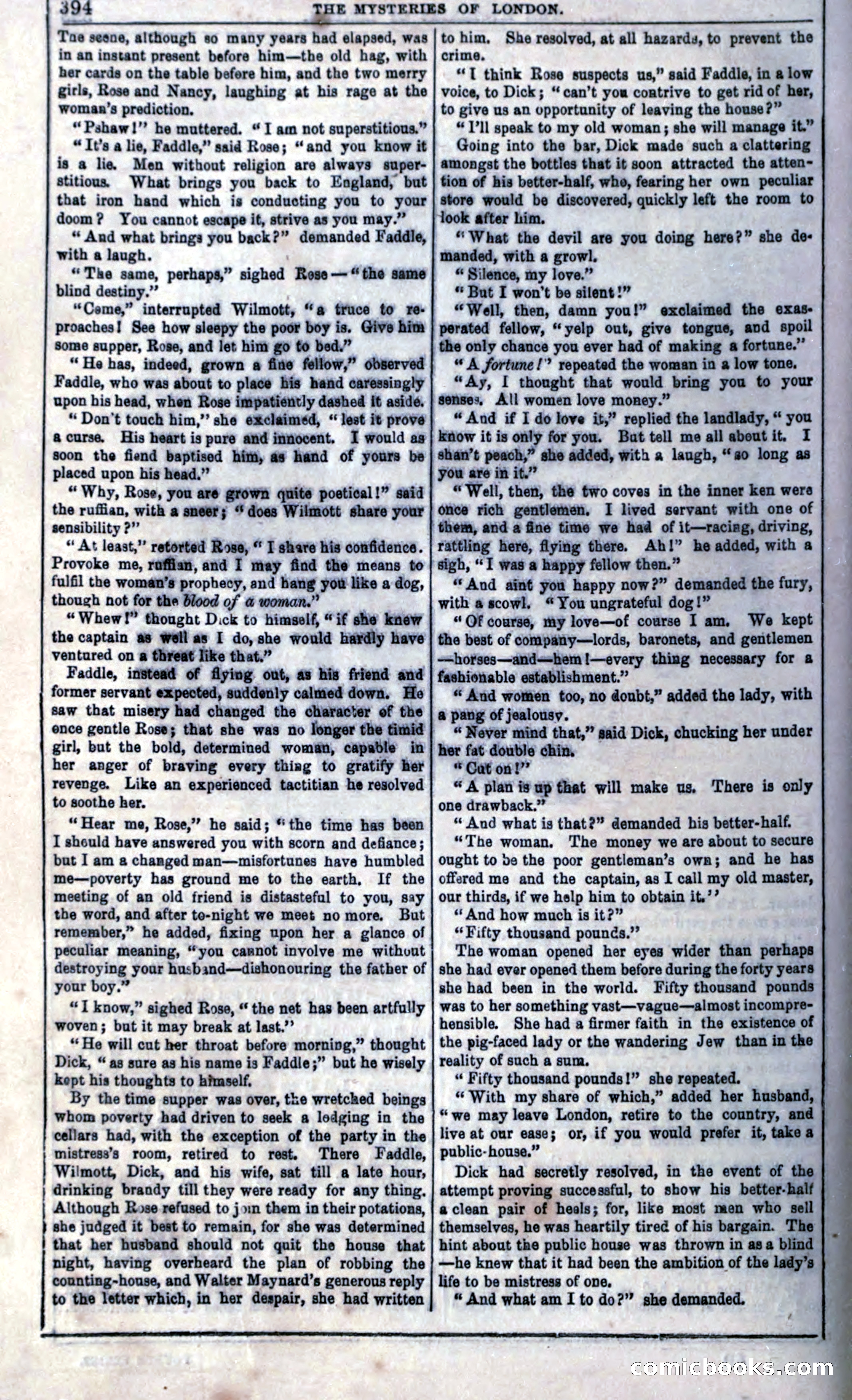
A restored page from Penny Dreadfuls, 1850. Page through the whole issue in the reader above.
📄 Transcribed text from this page (OCR, searchable)
Machine-transcribed from the original scan — historical spelling and the odd misread are preserved.
394 Tae sesne, although so many years had elapsed, was in an instant present before him—the old hag, with her cards on the table before him, and the two merry girls, Rose and Nancy, laughing at his rage at the woman’s prediction. “Pshaw!’’ he muttered. “I am not superstitious,” “ It’s a lie, Faddle,” said Rose; “and you know it is a lie Men without religion are always super- stitious, What brings you back to England, but that iron hand which is conducting you to your doom? You cannot escape it, strive as you may.” “ And what brings you back?” demanded Faddle, with a laugh. “The same, perhaps,” sighed Rose — “the same blind destiny.” “Ceme,” interrupted Wilmott, “a@ truce to re- proaches! See how sleepy the poor boy is. Give him some supper, Rose, and let him go to bed.” “He has, indeed, grown a fine fellow,” observed Faddle, who was about to place his hand caressingly upon his head, when Rose impatiently dashed it aside. “ Don't touch him,” she exclaimed, “ lest it prove | know it is only for you. But tell me all aboutit, I acurse. His heart is pure and innocent. I would ag soon the fiend baptised him, as hand of yours be placed upon his head,” “Why, Rose, you aré grown quite poetical!” said the ruffian, with a sneer; “does Wilmott share your sensibility ?” “At least,” retorted Rose, “ I share his confidence. Provoke me, raffian, and I may find the means to fulfil the woman’s prophesy, and hang you like a dog, though not for the blood of @ woman.” “Whew!” thought Dick to himself, “if she knew the captain as Well as I do, she would hardly have ventured on a threat like that.” Faddle, instead of flying out, as his friend and former servant expected, suddenly calmed down. He saw that misery had changed the character of the ence gentle Rose; that she was no longer the timid girl, but the bold, determined woman, capable in her anger of braving every thing to gratify her revenge. Like an experienced tactitian he resolved to soothe her. “Hear me, Rose,” he said; “the time has been I should have answered you with scorn and defiance; but I am a changed man—misfortunes have humbled me—poverty has ground me to the earth, If the meeting of an old friend is distasteful to you, say the word, and after te-night we meet no more, But remember,” he added, fixing upon her a glance of peculiar meaning, “you camnot involve me without destroying your husband—dishonouring the father of your boy.” “I know,” sighed Rose, “ the net has been artfully woven; but it may break at last.’’ “ He will cut her throat before morning,” thought Dick, “as sure as his name is Faddie;” but he wisely kept his thoughts to himself, By the time supper was over, the wretched beings whom poverty had driven to seek a ledging in the cellars had, with the exception of the party in the mistress’s room, retired to rest. There Faddle, Wilmott, Dick, and his wife, sat till a late hour, | drinking brandy till they were ready for any thing. | Although Rose refused to j om them in their potations, she judged it best to remain, for she was determined that her husband should not qnit the house that night, having overheard the plan of robbing the counting-house, and Walter Maynard’s generous reply to the letter which, in her despair, she had written E MYSTERIES OF LONDON. tohim, She resolved, at all hazards, to prevent the crime. “T think Rose suspects us,” said Faddile, in alow voice, to Dick; “can’t you contrive to get rid of her, to give us an opportunity of leaving the house?” “1’ll speak to my old woman; she will manage it.” Going into the bar, Dick made such a clattering amongst the bottles that it soon attracted the atten- tion of his better-half, who, fearing her own peculiar store would be discovered, quickly left the room to look after him. “What the devil are you doing here?” she de- manded, with a growl. “ Silence, my love.” * But I won't be silent!” “Well, then, damn you!” exclaimed the exas- perated fellow, “yelp out, give tongue, and spoil the only chance you ever had of making a fortune.” “ A fortune!” repeated the woman in a low tone. “Ay, I thought that would bring you to your senses, All women love money.” “And if I do love it,” replied the landlady, “ you shan’t peach,” she added, with a laugh, “so long as you are in it,” “Well, then, the two coves in the inner ken were once rich gentlemen, I lived servant with one of them, and a fine time we had of it—racing, driving, rattling here, flying there. Ah!” he added, with a ‘sigh, “I was a happy fellow then.” “And ainé you happy now?” demanded the fury, with a scowl, “You ungrateful dog!” “ Of course, my love—of course I am, We kept the best of ‘company—lords, baronets, and gentlemen “ And women too, no doubt,” added the lady, with +e mind that,” said Dick, chucking her under her fat double chin, * Cat on?” “ A plan is up that will make us, ‘There is only one drawback.” “ And what is that?” demanded his better-half. “The woman, The money we are about to secure ought to be the poor gentleman’s own; and he has offered me and the captain, as I call my old master, our thirds, if we help him to obtain it.’’ * And how much is it?” “Fifty thousand pounds.” The woman opened her eyes wider than perhaps she had ever opened them before during the forty years she had been in the world. Fifty thousand pounds was to her something vast—vague—almost incompre- hensible. She had a firmer faith in the existence of the pig-faced lady or the wandering Jew than in the | reality of such a sum. “ Fifty thousand pounds!” she repeated. “With my share of which,” added her rege) “we may leave London, retire to the country, and live at our ease; or, if you would prefer i ON Ee . public- house,” Dick had secretly resolved, in the event of attempt pro successful, to show his a clean pair themselves, he was heartily tired of his bargain. The hint about the public house was thrown in as pee —he knew that it had been the ambition of the life to be mistress of one, “ And what am I to do?” she demanded. La \oye) @) : cS heals; for, like most men who sell 4 com } Ip |