
Penny Dreadfuls, 1850 · page 40 of 394
The Mysteries of London; or, Lights and Shadows of London Life — page 40: what you’re looking at
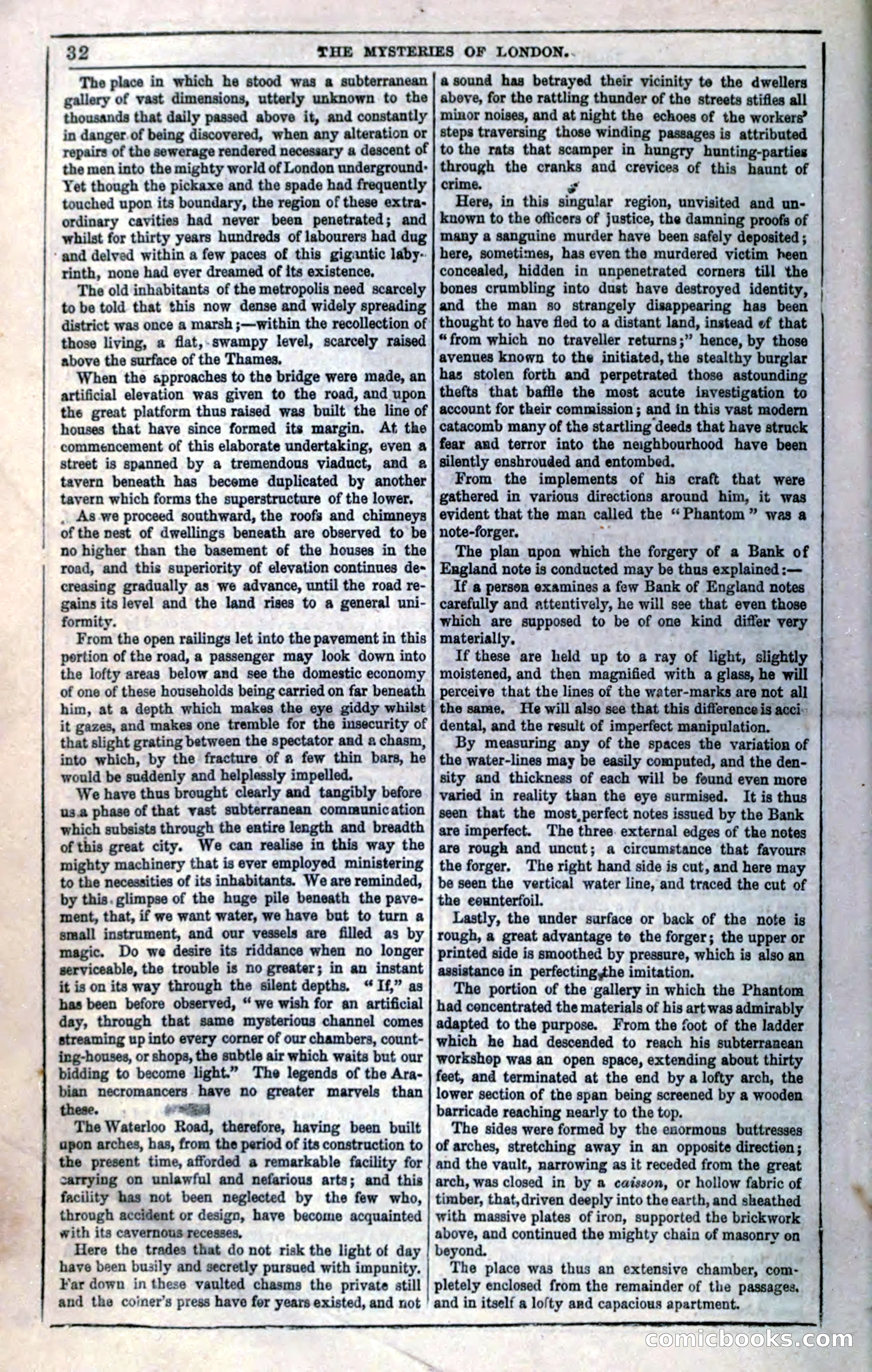
A restored page from Penny Dreadfuls, 1850. Page through the whole issue in the reader above.
📄 Transcribed text from this page (OCR, searchable)
Machine-transcribed from the original scan — historical spelling and the odd misread are preserved.
32 Le THE MYSTERIES OF LONDON.. The place in which he stood was a subterranean gallery of vast dimensions, utterly unknown to the thousands that daily passed above it, and constantly in danger.of being discovered, when any alteration or repairs of the sewerage rendered necessary a descent of the men into the mighty world of London underground: Yet though the pickaxe and the spade had frequently touched upon its boundary, the region of these extra- ordinary cavities had never been penetrated; and whilst for thirty years hundreds of labourers had dug ‘and delved within a few paces of this gigantic laby- rinth, none had ever dreamed of its existence. The old inhabitants of the metropolis need scarcely to be told that this now dense and widely spreading district was once a marsh ;—within the recollection of those living, a flat,.swampy level, scarcely raised above the surface of the Thames, When the approaches to the bridge were made, an artificial elevation was given to the road, and upon the great platform thus raised was built the line of houses that have since formed its margin. Af the commencement of this elaborate undertaking, even a street is spanned by a tremendous viaduct, and a tavern beneath has beceme duplicated by another tavern which forms the superstructure of the lower. _ As we proceed southward, the roofs and chimneys of the nest of dwellings beneath are observed to be no higher than the basement of the houses in the road, and this superiority of elevation continues de- creasing gradually as we advance, until the road re- gains its level and the land rises to a general uni- formity. From the open railings let into the pavement in this pertion of the road, a passenger may look down into the lofty areas below and see the domestic economy of one of these households being carried on far beneath him, at a depth which makes the eye giddy whilst it gazes, and makes one tremble for the insecurity of that slight grating between the spectator and a chasm, into which, by the fracture of a few thin bars, he would be suddenly and helplessly impelled, We have thus brought clearly and tangibly before us.a phase of that vast subterranean communication which subsists through the entire length and breadth of this great city. We can realise in this way the mighty machinery that is ever employed ministering to the necessities of its inhabitants. We are reminded, by this. glimpse of the huge pile beneath the pave- ment, that, if we want water, we have but to turn a small instrument, and our vessels are filled as by ic. Do we desire its riddance when no longer serviceable, the trouble is no greater; in an instant it is on its way through the silent depths. “If,” as has been before observed, “ we wish for an artificial day, through that same mysterious channel comes streaming up into every corner of our chambers, count- ing-houses, or shops, the subtle air which waits but our bidding to become light.” The legends of the Ara- bian necromancers have no greater marvels than The Waterloo Road, therefore, having been built upon arches, has, from the period of its construction to the present time, afforded a remarkable facility for carrying on unlawful and nefarious arts; and this facility has not been neglected by the few who, through accident or design, have become acquainted with its cavernous recesses, Here the trades that do not risk the light of day have been busily and secretly pursued with impunity. Far down in these vaulted chasms the private still a sound has betrayed their vicinity te the dwellers abeve, for the rattling thunder of the streets stifles all minor noises, and at night the echoes of the workers? one aprerees ed those wes passages is attributed e ra scamper in hungry hunting-parties through the cranks and crevices of this haunt of crime. - Here, in this singular region, unvisited and un- known to the officers of justice, the damning proofs of many a sanguine murder have been safely deposited ; here, sometimes, has even the murdered victim heen concealed, hidden in unpenetrated corners till the bones crumbling into dust have destroyed identity, been and the man so strangely disappearing has thought to have fled to a distant land, instead of that “from which no traveller returns;” hence, by those avenues known to the initiated, the stealthy burglar has stolen forth and perpetrated those thefts that baffle the most acute investigation to account for their commission ; and in this vast modern catacomb many of the startling deeds that have struck fear and terror into the neighbourhood have been silently enshrouded and entombed. From the implements of his craft that were gathered in various directions around him, it was evident that the man called the “ Phantom” was a note-forger. * The plan upon which the forgery of a Bank of England note is conducted may be thus explained :— If a person examines a few Bank of England notes carefully and attentively, he will see that even those which are supposed to be of one kind differ very materially, If these are held up to a ray of light, slightly moistened, and then magnified with a glass, he will perceive that the lines of the water-marks are not all the same, He will also see that this difference is acci~ dental, and the result of imperfect manipulation. By measuring any of the spaces the variation of the water-lines may be easily computed, and the den- sity and thickness of each will be found even more varied in reality than the eye surmised. It is thus seen that the most,perfect notes issued by the Bank are imperfect. The three. external edges of the notes are rough and uncut; a circumstance that favours the forger. The right hand side is cut, and here may be seen the vertical water line, and traced the cut of the eeunterfoil. : Lastly, the under surface or back of the note is rough, a great advantage te the forger; the upper or printed side is smoothed by pressure, which is also an assistance in perfecting,the imitation. | The portion of the gallery in which the Phantom had concentrated the materials of his art was admirably adapted to the purpose. From the foot of the ladder which he had descended to reach his subterranean workshop was an open space, extending about feet, and terminated at the end by a lofty arch, the lower section of the span being screened by a wooden barricade reaching nearly to the top. The sides were formed by the enormous buttresses of arches, stretching away in an opposite direction; and the vault, narrowing as it receded from the great arch, was closed in by a caisson, or hollow fabric of timber, that, driven deeply into the earth, and sheathed with massive plates of iron, supported the brickwork above, and continued the mighty chain of masonry on beyond. The place was thus an extensive chamber, com- pletely enclosed from the remainder of the passages, and the coiner’s press have fer years existed, and not ' and in itself a lofty and capacious apartment. ne LL LLL LLL LALO LE TL TI LL LT ELL CONNICK OLS (E(e) m