
Penny Dreadfuls, 1850 · page 45 of 394
The Mysteries of London; or, Lights and Shadows of London Life — page 45: what you’re looking at
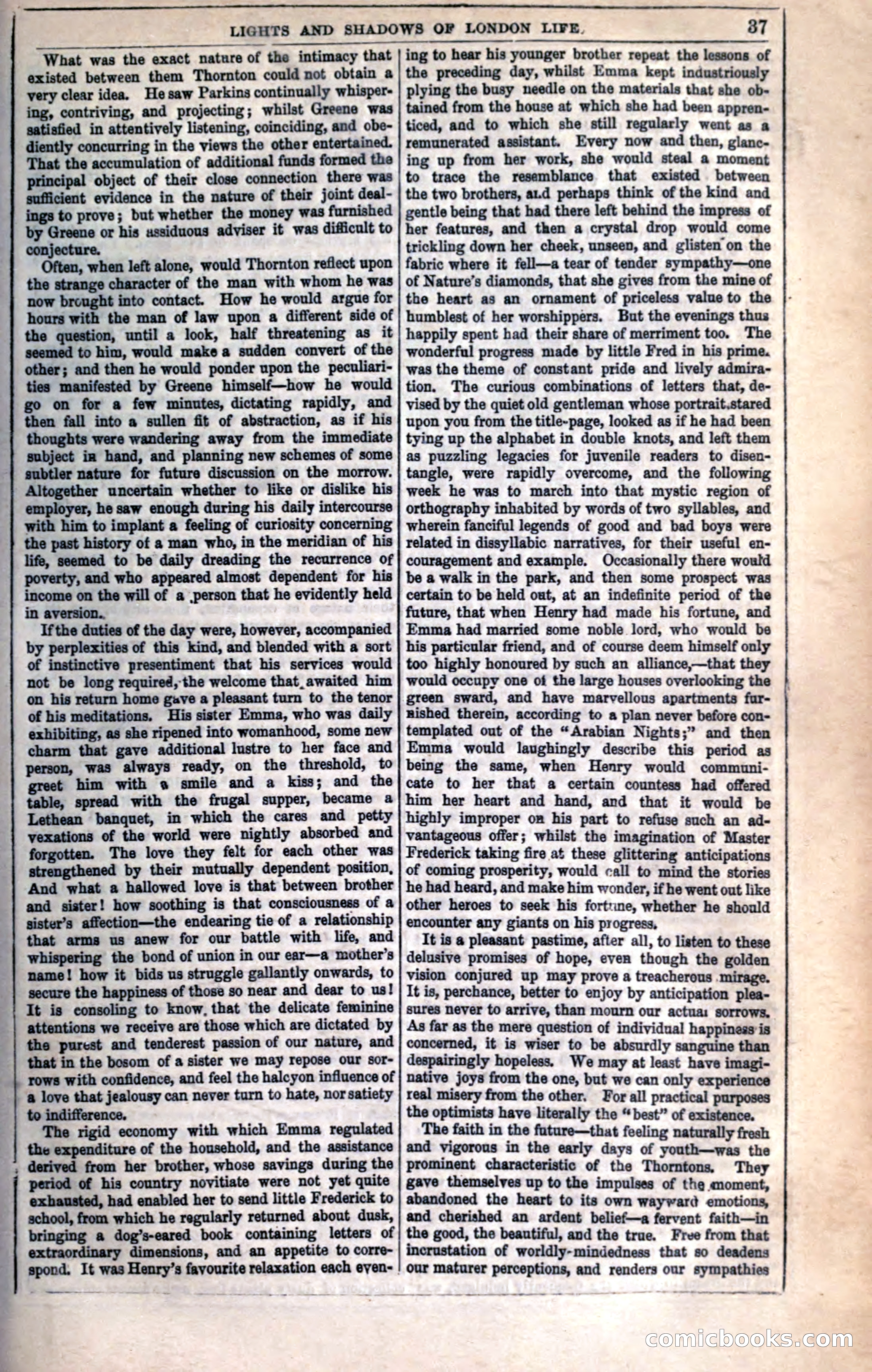
A restored page from Penny Dreadfuls, 1850. Page through the whole issue in the reader above.
📄 Transcribed text from this page (OCR, searchable)
Machine-transcribed from the original scan — historical spelling and the odd misread are preserved.
, —— =e LIGHTS AND SHADOWS OF LONDON LIFE. ihe oe cee S As een What was the exact nature of the intimacy that existed between them Thornton could not obtain a very clear idea. Hesaw Parkins continually whisper- ing, contriving, and projecting; whilst Greene was satisfied in attentively listening, coinciding, and obe- diently concurring in the views the other entertained. That the accumulation of additional funds formed the sufficient evidence in ings to prove; but whether the money was furnished by Greene or his ussiduous adviser it was difficult to conjecture. Often, when left alone, would Thornton reflect upon the strange character of the man with whom he was now into contact. How he would argue for hours with the man of law upon a different side of the question, until a look, half threatening as it to him, would make a sudden convert of the then he would ponder upon the peculiari- manifested by Greene himself—how he would on for a few minutes, dictating rapidly, and fall into a sullen fit of abstraction, as if his thoughts were wandering away from the immediate subject im hand, and planning new schemes of some subtler nature for future discussion on the morrow. Altogether uncertain whether to like or dislike his employer, he saw enough during his daily intercourse with him to implant a feeling of curiosity concerning the past history of a man who, in the meridian of his life, seemed to be daily dreading the recurrence of poverty, and who appeared almost dependent for his income on the will of a .person that he evidently held in a Ifthe duties of the day were, however, accompanied by perplexities of this kind, and blended with a sort of instinctive presentiment that his services would not be long required, the welcome that_awaited him on his return home gave a pleasant turn to the tenor of his meditations. His sister Emma, who was daily exhibiting, as she ripened into womanhood, some new that gave additional lustre to her face and was always ready, on the threshold, to him with a smile and a kiss; and the spread with the frugal supper, became a banquet, in which the cares and petty of the world were nightly absorbed and The love they felt for each other was by their mutually dependent position, what a hallowed love is that between brother sister! how soothing is that consciousness of a sister’s affection—the endearing tie of a relationship that arms us anew for our battle with life, and whispering the bond of union in our ear—a mother’s name! how it bids us struggle gallantly onwards, to secure the happiness of those so near and dear to us! It is consoling to know, that the delicate feminine attentions we receive are those which are dictated by the purest and tenderest passion of our nature, and that in the bosom of a sister we may repose our sor- Ful Ht i to indifference. The rigid economy with which Emma regulated the expenditure of the household, and the assistance derived from her brother, whose savings during the period of his country novitiate were not yet quite exhausted, had enabled her to send little Frederick to school, from which he regularly returned about dusk, bringing a dog’s-eared book containing letters of dimensions, and an appetite to corre- ——- extraordinary spond. It was Henry’s favourite relaxation each even- | 37 ing to hear his younger brother repeat the lessons of the preceding day, whilst Emma kept industriously plying the busy needle on the materials that she ob- tained from the house at which she had been appren- ticed, and to which she still regularly went as a remunerated assistant. Every now and then, glanc- ing up from her work, she would steal a moment to trace the resemblance that existed between the two brothers, aud perhaps think of the kind and gentle being that had there left behind the impress of her features, and then a crystal drop would come trickling down her cheek, unseen, and glisten on the fabric where it fell—a tear of tender sympathy—one of Nature’s diamonds, that she gives from the mine of the heart as an ornament of priceless value to the humblest of her worshippers. But the evenings thus happily spent had their share of merriment too. The wonderful progress made by little Fred in his prime. was the theme of constant pride and lively admira- tion. The curious combinations of letters that, de- vised by the quiet old gentleman whose portrait.stared upon you from the title-page, looked as if he had been tying up the alphabet in double knots, and left them as puzzling legacies for juvenile readers to disen- tangle, were rapidly overcome, and the following week he was to march into that mystic region of orthography inhabited by words of two syllables, and wherein fanciful legends of good and bad boys were related in dissyllabic narratives, for their useful en- couragement and example. Occasionally there would be a walk in the park, and then some prospect was certain to be held out, at an indefinite period of the future, that when Henry had made his fortune, and Emma had married some noble lord, who would be his particular friend, and of course deem himself only too highly honoured by such an alliance,—that they would occupy one of the large houses overlooking the green sward, and have marvellous apartments fur- nished therein, according to a plan never before con- templated out of the “Arabian Nights;” and then Emma would laughingly describe this period as being the same, when Henry would communi- cate to her that a certain countess had offered him her heart and hand, and that it would be highly improper om his part to refuse such an ad- vantageous offer; whilst the imagination of Master Frederick taking fire at these glittering anticipations of coming prosperity, would call to mind the stories he had heard, and make him wonder, if he went out like other heroes to seek his fortrine, whether he should encounter any giants on his progress, It is a pleasant pastime, after all, to listen to these delusive promises of hope, even though the golden vision conjured up may prove a treacherous mirage. It is, perchance, better to enjoy by anticipation plea- sures never to arrive, than mourn our actua: sorrows. As far as the mere question of individual happiness’is concerned, it is wiser to be absurdly sanguine than despairingly hopeless. We may at least have imagi- native joys from the one, but we can only experience real misery from the other. For all practical purposes the optimists have literally the “best” of existence. The faith in the fature—that feeling naturally fresh and vigorous in the early days of youth—was the prominent characteristic of the Thorntons, They gave themselves up to the impulses of the moment, abandoned the heart to its own wayward emotions, and cherished an ardent belief—a fervent faith—in the good, the beautiful, and the true. Free from that incrustation of worldly-mindedness that so deadens our maturer perceptions, and renders our sympathies _— _—- - ECORNICLO@ i —- Ss (EO) m