
Penny Dreadfuls, 1850 · page 48 of 394
The Mysteries of London; or, Lights and Shadows of London Life — page 48: what you’re looking at
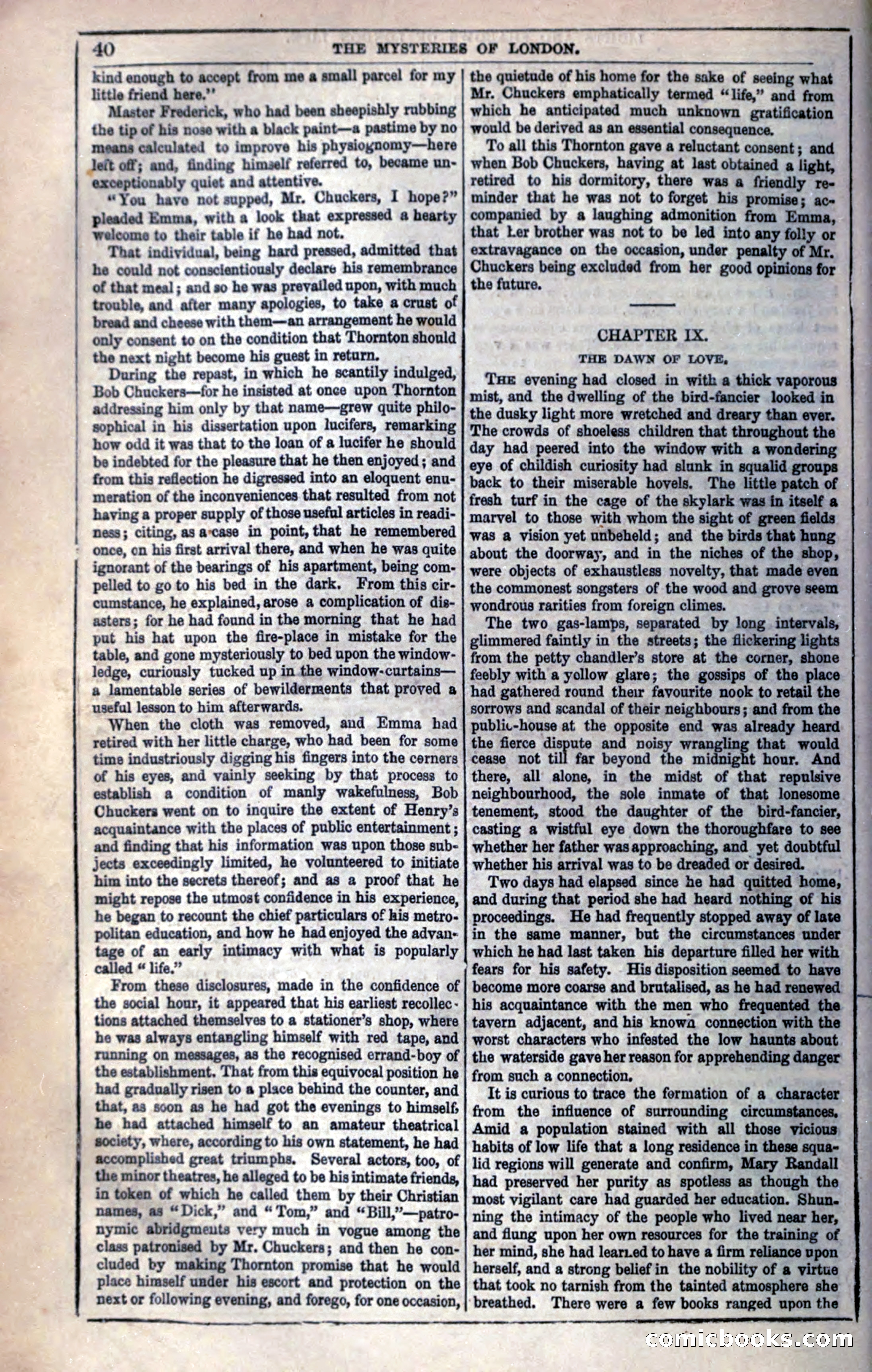
A restored page from Penny Dreadfuls, 1850. Page through the whole issue in the reader above.
📄 Transcribed text from this page (OCR, searchable)
Machine-transcribed from the original scan — historical spelling and the odd misread are preserved.
ee — 40. HE MYSTERIES OF LONDON. == ‘| kind enough to accept from me a small parcel for my little friend here,”’ Master Frederick, who had been sheepishly rubbing the tip of his nose with a black paint—a pastime by no means calculated to improve his physiognomy—here Jett off; and, finding himself referred to, became un- exceptionably quiet and ae “You have not supped, Mr. Chuckers, I hope?” pleaded Emma, with a look that expressed a hearty welcome to their table if he had not. That individual, being bard pressed, admitted that he could not conscientiously declare his remembrance of that meal; and so he was prevailed upon, with much trouble, and ‘after many apologies, to take a crust of bread and cheese with them—an arrangement he would only consent to on the condition that Thornton should the next night become his guest in return. During the repast, in which he scantily indulged, Bob Chuckers—for he insisted at once upon Thornton addressing him only by that name—grew quite philo- sophical in his dissertation upon lucifers, remarking how odd it was that to the loan of a lucifer he should be indebted for the pleasure that he then enjoyed; and from this reflection he digressed into an eloquent enu- meration of the inconveniences that resulted from not having a proper supply of those useful articles in readi- ness; citing, as avcase in point, that he remembered once, on his first arrival there, and when he was quite ignorant of the bearings of his apartment, being com- pelled to go to his bed in the dark. From this cir- cumstance, he explained, arose a complication of dis- asters; for he had found in the morning that he had put his hat upon the fire-place in mistake for the table, and gone mysteriously to bed upon the window- ledge, curiously tucked up in the window-curtains— a lamentable series of bewilderments that proved a useful lesson to him afterwards. When the cloth was removed, and Emma had retired with her little charge, who had been for some time industriously digging his fingers into the cerners of his eyes, and vainly seeking by that process to establish a condition of manly wakefulness, Bob Chuckers went on to inquire the extent of Henry’s acquaintance with the places of public entertainment ; and finding that his information was upon those sub- jects exceedingly limited, he volunteered to initiate him into the secrets thereof; and as a proof that he might repose the utmost confidence in his experience, he began to recount the chief particulars of his metro- politan education, and how he had enjoyed the advan- tage of an early intimacy with what is popularly called “ life.” From these disclosures, made in the confidence of the social hour, it appeared that his earliest recollec - tions attached themselves to a stationer’s shop, where he was always entangling himself with red tape, and running on messages, as the recognised errand-boy of the establishment. That from this equivocal position he had gradually risen to a place behind the counter, and that, as soon as he had got the evenings to himself; he had attached himself to an amateur theatrical society, where, according to his own statement, he had accomplished great triumphs. Several actors, too, of the minor theatres, he alleged to be his intimate friends, in token of which he called them by their Christian names, as “Dick,” and “Tom,” and “Bill,”—patro- nymic abridgmeuts very much in vogue among the class patronised by Mr. Chuckers; and then he con- cluded by making Thornton promise that he would place himself under his escort and protection on the next or following evening, and forego, for one occasion, ti ccnp ee THE MYSTERIES OF LONDON, the quietude of his home for the sake of what Mr. Chuckers emphatically termed “life,” and from which he anticipated much unknown gratification would be derived as an essential consequence, To all this Thornton gave a reluctant consent; and when Bob Chuckers, having at last obtained a light, retired to his dormitory, there was a friendly re- minder that he was not to forget his promise; ac- companied by a laughing admonition from cae that Ler brother was not to be led into any folly or extravagance on the occasion, under penalty of Mr. Chuckers being excluded from her good opinions for the future. CHAPTER IX, THE DAWN OF LOVE, THE evening had closed in with a thick vaporous mist, and the dwelling of the bird-fancier looked in the dusky light more wretched and dreary than ever. The crowds of shoeless children that throughout the day had peered into the window with a wondering eye of childish curiosity had slunk in squalid groups back to their miserable hoyels. The little patch of fresh turf in the cage of the skylark was in itself a marvel to those with whom the sight of green fields was a vision yet unbeheld; and the birds that hung about the doorway, and in the niches of the shop, were objects of exhaustless novelty, that made even the commonest songsters of the wood and grove seem wondrous rarities from foreign climes. The two gas-lamps, separated by long intervals, glimmered faintly in the streets; the flickering lights from the petty chandler’s store at the corner, shone feebly with a yollow glare; the gossips of the place had gathered round their favourite nook to retail the sorrows and scandal of their neighbours; and from the public-house at the opposite end was already heard the fierce dispute and noisy that wove cease not till far beyond the 1ehinke t hour. And there, all alone, in the midst of that repulsive neighbourhood, the sole inmate of that lonesome tenement, stood the daughter of the bird-fancier, casting a wistful eye down the thoroughfare to see whether her father was approaching, and yet doubtful whether his arrival was to be dreaded or desired. Two days had elapsed since he had quitted home, and during that period she had heard nothing of his proceedings. He had frequently stopped away of late in the same manner, but the circumstances under which he had last taken his departure filled her with fears for his safety. His disposition seemed to have become more coarse and brutalised, as he had renewed his acquaintance with the men who frequented the tavern adjacent, and his knowa connection with the worst characters who infested the low haunts about the waterside gave her reason for apprehending danger from such a connection, It is curious to trace the formation of a character from the influence of surrounding circumstances, Amid a population stained with all those vicious, habits of low life that a long residence in these squa- lid regions will generate and confirm, Mary Randall had preserved her purity as spotless as though the most vigilant care had guarded her education. Shun. ning the intimacy of the people who lived near her, and flung upon her own resources for the training of her mind, she had learzed to have a firm reliance upon herself, and a strong belief in the nobility of a virtue that took no tarnish from the tainted atmosphere she breathed. There were a few books ranged upon the Gomichoo <SsGOmM es