
Penny Dreadfuls, 1850 · page 54 of 394
The Mysteries of London; or, Lights and Shadows of London Life — page 54: what you’re looking at
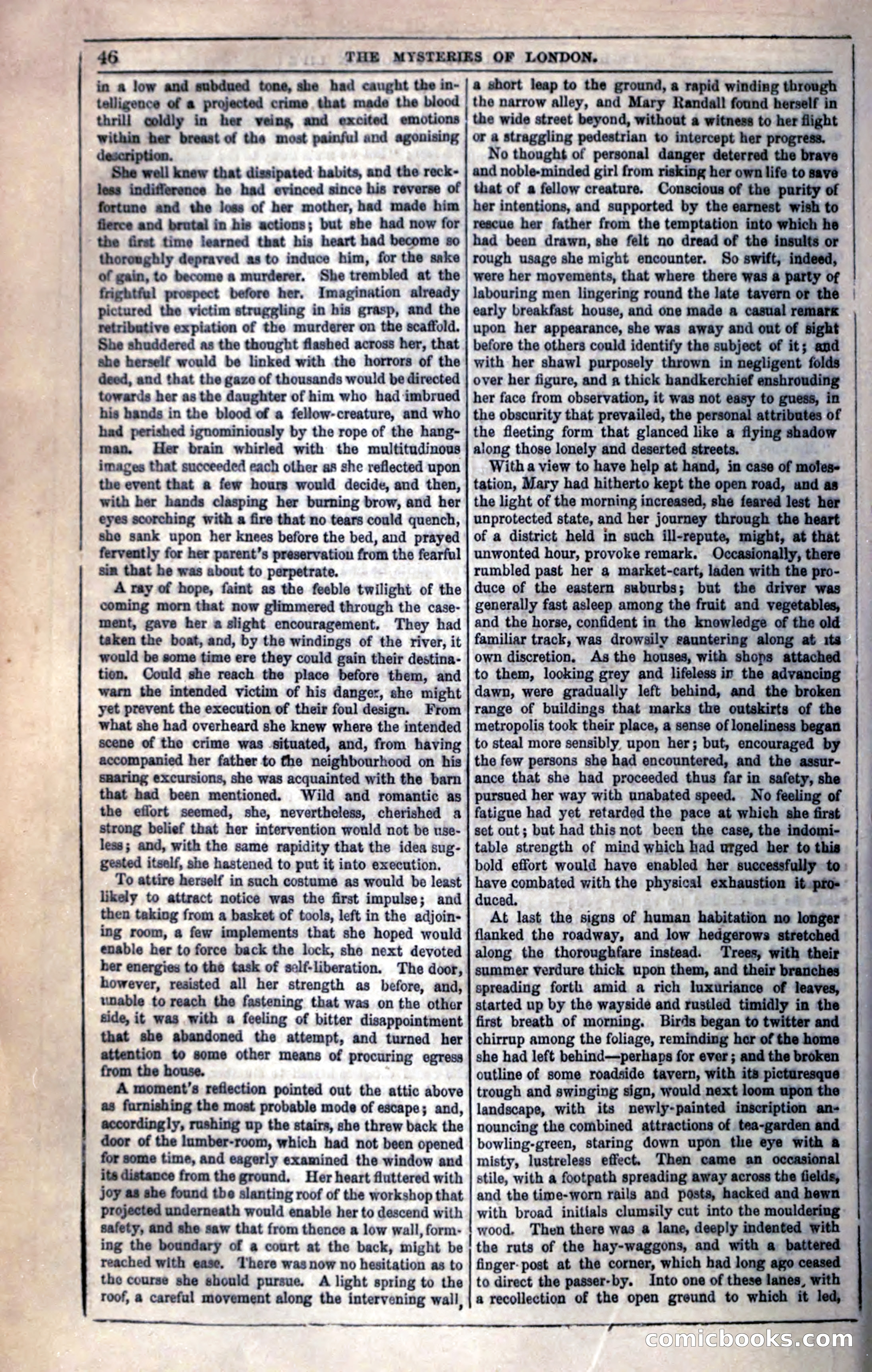
A restored page from Penny Dreadfuls, 1850. Page through the whole issue in the reader above.
📄 Transcribed text from this page (OCR, searchable)
Machine-transcribed from the original scan — historical spelling and the odd misread are preserved.
46 in a low and subdued tone, she had caught the in- telligence of a projected crime that made the blood thrill coldly in her veing, and excited emotions | the wide street beyond, without a witness to her flight within her breast of the most painful and agonising description. She well knew that dissipated habits, and the reck- less indifference he had evinced since his reverse of fortune and the joss of her mother, had made him flerce and brutal in his actions; but she had now for the first time learned that his heart had become so thoroughly depraved as to induce him, for the sake of gain, to become a murderer. She trembled at the frightful prospect before her. Imagination already pictured the victim struggling in his grasp, and the retributive expiation of the murderer on the scaffold. She shuddered as the thought flashed across her, that she herself would be linked with the horrors of the deed, and that the gaze of thousands would be directed towards her as the daughter of him who had -imbrued his hands in the blood of a fellow-creature, and who had perished ignominiously by the rope of the hang- man. Her brain whirled with the multitudinous images that succeeded each other as she reflected upon the event that a few hours would decide, and then, with her hands clasping her burning brow, and her eyes scorching with a fire that no tears could quench, she sank upon her knees before the bed, and prayed fervently for her parent’s preservation from the fearful sim that he was about to perpetrate. A ray of hope, faint as the feeble twilight of the coming morn that now glimmered through the case- ment, gave her a slight encouragement. They had taken the boat, and, by the windings of the river, it would be some time ere they could gain their destina- tion. Could she reach the place before them, and warn the intended victim of his danger, she might yet prevent the execution of their foul design. From what she had overheard she knew where the intended scene of the crime was -situated, and, from having accompanied her father to fhe neighbourhood on his smaring excursions, she was acquainted with the barn that had been mentioned. Wild and romantic as the effort seemed, she, nevertheless, cherished a strong belief that her intervention would not be use- less; and, with the same rapidity that the idea sug- gested itself, she hastened to put it into execution. To attire herself in such costume as would be least likely to attract notice was the first impulse; and then taking from a basket of tools, left in the adjoin- ing room, a few implements that she hoped would enable her to force back the lock, she next devoted her energies to the task of self-liberation. The door, however, resisted all her strength as before, and, wiable to reach the fastening that was on the other side, it was with a feeling of bitter disappointment that she abandoned the attempt, and turned her attention to some other means of procuring egress from the house. A moment’s reflection pointed out the attic above as furnishing the most probable mode of escape; and, accordingly, rushing up the stairs, she threw back the door of the lumber-room, which had not been opened for some time, and eagerly examined the window and its distance from the ground. Her heart fluttered with joy as she found tbe slanting roof of the workshop that projected underneath would enable her to descend with safety, and she saw that from thence a low wall, form- ing the boundary of a court at the back, might be reached with ease. There was now no hesitation as to the course she should pursue. A light spring to the | to direct the passer-by. Into one of these lanes, with roof, a careful movement along the intervening wall, | a recollection of the open greund to which it led, — TT ee THE MYSTERIES OF LONDON, | | a short leap to the ground, a rapid winding through the narrow alley, and Mary Randall found herself in or a straggling pedestrian to intercept her progress. No thought of personal danger deterred the brave and noble-minded girl from risking her own life to savé that of a fellow creature. Conscious of the purity of her intentions, and supported by the earnest wish to rescue her father from the temptation into which he had been drawn, she felt no dread of the insults or rough usage she might encounter. So swift, indeed, were her movements, that where there was a patty of labouring men lingering round the late tavern or the early breakfast house, and one made a casual remark upon her appearance, she was away and out of sight before the others could identify the subject of it; and with her shawl purposely thrown in negligent folds over her figure, and a thick handkerchief enshrouding her face from observation, it was not easy to guess, in the obscurity that prevailed, the personal attributes of the fleeting form that glanced like a flying shadow along those lonely and deserted streets. With a view to have help at hand, in case of moles tation, Mary had hitherto kept the open road, and as the light of the morning increased, she feared lest her unprotected state, and her journey through the heart of a district held in such ill-repute, might, at that unwonted hour, provoke remark. Occasionally, there rumbled past her a market-cart, laden with the pro- duce of the eastern suburbs; but the driver was generally fast asleep among the fruit and vegetables, and the horse, confident in the knowledge of the old familiar track, was drowsily sauntering along at its own discretion. As the houses, with shops attached to them, looking grey and lifeless in the advancing dawn, were gradually left behind, and the broken range of buildings that marks the outskirts of the metropolis took their place, a sense of loneliness began to steal more sensibly, upon her; but, encouraged by the few persons she had encountered, and the assur- ance that she had proceeded thus far in safety, she pursued her way with unabated speed. No feeling of fatigue had yet retarded the pace at which she first set out; but had this not been the case, the indomi- table strength of mind which had urged her to this bold effort would have enabled her successfully to: have combated with the physical exhaustion itspto- duced. At last the signs of human habitation no longer flanked the roadway, and low hedgerows stretched along the thoroughfare instead. Trees; with their summer verdure thick upon them, and their branches spreading forth amid a rich luxuriance of leaves, started up by the wayside and rustled timidly in the first breath of morning. Birds began to twitter and chirrup among the foliage, reminding her of the home she had left behind—perhaps for ever ; and the broken outline of some roadside tavern, with its picturesque trough and swinging sign, would next loom upon the landscape, with its newly-painted inscription an- nouncing the combined attractions of tea-garden and bowling-green, staring down upon the eye with a misty, lustreless effect, Then came an stile, with a footpath spreading away across the fields, and the time-worn rails and posts, hacked and hewn with broad initials clumsily cut into the mouldering wood. Then there was a lane, deeply indented with the ruts of the hay-waggons, and with a battered finger-post at the corner, which had long ago ceased eee NC SE eee - * a a rn ne i em | com (C