
Penny Dreadfuls, 1850 · page 75 of 394
The Mysteries of London; or, Lights and Shadows of London Life — page 75: what you’re looking at
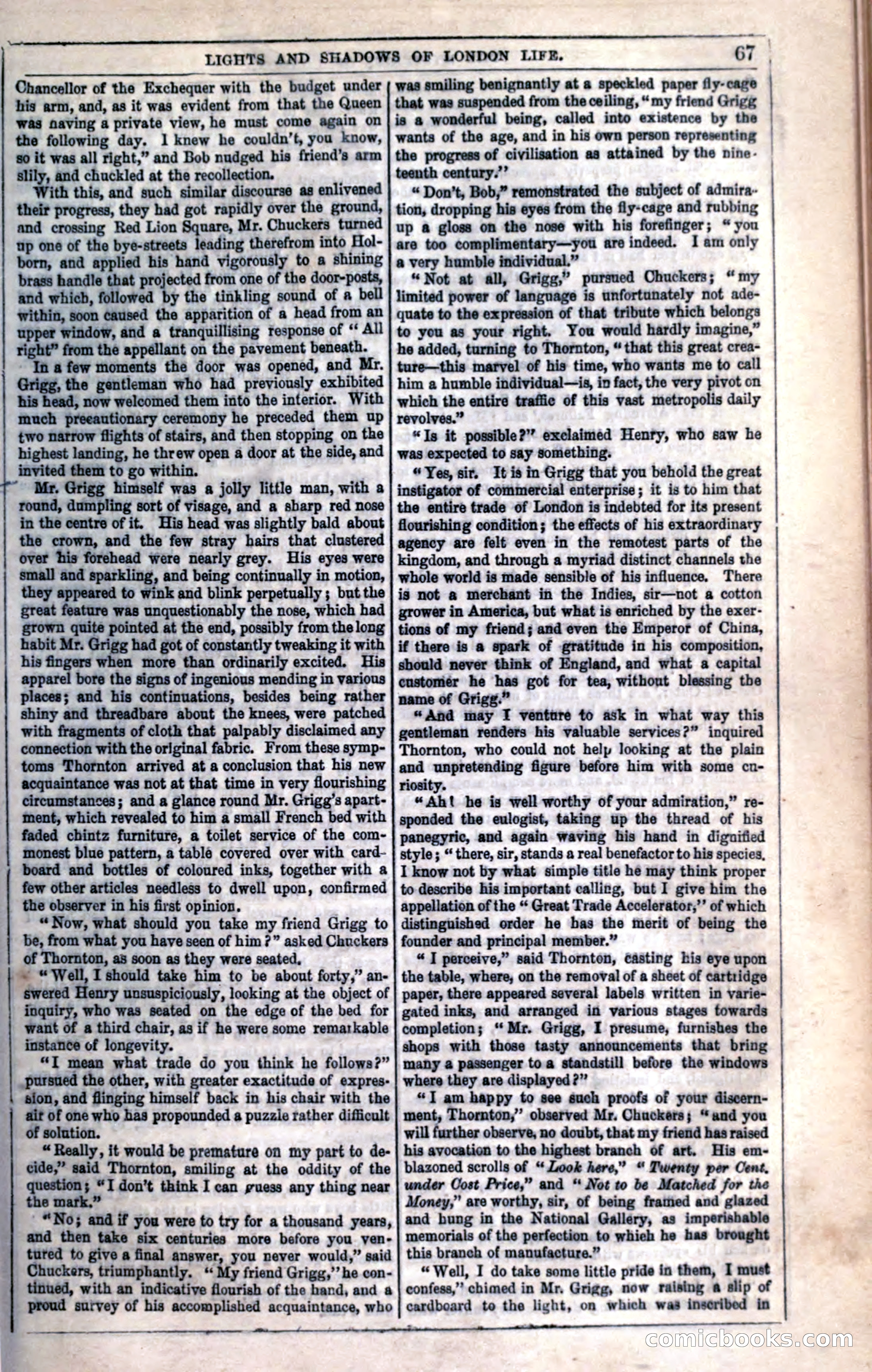
A restored page from Penny Dreadfuls, 1850. Page through the whole issue in the reader above.
📄 Transcribed text from this page (OCR, searchable)
Machine-transcribed from the original scan — historical spelling and the odd misread are preserved.
LIGHTS AND SHADOWS OF LONDON LIFE. Chancellor of the Exchequer with the budget under his arm, and, as it was evident from that the Queen was naving a private view, he must come again on the following day. 1 knew he couldn’t, you know, so it was all right,” and Bob nudged his friend’s arm slily, and chuckled at the recollection. With this, and such similar discourse as enlivened their progress, they had got rapidly over the ground, uare, Mr. Chuckers turned and crossing Red Lion up one of the sreamues ene therefrom into Hol- born, and applied his hand vigorously to a shining brass handle that projected from one of the door-posts, and which, followed by the tinkling sound of a bell Within, soon caused the apparition of a head from an upper window, and a tranquillising response of “ All right” from the appéllant on the pavement beneath. highest landing, he threw open a door at the side, and in the centre of it. His head was slightly bald about the crown, and the few stray hairs that clustered over this forehead were nearly grey. His eyes were smal] and sparkling, and being continually in motion, they appeared to wink and blink perpetually; but the great feature was unquestionably the nose, which had grown quite pointed at the end, possibly from the long habit Mr. Grigg had got of constantly tweaking it with his when more than ordinarily excited. His apparel bore the signs of ingenious mending in various places; and his continuations, besides being rather shiny and threadbare about the knees, were patched with fragments of cloth that palpably disclaimed any connection with the original fabric. From these symp- toms Thornton arrived at a conclusion that his new acquaintance was not at that time in very flourishing circumstances; and a glance round Mr. Grigg’s apart- ment, which revealed to him a small French bed with faded chintz furniture, a toilet service of the com- monest blue pattern, a tablé covered over with card- board and bottles of coloured inks, together with a few other articles needless to dwell upon, confirmed the observer in his first opinion. “ Now, what should you take my friend Grigg to be, from what you have seen of him?” asked Chuckers of Thornton, a8 soon as they were seated, ~ “Well, I should take him to be about forty,” an- swered Henry unsuspiciously, looking at the object of inquiry, who was seated on the edge of the bed for want of a third chair, as if he were some remarkable instance of longevity. “T mean what trade do you think he follows?” pursued the other, with greater exactitude of expres- sion, and flinging himself back in his chair with the ait of one who has propounded a puzzle rather difficult of solution. “ Really, it would be premature on my part to de- cide,” said Thornton, smiling at the oddity of the question; “I don’t think I can guess any thing near the mark,” » “No; and if you were to try for a thousand years, and then take six centuries more before you ven- tured to give a final answer, you never would,” said Chuckers, triumphantly. “My friend Grigg,’’ he con- tinued, with an indicative flourish of the hand, and a proud survey of his accomplished acquaintance, who eee ee a ee Th a few moments the door was opened, and Mr. Grigg, the gentleman who had previously exhibited his head, now welcomed them into the interior. With much preeautionary ceremony he preceded them up two natrow flights of stairs, and then stopping on the invited them to go within. * Mr. Grigg himself was a jolly little man, with a round, dumpling sort of visage, and a sbarp red nose —— rs 67 was smiling benignantly at a speckled paper fly-cage that was suspended from the ceiling, “my friend Grigg is a wonderful being, called into existence by the wants of the age, and in his own person representing the progress of civilisation as attained by the nine- teenth century.’’ “ Don’t, Bob;” remonstrated the subject of admira.- tion, dropping his eyes from the fly-cage and rubbing up a gloss on the nose with his forefinger; “you are too complimentary—you are indeed. 1 am only a very humble individual.” “Not at all, Grigg,” pursued Chuckers; “my limited power of language is unfortunately not ade- quate to the expression of that tribute which belongs to you as your right. You would hardly imagine,” he added, turning to Thornton, “that this great crea- ture—this marvel of his time, who wants me to call him a humble individual—is, in fact, the very pivot on which the entire traffie of this vast metropolis daily revolves.” “Is it possible?” exclaimed Henry, who saw he was expected to say something. “ Yes, sir, It is in Grigg that you behold the great instigator of commercial enterprise; it is to him that the entire trade of London is indebted for its present flourishing condition; the effects of his extraordinary agency are felf even in the remotest parts of the kingdom, and through a myriad distinct channels the whole world is made sensible of his influence. There is not a merchant in the Indies, sir—not a cotton grower in America, but what is enriched by the exer- tions of my friend; and even the Emperor of China, if there is a spark of gratitude in his composition, should never think of England, and what a capital customer he has got for tea, withont blessing the name of Grigg.” “And may I venture to ask in what way this gentleman refiders his valuable services?” inquired Thornton, who could not help looking at the plain and unpretending figure before him with some cn- riosity. “Aht he is well worthy of your admiration,” re- sponded the eulogist, taking up the thread of his panegyric, and again waving his hand in dignified style; “ there, sir, stands a real benefactor to his species, I know not by what simple title he may think proper to describe his important calling, but I give him the appellation of the “ Great Trade Accelerator,’’ of which distinguished order he bas the merit of being the founder and principal member.” “ I perceive,” said Thornton, casting his eye upon the table, where, on the removal of a sheet of cartridge paper, there appeared several labels written in varie- gated inks, and arranged in various stages towards completion; “Mr. Grigg, I presume, furnishes the shops with those tasty announcements that bring many a passenger to a standstill before the windows where they are displayed?” “]T am happy to see such proofs of your diseern- ment, Thornton,” observed Mr. Chuckers; “and you will further observe, no doubt, that my friend has raised his avocation to the highest branch of art. His em- blazoned scrolls of “ Look here,” “ Twenty per Cent, under Oost Price,” and “* Not to be Matched for the Money,” are worthy, sir, of being fratied and glazed and hung in the National Gallery, as imperishable memorials of the perfection to whieh he has brought this branch of manufacture.” “Well, I do take some little pride in them, I must confess,’ chimed in Mr. Grigg, now raising a slip of cardboard to the light, on which was inscribed in —_ = —— eee ome - - -—- are rs , . ElOOOKS (CO) im (E@) im