
Penny Dreadfuls, 1850 · page 80 of 394
The Mysteries of London; or, Lights and Shadows of London Life — page 80: what you’re looking at
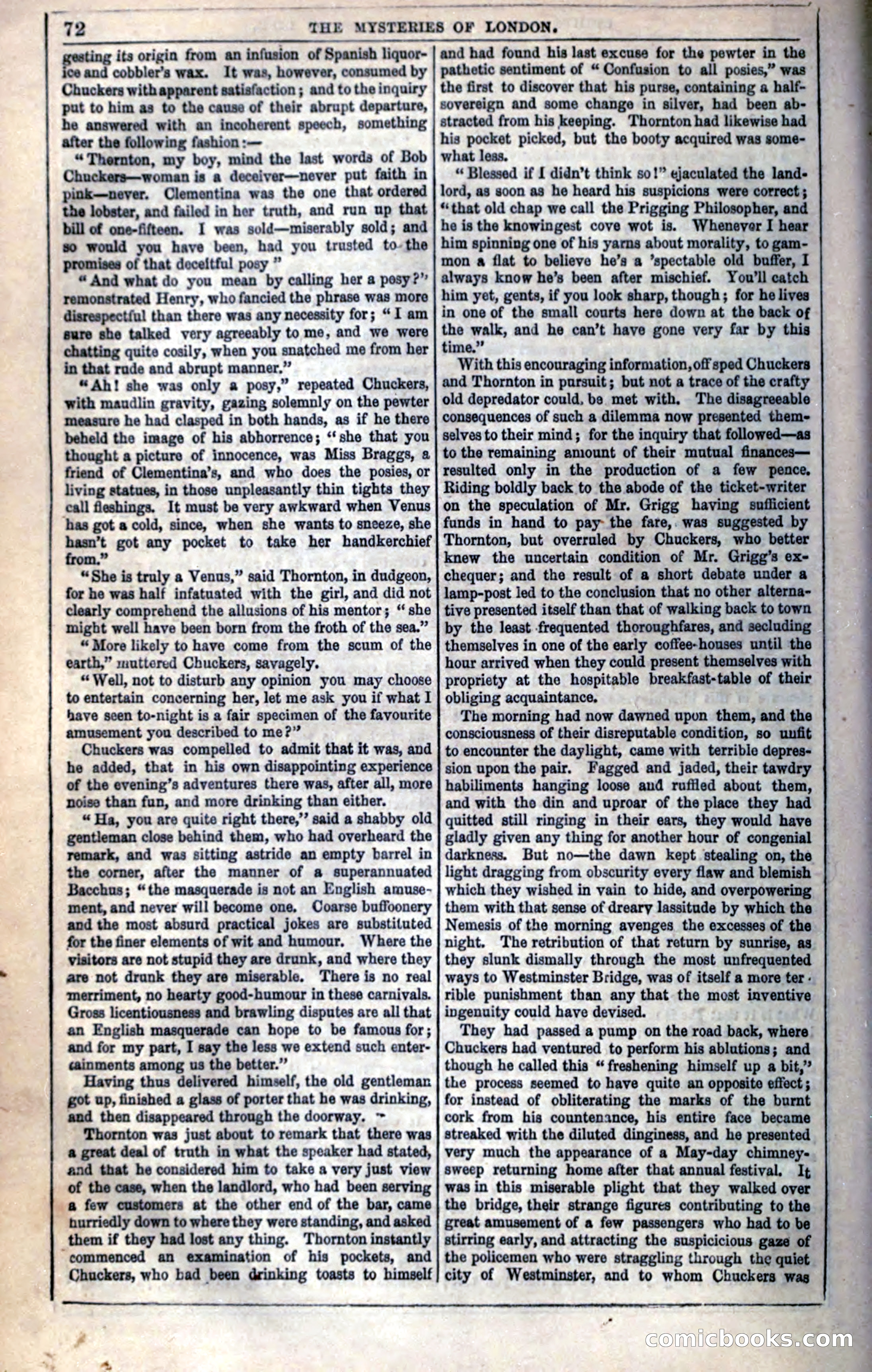
A restored page from Penny Dreadfuls, 1850. Page through the whole issue in the reader above.
📄 Transcribed text from this page (OCR, searchable)
Machine-transcribed from the original scan — historical spelling and the odd misread are preserved.
72 ting its origin from an infusion of Spanish liquor- and cobbler’s wax. It was, however, consumed by Chuckers with apparent satisfaction ; and to the inquiry put to him as to the cause of their abrupt departure, he answered with an incoherent speech, something after the following fashion :-— “Thernton, my boy, mind the last words of Bob Chuckers—woman is a deceiver—never put faith in pink—never. Clementina was the one that ordered the lobster, and failed in her truth, and run up that bill of one-fifteen. I was sold—miserably sold; and so would you have been, had you trusted to-the promises of that deceitful posy ” “And what do you mean by calling her a posy?” remonstrated Henry, who fancied the phrase was more disrespectful than there was any necessity for; “I am gure she talked very agreeably to me, and we were chatting quite cosily, when you snatched me from her in that rade and abrupt manner,” “Ah! she was only a posy,” repeated Chuckers, with maudlin gravity, gazing solemnly on the pewter measure he had clasped in both hands, as if he there beheld the image of his abhorrence; ‘‘she that you thought a picture of innocence, was Miss Braggs, a friend of Clementina’s, and who does the posies, or living statues, in those unpleasantly thin tights they call fleshings, It must be very awkward when Venus has got a cold, since, when she wants to sneeze, she hasn’t got any pocket to take her handkerchief from.” “She is truly a Venus,” said Thornton, in dudgeon, for he was half infatuated with the girl, and did not clearly comprehend the allusions of his mentor; “ she might well have been born from the froth of the sea.” “ More likely to have come from the scum of the earth,” muttered Chuckers, savagely. “Well, not to disturb any opinion you may choose to entertain concerning her, let me ask you if what I have seen to-night is a fair specimen of the favourite amusement you described to me?” Chuckers was compelled to admit that it was, and he added, that in his own disappointing experience of the evening’s adventures there was, after all, more noise than fun, and more drinking than either. “Ha, you are quite right there,”’ said a shabby old gentleman close behind them, who had overheard the remark, and was sitting astride an empty barrel in the corner, after the manner of a superannuated Bacchus; “the masquerade is not an English amuse- ment, and never will become one, Coarse buffoonery and the most absurd practical jokes are substituted for the finer elements of wit and humour. Where the visitors are not stupid they are drunk, and where they are not drank they are miserable. There is no real merriment, no hearty good-humour in these carnivals. Gross licentiousness and brawling disputes are all that an English masquerade can hope to be famous for; and for my part, I say the less we extend such enter- cainments among us the better.” Having thus delivered himself, the old gentleman got up, finished a glass of porter that he was drinking, and then disappeared through the doorway. = Thornton was just about to remark that there was a great deal of truth in what the speaker had stated, and that he considered him to take a very just view of the case, when the landlord, who had been serving a few customers at the other end of the bar, came hurriedly down to where they were standing, and asked them if they had lost any thing. Thornton instantly ‘commenced an examination of his pockets, and Chuckers, who bad been drinking toasts to himself me eee eee THE MYSTERIES OF LONDON, and had found his last excuse for the pewter in the me a A ny A, A Se ee eee ee pathetic sentiment of “Confusion to all posies,” was the first to discover that his purse, containing a half- sovereign and some change in silver, had been ab- stracted from his keeping. Thornton had likewise had his pocket picked, but the booty acquired was some- what less. “ Blessed if { didn’t think so!” ejaculated the land- lord, as soon as he heard his suspicions were correct; “that old chap we call the Prigging Philosopher, and he is the knowingest cove wot is. Whenever I hear him spinning one of his yarns about morality, to gam- mon a flat to believe he’s a ’spectable old buffer, I always know he’s been after mischief. You'll catch him yet, gents, if you look sharp, though; for he lives in one of the small courts here down at the back of the walk, and he can’t have gone very far by this time.” With this encouraging information, off sped Chuckers and Thornton in pursuit; but not a trace of the crafty old depredator could, be met with. The disagreeable consequences of such a dilemma now presented them- selves to their mind; for the inquiry that followed—as to the remaining amount of their mutual finances— resulted only in the production of a few pence, Riding boldly back to the abode of the ticket-writer on the speculation of Mr. Grigg having sufficient funds in hand to pay the fare,. was suggested by Thornton, but overruled by Chuckers, who better knew the uncertain condition of Mr. Grigg’s ex- chequer; and the result of a short debate under a lamp-post led to the conclusion that no other alterna- tive presented itself than that of walking back to town by the least frequented thoroughfares, and secluding themselves in one of the early coffee-houses until the hour arrived when they could present themselves with propriety at the hospitable breakfast-table of their obliging acquaintance, The morning had now dawned upon them, and the consciousness of their disreputable condition, so unfit to encounter the daylight, came with terrible depres- sion upon the pair. Fagged and jaded, their tawdry habiliments hanging loose and ruffled about them, and with the din and uproar of the place they had quitted still ringing in their ears, they would have gladly given any thing for another hour of congenial darkness. But no—the dawn kept stealing on, the | light dragging from obscurity every flaw and blemish which they wished in vain to hide, and overpowering them with that sense of dreary lassitude by which the Nemesis of the morning avenges the excesses of the night. The retribution of that return by sunrise, as they slunk dismally through the most unfrequented ways to Westminster Bridge, was of itself a more ter - rible punishment than any that the most inventive ingenuity could have devised. They had passed a pump on the road back, where Chuckers had ventured to perform his ablutions; and though he called this “freshening himself up a bit,” the process seemed to have quite an opposite effect ; for instead of obliterating the marks of the burnt cork from his countenance, his entire face became streaked with the diluted dinginess, and he presented very much the appearance of a May-day chimney-. sweep returning home after that annual festival, It was in this miserable plight that they walked over the bridge, their strange figures contributing to the - great amusement of a few passengers who had tobe | stirring early, and attracting the suspicicious gaze of | the policemen who were straggling through the quiet city of Westminster, and to whom Chuckers wag CORMICLACe) SS (Efe)