
Penny Dreadfuls, 1850 · page 88 of 394
The Mysteries of London; or, Lights and Shadows of London Life — page 88: what you’re looking at
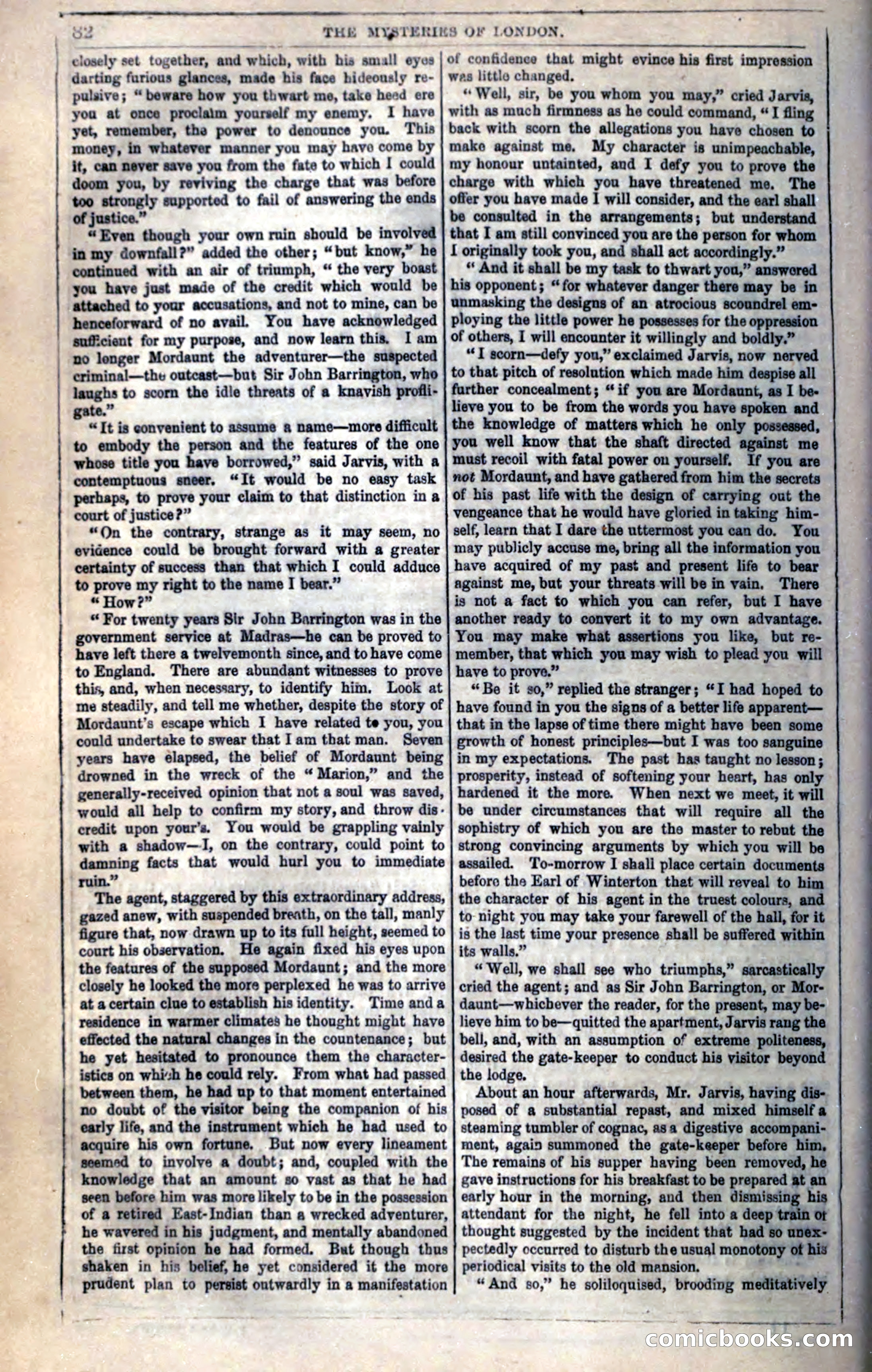
A restored page from Penny Dreadfuls, 1850. Page through the whole issue in the reader above.
📄 Transcribed text from this page (OCR, searchable)
Machine-transcribed from the original scan — historical spelling and the odd misread are preserved.
= 7 ————E a a ee - <“_gey aID* "==" _ "hl Ae ruin. — o2 closely set together, and which, with his small eyes darting furious glances, made his face hideously re- pulsive; “beware how you thwart me, take heed ere you at once proclaim yourself my enemy, I have yet, remember, the power to denounce you. This money, in whatever manner you may have come by it, can never save you from the fate to which | could doom you, by reviving the charge that was before too strongly supported to fail of answering the ends of ” “Even though your own ruin should be involved in my downfall?” added the other; “but know,” he continued with an air of triumph, “ the very boast you have just made of the credit which would be attached to your accusations, and not to mine, can be henceforward of no avail. You have acknowledged sufficient for my purpose, and now learn this. I am no longer Mordaunt the adventurer—the suspected criminal—the outcast—but Sir John Barrington, who laughs to scorn the idle threats of a knavish profli- “It is eonvenient to assame a name—more difficult to embody the person and the features of the one whose title you have borrowed,” said Jarvis, with a contemptuous sneer, “It would be no easy task perhaps, to prove your claim to that distinction in a court of justice?” “On the contrary, strange as it may seem, no evidence could be brought forward with a greater certainty of success than that which I could adduce to prove my right to the name I bear.” “ How?” “For twenty years Sir John Barrington was in the ent service at Madras—he can be proved to have left there a twelvemonth since, and to have come to England. There are abundant witnesses to prove this, and, when necessary, to identify him. Look at me steadily, and tell me whether, despite the story of Mordaunt’s escape which I have related te you, you could undertake to swear that Iam that man. Seven years have elapsed, the belief of Mordaunt being drowned in the wreck of the “ Marion,” and the generally-received opinion that not a soul was saved, would all help to confirm my story, and throw dis- credit upon your’s. You would be grappling vainly with a shadow—I, on the contrary, could point to damning facts that would hurl you to immediate tn, 27 The agent, staggered by this extraordinary address, gazed anew, with suspended breath, on the tall, manly figure that, now drawn up to its full height, seemed to court his observation. He again fixed his eyes upon the features of the supposed Mordaunt; and the more closely he looked the more perplexed he was to arrive at a certain clue to establish his identity. Time anda residence in warmer climates he thought might have effected the natural changes in the countenance; but he yet hesitated to pronounce them the character- istics on which he could rely. From what had passed between them, he had up to that moment entertained no doubt of the visitor being the companion of his early life, and the instrument which he had used to acquire his own fortune. But now every lineament seemed to involve a doubt; and, coupled with the knowledge that an amount so vast as that he had seen before him was more likely to be in the possession of a retired East-Indian than a wrecked adventurer, he wavered in his judgment, and mentally abandoned the first opinion he had formed. But though thus shaken in his belief, he yet considered it the more prudent plan to persist outwardly in a manifestation of confidence that might evince was little changed. ploying the little power he of others, I will encounter it willingly and boldly.” * — THE MYSTERICS OF LONDON, his first impression “ Well, sir, be you whom you may,” cried Jarvia, with as much firmness as he could command, “I fling back with scorn the allegations you have chosen to make against me. My character is unimpeachable, my honour untainted, and I defy you to prove the charge with which you have threatened me, The offer you have made I will consider, and the earl shall be consulted in the arrangements; but understand that I am still convinced you are the f originally took you, and shall act accordingly. person for whom ~ * And it shall be my task to thwart you,” answored his opponent; “for whatever danger there may be in the designs of an atrocious scoundrel em- possesses for the oppression “I scorn—defy you,” exclaimed Jarvis, now nerved to that pitch of resolution which made him despise all further concealment; “if you are Mordaunt, as I be- lieve you to be from the words you have spoken and the knowledge of matters which he only possessed, you well know that the shaft directed must recoil with fatal power on yourself, not Mordaunt, and have gathered from him the secrets of his past life with the design of carrying out the vengeance that he would have gloried in taking him- self, learn that I dare the uttermost you can do. You may publicly accuse me, bring all the information you have acquired of my past and present life to bear against me, but your threats will be in vain. There is not a fact to which you can refer, but I have another ready to convert it to my own advantage. You may make what assertions you like, but re- member, that which you may wish to plead you will have to prove.” me you are “Be it so,” replied the stranger; “I had hoped to have found in you the signs of a better life apparent— that in the lapse of time there might have been some growth of honest principles—but I was too sanguine in my expectations. The past has taught no lesson; prosperity, instead of softening your heart, has only hardened it the more. When next we meet, it will be under circumstances that will require all the sophistry of which you are the master to rebut the strong convincing arguments by which you will be assailed. ‘To-morrow I shall place certain documents before the Earl of Winterton thet will reveal to the character of his agent in the truest colours, to night you may take your farewell of the hall, for it is the last time your presence shall be suffered within its walls.” “Well, we shall see who triumphs,” s¢ cried the agent; and as Sir John Barrington, or Mor- daunt—whicbever the reader, for the present, may be- lieve him to be—quitted the apartment, Jarvis rang the bell, and, with an assumption of extreme politeness, desired the gate-keeper to conduct his visitor beyond the lodge, ; About an hour afterwards, Mr. Jarvis, having dis- | posed of a substantial repast, and mixed himself a steaming tumbler of cognac, asa digestive accompani- ment, again summoned the gate-keeper before hin The remains of his supper having been removed, he gave instructions for his breakfast to be prepared at an early hour in the morning, and then svar attendant for the night, he fell into a deep train or thought suggested by the incident that had so unéx- pectedly occurred to disturb the usual monotony of his periodical visits to the old mansion. bo Orie ee “And so,” he soliloquised, brooding meditatively — (ae) Eomichoo cS -