
Penny Dreadfuls, 1853 · page 109 of 151
The Seamstress; or, The White Slave of England — page 109: what you’re looking at
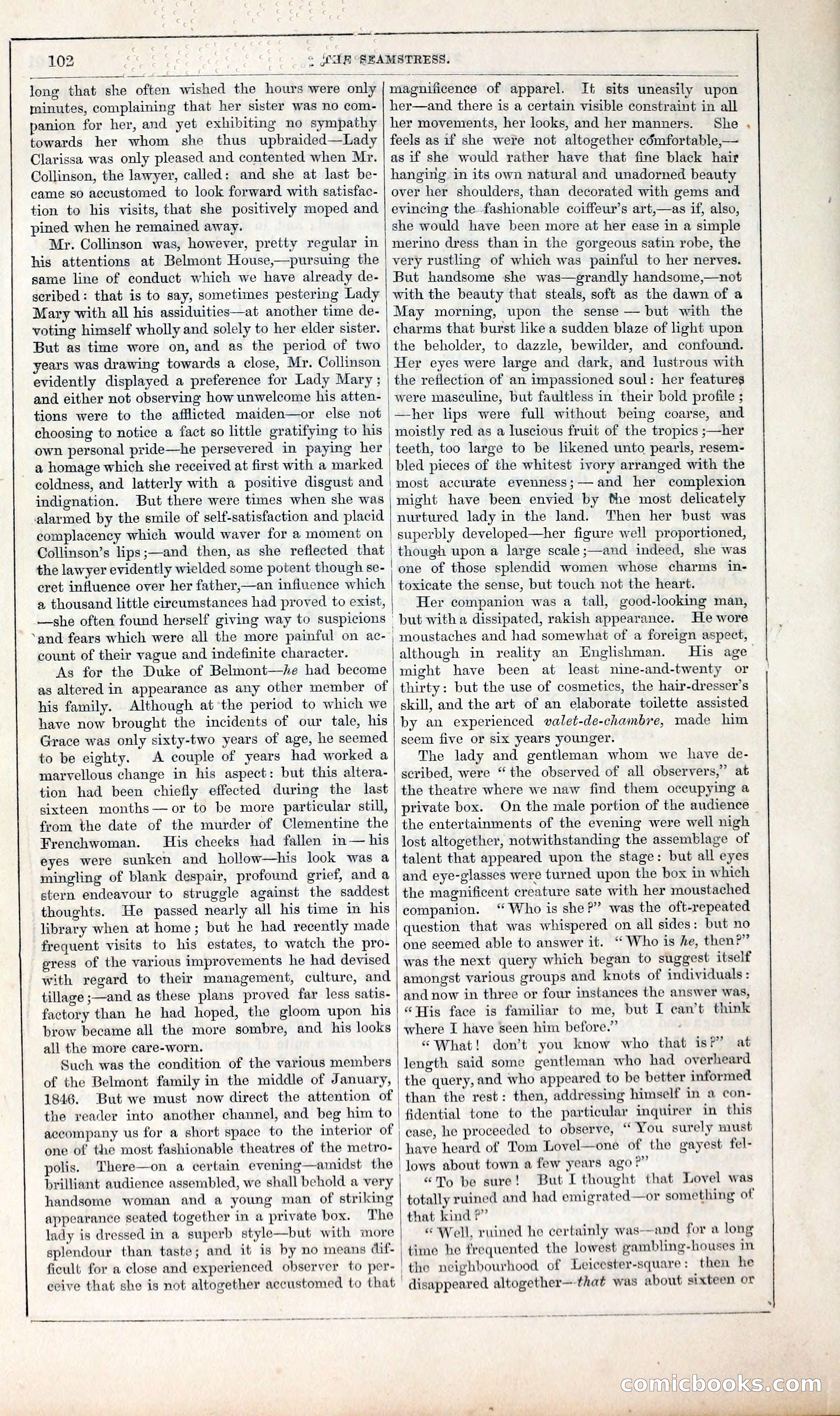
A restored page from Penny Dreadfuls, 1853. Page through the whole issue in the reader above.
📄 Transcribed text from this page (OCR, searchable)
Machine-transcribed from the original scan — historical spelling and the odd misread are preserved.
a 102 - TUB OSEAMSTRESS. long that she often wished the hours were only minutes, complaining that her sister was no com- panion for her, and yet exhibiting no sympathy towards her whom she thus upbraided—Lady Clarissa was only pleased and contented when Mr. Collinson, the lawyer, called: and she at last be- came so accustomed to look forward with satisfac- tion to his visits, that she positively moped and pined when he remained away. Mr. Collinson was, however, pretty regular in his attentions at Belmont House,—pursuing the same line of conduct which we have already de- scribed: that is to say, sometimes pestering Lady Mary with all his assiduities—at another time de- voting himself wholly and solely to her elder sister. But as time wore on, and as the period of two years was drawing towards a close, Mr. Collinson evidently displayed a preference for Lady Mary ; and either not observing how unwelcome his atten- tions were to the afflicted maiden—or else not choosing to notice a fact so little gratifying to his own personal pride—he persevered in paying her a homage which she received at first with a marked coldness, and latterly with a positive disgust and indignation. But there were times when she was alarmed by the smile of self-satisfaction and placid complacency which would waver for a moment on Collinson’s lips;—and then, as she reflected that the lawyer evidently wielded some potent though se- eret influence over her father,—an influence which a thousand little cireumstances had proved to exist, —she often found herself giving way to suspicions ‘and fears which were all the more painful on ac- count of their vague and indefinite character. As for the Duke of Belmont—/e had become as altered in appearance as any other member of his family. Although at the period to which we have now brought the incidents of our tale, his Grace was only sixty-two years of age, he seemed to be eighty. A couple of years had worked a marvellous change in his aspect: but this altera- tion had been chiefly effected during the last sixteen months—or to be more particular still, from the date of the murder of Clementine the Frenchwoman. His cheeks had fallen in— his eyes were sunken and hollow—his look was a mingling of blank despair, profound grief, and a stern endeavour to struggle against the saddest thoughts. He passed nearly all his time im his library when at home; but he had recently made frequent visits to his estates, to watch the pro- eress of the various improvements he had devised with regard to their management, culture, and tillage ;—and as these plans proved far less satis- factory than he had hoped, the gloom upon his brow became all the more sombre, and his looks all the more care-worn. Such was the condition of the various members of the Belmont family in the middle of January, 1846. But we must now direct the attention of the reader into another channel, and beg him to accompany us for a short space to the interior of one of the most fashionable theatres of the metro- polis. There—on a certain evening—amidst the brilliant audience assembled, we shall behold a very handsome woman and a young man of striking appearance seated together in a private box. The lady is dressed in a superb style—but with more splendour than taste; and it is by no means dif- ficult for a close and experienced observer to per- ecive that she is not altogether accustomed to that ee ee — —— magnificence of apparel. It sits uneasily upon her—and there is a certain visible constraint in all her movements, her looks, and her manners. She feels as if she were not altogether cdmfortable,— as if she would rather have that fine black hair hanging in its own natural and unadorned beauty over her shoulders, than decorated with gems and evincing the fashionable coiffeur’s art,—as if, also, she would have been more at her ease in a simple merino dress than in the gorgeous satin robe, the very rustling of which was painful to her nerves. But handsome she was—grandly handsome,—not with the beauty that steals, soft as the dawn of a May morning, upon the sense — but with the charms that burst like a sudden blaze of light upon the beholder, to dazzle, bewilder, and confound. Her eyes were large and dark, and lustrous with the reflection of an impassioned soul: her features -were masculine, but faultless in their bold profile ; —her lips were full without being coarse, and moistly red as a luscious fruit of the tropics ;—her teeth, too large to be hkened unto pearls, resem- bled pieces of the whitest ivory arranged with the most accurate evenness;— and her complexion might have been envied by the most delicately nurtured lady in the land. Then her bust was superbly developed—her figure well proportioned, though upon a large scale ;—and indeed, she was one of those splendid women whose charms in- toxicate the sense, but touch not the heart. Her companion was a tall, good-looking man, but with a dissipated, rakish appearance. He wore /moustaches and had somewhat of a foreign aspect, although in reality an Englishman. His age | might have been at least nime-and-twenty or | thirty: but the use of cosmetics, the hair-dresser’s skill, and the art of an elaborate toilette assisted by an experienced valet-de-chambre, made him seem five or six years younger. The lady and gentleman whom we have de- scribed, were “the observed of all observers,” at the theatre where we naw find them occupying a private box. On the male portion of the audience the entertainments of the evening were well nigh lost altogether, notwithstanding the assemblage of talent that appeared upon the stage: but all eyes and eye-glasses were turned upon the box in which the magnificent creature sate with her moustached companion. “Who is she?” was the oft-repeated question that was whispered on all sides: but no one seemed able to answer it. “ Who is he, then?” was the next query which began to suggest itself amongst various groups and knots of individuals: and now in three or four instances the answer was, “Fis face is familiar to me, but I can’t think where I have seen him before.” ; “What! don’t you know who that is?” at length said some gentleman who had overheard the query, and who appeared to be better informed than the rest: then, addressing himself in a con- ‘fidential tone to the particular inquirer in this case, he proceeded to observe, “ You surely must have heard of Tom Lovel—one of the gayest fel- ‘lows about town a few years ago?” «To be sure! But I thought that Lovel was totally ruined and had emigrated—or something of that kind ?” « Well, ruined he certainly was—and for a long ‘time he frequented the lowest gambling-houses im the neighbourhood of Leicester-square : then he disappeared altogether—that was about sixteen or * ens a Seana eee > os orem +0 - ee ee Eomichooks:ecom > Jes A