
Penny Dreadfuls, 1853 · page 117 of 151
The Seamstress; or, The White Slave of England — page 117: what you’re looking at
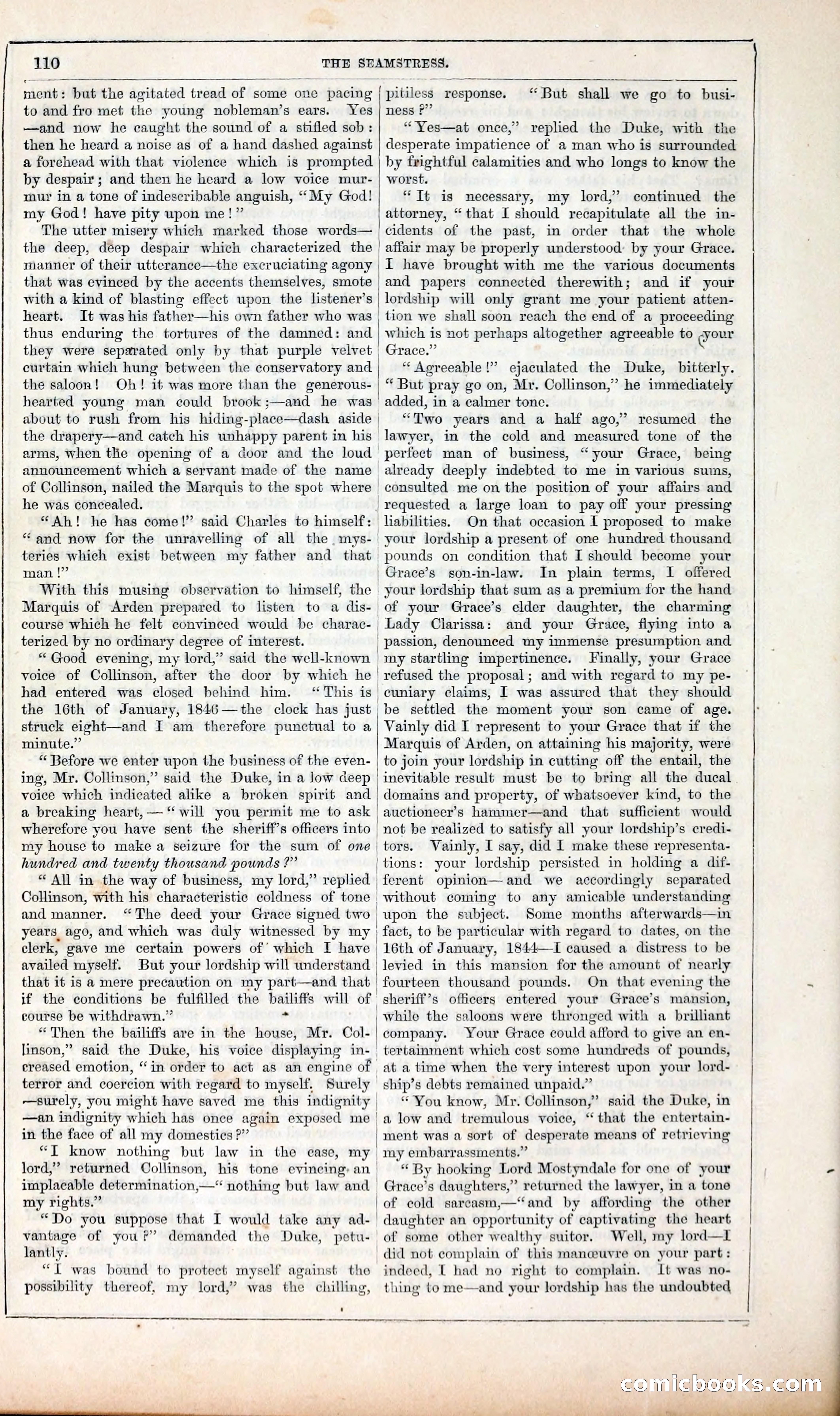
A restored page from Penny Dreadfuls, 1853. Page through the whole issue in the reader above.
📄 Transcribed text from this page (OCR, searchable)
Machine-transcribed from the original scan — historical spelling and the odd misread are preserved.
110 ment: but the agitated tread of some one pacing to and fro met the young nobleman’s ears. Yes —and now he caught the sound of a stifled sob: then he heard a noise as of a hand dashed against a forehead with that violence which is prompted by despair; and then he heard a low voice mur- mur in a tone of indescribable anguish, “My God! my God! have pity upon me!” The utter misery which marked those words— the deep, deep despair which characterized the manner of their utterance—the excruciating agony that was evinced by the accents themselves, smote with a kind of blasting effect upon the listener’s heart. thus enduring the tortures of the damned: and they were separated only by that purple velvet curtain which hung between the conservatory and the saloon! Oh! it was more than the generous- hearted young man could brook ;—and he was! about to rush from his hiding-place—dash aside | the drapery—and catch his unhappy parent in his It was his father—his own father who was | arms, when tlie opening of a door and the loud announcement which a servant made of the name of Collinson, nailed the Marquis to the spot where he was concealed. “Ah! he has come!” said Charles to himself: | THE SEAMSTRESS. pitiless response. “But shall we go to busi- ness ?”’ “Yes—at once,’ replied the Duke, with the desperate impatience of a man who is surrounded by frightful calamities and who longs to know the worst. “It is necessary, my lord,’ continued the attorney, “that I should recapitulate all the in- cidents of the past, in order that the whole affair may be properly understood by your Grace. I have brought with me the various documents and papers connected therewith; and if your lordship will only grant me your patient atten- tion we shall soon reach the end of a proceeding which is not perhaps altogether agreeable to (your Grace.” ““ Agreeable!” ejaculated the Duke, bitterly. “ But pray go on, Mr. Collinson,” he immediately added, in a calmer tone. “Two years and a half ago,’ resumed the lawyer, in the cold and measured tone of the perfect man of business, “your Grace, being already deeply indebted to me in various sums, consulted me on the position of your affairs and ‘requested a large loan to pay off your pressing habilities. On that occasion I proposed to make “and now for the unravelling of all the mys- your lordship a present of one hundred thousand teries which exist between my father and that pounds on condition that I should become your man !”’ | Grace’s son-in-law. In plain terms, I offered With this musing observation to himself, the your lordship that sum as a premium for the hand Marquis of Arden prepared to listen to a dis- | of your Grace’s elder daughter, the charming course which he felt convinced would be charac- | Lady Clarissa: terized by no ordinary degree of interest. “Good evening, my lord,” said the well-known voice of Collinson, after the door by which he had entered was closed behind him. | “This is” the 16th of January, 1846—the clock has just | struck eight—and I am therefore punctual to a minute.” “‘Before we enter upon the business of the even- ing, Mr. Collinson,” said the Duke, in a low deep voice which indicated alike a broken spirit and a breaking heart, — “will you permit me to ask wherefore you have sent the sheriff’s officers into my house to make a seizure for the sum of one hundred and twenty thousand pounds ?” “ All in the way of business, my lord,” replied Collinson, with his characteristic coldness of tone | ‘upon the subject. and manner. “The deed your Grace signed two years ago, and which was duly witnessed by my clerk, gave me certain powers of’ which I have availed myself. But your lordship will understand that it is a mere precaution on my part—and that | if the conditions be fulfilled the bailiffs will of course be withdrawn.” ~ “Then the bailiffs are in the house, Mr. Col- and your Grace, flying into a passion, denounced my immense presumption and my startling impertinence. Finally, your Grace refused the proposal; and with regard to my pe- cuniary claims, I was assured that they should be settled the moment your son came of age. Vainly did I represent to your Grace that if the Marquis of Arden, on attaining his majority, were to join your lordship in cutting off the entail, the inevitable result must be to bring all the ducal domains and property, of whatsoever kind, to the auctioneer’s hammer—and that sufficient would not be realized to satisfy all your lordship’s credi- tors. Vainly, I say, did 1 make these representa- tions: your lordship persisted in holding a dif- ferent opinion—and we accordingly separated without coming to any amicable understanding Some months afterwards—in ‘fact, to be particular with regard to dates, on the 16th of January, 1844—I caused a distress to be levied in this mansion for the amount of nearly linson,” said the Duke, his voice displaying in-— ereased emotion, “in order to act as an engine of terror and coercion with regard to myself. Surely —surely, you might have saved me this indignity —an. indignity which has once again exposed me in the face of all my domestics ?” “T know nothing but law in the ease, my lord,” returned Collinson, his tone evineingy an | implacable determination,—* nothing but law and my rights.” “Do you suppose that I would take any ad- vantage of you?” demanded the Duke, petu- lantly. “TL was bound to protect myself against the possibility thereof, my lord,’ was the chilling, — rs fourteen thousand pounds. On that evening the sheriff’s officers entered your Grace’s mansion, while the saloons were thronged with a_ brilliant company. Your Grace could afford to give an en- tertainment which cost some hundreds of pounds, at a time when the very interest upon your lord- ship’s debts remained unpaid.” “You know, Mr. Collinson,” said the Duke, in a low and tremulous voice, “ that the entertain- ment was a sort of desperate means of retrieving my embarrassments.” “ By hooking Lord Mostyndale for one of your _Grace’s daughters,” returned the lawyer, in a tone of cold sarcasm,—‘“‘and by affording the other daughter an opportunity of captivating the heart of some other wealthy suitor. Well, my lord—t did not complain of this manwuyre on your part : ee ee ee ee ee indeed, t had no right to complain. Lt was no- thing tome—and your lordship has the undoubted