
Penny Dreadfuls, 1853 · page 121 of 151
The Seamstress; or, The White Slave of England — page 121: what you’re looking at
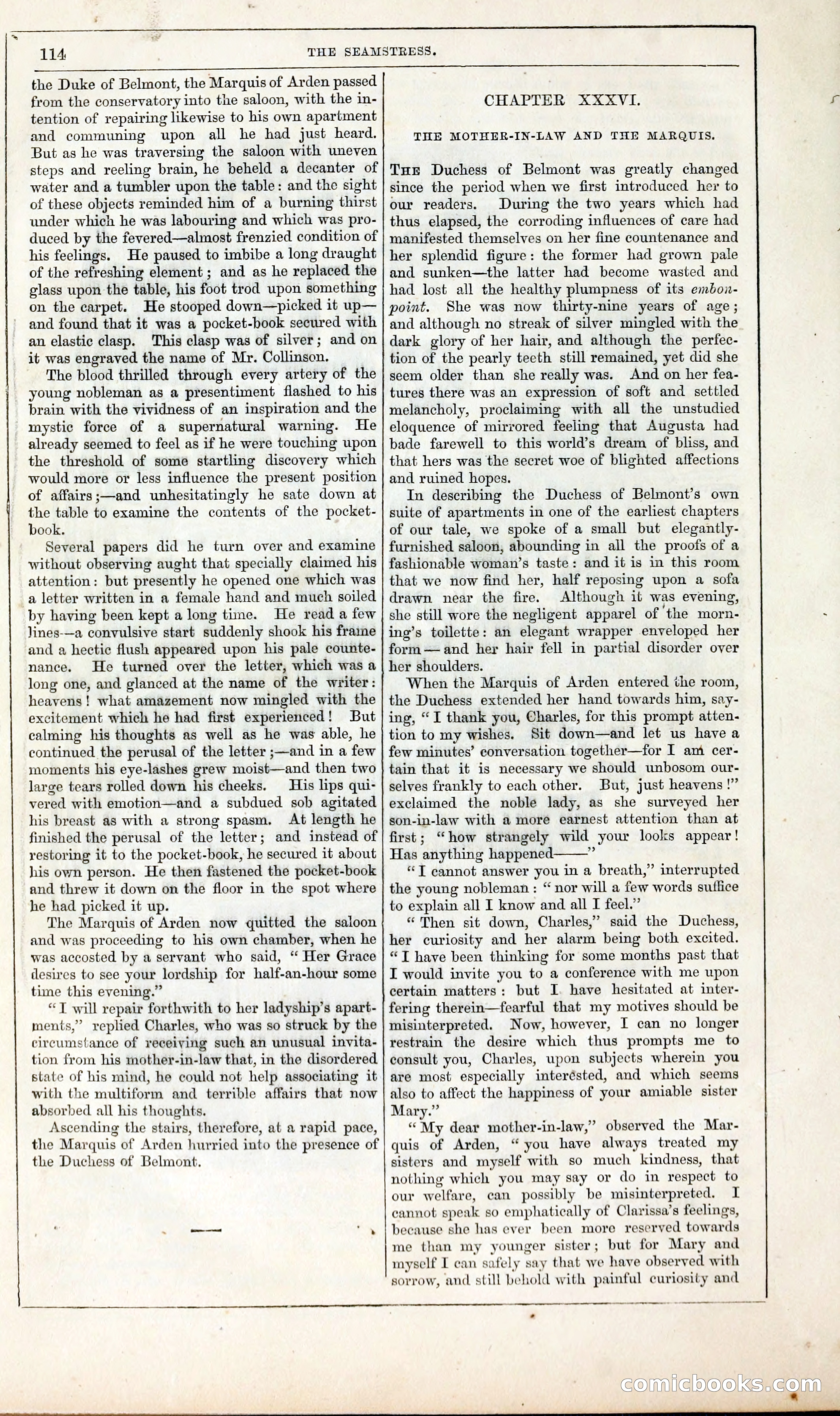
A restored page from Penny Dreadfuls, 1853. Page through the whole issue in the reader above.
📄 Transcribed text from this page (OCR, searchable)
Machine-transcribed from the original scan — historical spelling and the odd misread are preserved.
114 THE SEAMSTRESS. nn Lae aaa NS LS aa ea a era a see Se TG eat ra eel the Duke of Belmont, the Marquis of Arden passed from the conservatory into the saloon, with the in- tention of repairing likewise to his own apartment and communing upon all he had just heard. But as he was traversing the saloon with uneven steps and reeling brain, he beheld a decanter of water and a tumbler upon the table: and the sight of these objects reminded him of a burning thirst under which he was labouring and which was pro- duced by the fevered—almost frenzied condition of his feelings. He paused to imbibe a long draught of the refreshing element ; and as he replaced the glass upon the table, his foot trod upon something on the carpet. He stooped down—picked it up— and found that it was a pocket-book secured with an elastic clasp. This clasp was of silver; and on it was engraved the name of Mr. Collinson. The blood thrilled through every artery of the young nobleman as a presentiment flashed to his brain with the vividness of an inspiration and the mystic force of a supernatural warning. He already seemed to feel as if he were touching upon the threshold of some startling discovery which would more or less influence the present position of affairs ;—and unhesitatingly he sate down at the table to examine the contents of the pocket- book. Several papers did he turn over and examine without observing aught that specially claimed his attention: but presently he opened one which was a letter written in a female hand and much soiled by having been kept a long time. He read a few lines-——a convulsive start suddenly shook his frame and a hectic flush appeared upon his pale counte- nance. He turned over the letter, which was a long one, and glanced at the name of the writer: heavens! what amazement now mingled with the excitement which he had first experienced! But calming his thoughts as well as he was able, he continued the perusal of the letter ;—and in a few moments his eye-lashes grew moist—and then two large tears rolled down his cheeks. His lips qui- vered with emotion—and a subdued sob agitated his breast as with a strong spasm. At length he finished the perusal of the letter; and instead of restoring it to the pocket-book, he secured it about his own person. He then fastened the pocket-book and threw it down on the floor in the spot where he had picked it up. The Marquis of Arden now quitted the saloon and was proceeding to his own chamber, when he was accosted by a servant who said, “ Her Grace desires to see your lordship for half-an-hour some time this evening.” “JT will repair forthwith to her ladyship’s apart- ments,” replied Charles, who was so struck by the circumstance of receiving such an unusual invita- tion from his mother-in-law that, in the disordered state of his mind, he could not help associating it with the multiform and terrible affairs that now absorbed all his thoughts. Ascending the stairs, therefore, at a rapid pace, the Marquis of Arden hurried into the presence of the Duchess of Belmont, TT CHAPTER XXXVI. THE MOTHER-IN-LAW AND THE MARQUIS. Tur Duchess of Belmont was greatly changed since the period when we first introduced her to our readers. During the two years which had thus elapsed, the corroding influences of care had manifested themselves on her fine countenance and her splendid figure: the former had grown pale and sunken—the latter had become wasted and had lost all the healthy plumpness of its embon- point. She was now thirty-nine years of age; and although no streak of silver mingled with the dark glory of her hair, and although the perfec- tion of the pearly teeth still remained, yet did she seem older than she really was. And on her fea- tures there was an expression of soft and settled melancholy, proclaiming with all the unstudied eloquence of mirrored feeling that Augusta had bade farewell to this world’s dream of bliss, and that hers was the secret woe of blighted affections and ruined hopes. In describing the Duchess of Belmont’s own suite of apartments in one of the earliest chapters of our tale, we spoke of a small but elegantly- furnished saloon, abounding in all the proofs of a fashionable woman’s taste: and it is in this room that we now find her, half reposing upon a sofa drawn near the fire. Although it was evening, she still wore the negligent apparel of ‘the morn- ing’s toilette: an elegant wrapper enveloped her form — and her hair fell in partial disorder over her shoulders. When the Marquis of Arden entered the room, the Duchess extended her hand towards hin, say- ing, “ I thank you, Charles, for this prompt atten- tion to my wishes. Sit down—and let us havea few minutes’ conversation together—for I am cer- tain that it is necessary we should unbosom our- selves frankly to each other. But, just heavens !” exclaimed the noble lady, as she surveyed her son-in-law with a more earnest attention than at first; “how strangely wild your looks appear! Has anything happened. a “T cannot answer you in a breath,” interrupted the young nobleman : “ nor will a few words sutflice to explain all I know and all I feel.” “Then sit down, Charles,” said the Duchess, her curiosity and her alarm being both excited. “T have been thinking for some months past that I would invite you to a conference with me upon certain matters: but I. have hesitated at inter- fering therein—fearful that my motives should be misinterpreted. Now, however, I can no longer restrain the desire which thus prompts me to consult you, Charles, upon subjects where you are most especially interésted, and which seems also to affect the happiness of your amiable sister Mary.” “My dear mother-in-law,” observed the Mar- quis of Arden, “ you have always treated my sisters and myself with so much kindness, that nothing which you may say or do in respect to our welfare, ean possibly be misinterpreted. I cannot speak so emphatically of Clarissa’s feelings, because she has ever been more reserved towards me than my younger sister; but for Mary and myself I can safely say that we have observed with sorrow, and still behold with painful curiosity and —— ee eae *