
Penny Dreadfuls, 1853 · page 132 of 151
The Seamstress; or, The White Slave of England — page 132: what you’re looking at
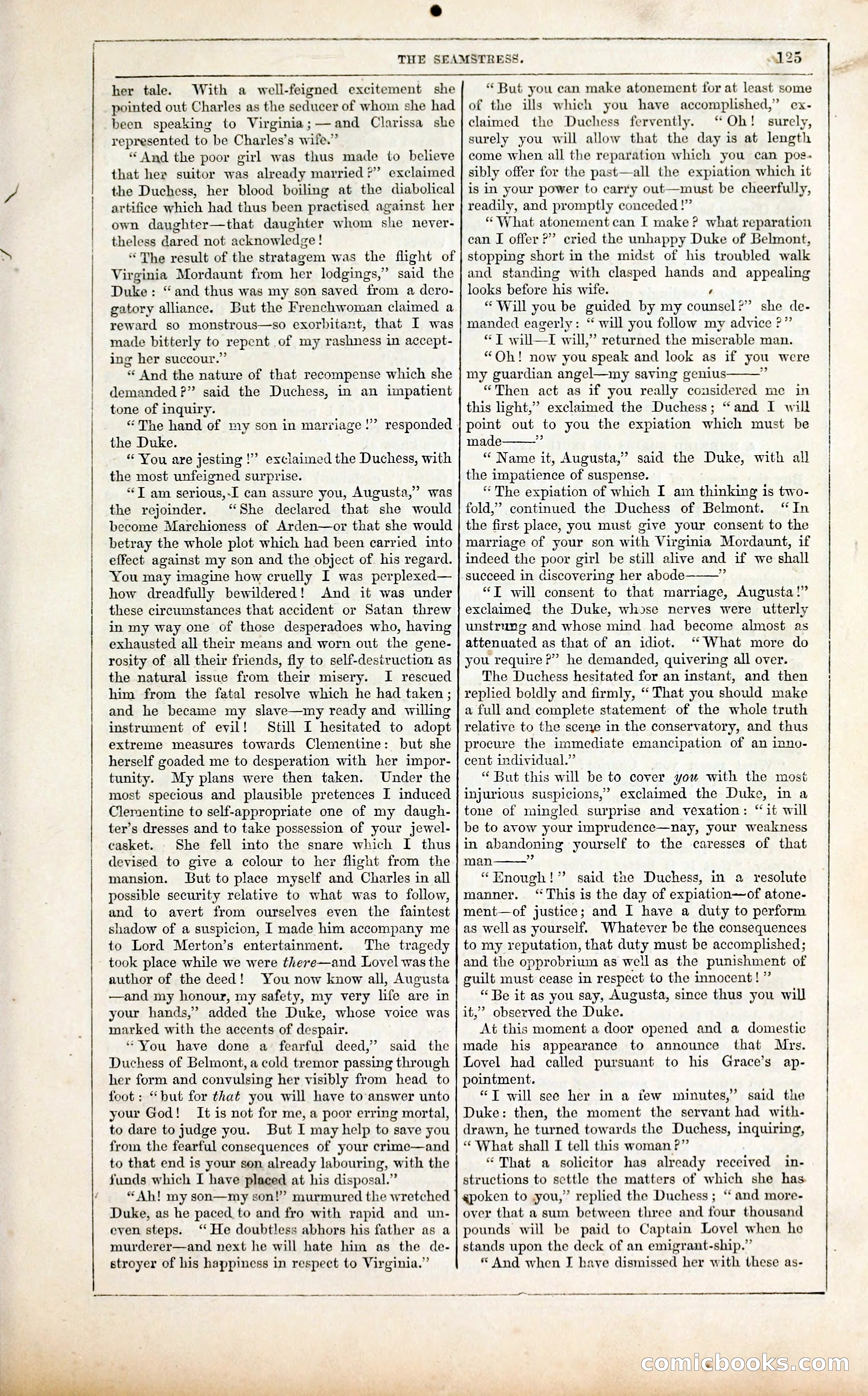
A restored page from Penny Dreadfuls, 1853. Page through the whole issue in the reader above.
📄 Transcribed text from this page (OCR, searchable)
Machine-transcribed from the original scan — historical spelling and the odd misread are preserved.
THE SEAMSTRESS. me ee et er eee en ne “125 ene ee her tale. With a well-feigned excitement she pointed out Charles as the seducer of whom she had been speaking to Virginia;—and Clarissa she represented to be Charles’s wife.” “And the poor girl was thus made to believe that her suitor was already married?” exclaimed the Duchess, her blood boiling at the diabolical artifice which had thus been practised against her own daughter—that daughter whom she never- theless dared not acknowledge! “The result of the stratagem was the flight of Virginia Mordaunt from her lodgings,” said the Duke: “and thus was my son saved from a dcro- gatory alliance. But the Frenchwoman claimed a reward so monstrous—so exorbitant, that I was made bitterly to repent of my rashness in accept- ing her succour.’ “< And the nature of that recompense which she demanded ?” said the Duchess, in an impatient tone of inquiry. “The hand of my son in marriage! the Duke. “You are jesting !”’ exclaimed the Duchess, with the most unfeigned surprise. “T am serious,-I can assure you, Augusta,” was the rejoinder. “She declared that she would become Marchioness of Arden—or that she would betray the whole plot which had been carried into effect against my son and the object of his regard. You may imagine how cruelly I was perplexed— how dreadfully bewildered! And it was under these circumstances that accident or Satan threw in my way one of those desperadoes who, having exhausted all their means and worn out the gene- rosity of all their friends, fly to self-destruction as the natural issue from their misery. I rescued him from the fatal resolve which he had taken ; and he became my slave—my ready and willing instrument of evil! Still I hesitated to adopt extreme measures towards Clementine: but she herself goaded me to desperation with her impor- tunity. My plans were then taken. Under the most specious and plausible pretences I induced Clementine to self-appropriate one of my daugh- ter’s dresses and to take possession of your jewel- casket. She fell into the snare which I thus devised to give a colour to her flight from the mansion. But to place myself and Charles in all possible security relative to what was to follow, and to avert from ourselyes even the faintest shadow of a suspicion, I made him accompany me to Lord Merton’s entertainment. The tragedy took place while we were there—and Lovel was the author of the deed! You now know all, Augusta —and my honour, my safety, my very life are in your hands,’ added the Duke, whose voice was marked with the accents of despair. “You have done a fearful deed,” said the Duchess of Belmont, a cold tremor passing through her form and convulsing her visibly from head to foot: “but for that you will have to answer unto your God! It is not for me, a poor erring mortal, to dare to judge you. But I may help to save you from the fearful consequences of your crime—and to that end is your son already labouring, with the funds which I have placed at his disposal.” “Ah! my son—my son!” murmured the wretched Duke, as he paced to and fro with rapid and un- even steps. ‘‘ He doubtless abhors his father as a murderer—and next he will hate him as the de- stroyer of his happiness in respect to Virginia.” 2 responded 39 succeed in discovering her abode “ But you can make atonement for at least some of the ills which you haye accomplished,” ex- claimed the Duchess fervently. “Oh! surely, surely you will allow that the day is at length come when all the reparation which you can pos. sibly offer for the past—all the expiation which it is in your power to carry out—must be cheerfully, readily, and promptly conceded !” “What atonement can I make? what reparation can I offer ?” cried the unhappy Duke of Belmont, stopping short in the midst of his troubled walk and standing with clasped hands and appealing looks before his wife. “Will you be guided by my condnel? ?” she de- manded eagerly: “ will you follow my advice ?” «T willl will,” returned the miserable man. “Oh! now you speak and look as if you were my guardian angel—my saying genius “Then act as if you really considered me in this light,” exclaimed the Duchess; “and I will point out to you the expiation which must be made * “ Name it, Augusta,” said the Duke, with all the impatience of suspense. “The expiation of which I am thinking is two- fold,’ continued the Duchess of Belmont. “In the first place, you must give your consent to the marriage of your son with Virginia Mordaunt, if indeed the poor girl be still alive and if we shall 33 “T will consent to that marriage, Augusta!” exclaimed the Duke, whose nerves were utterly unstrung and whose mind had become almost as attenuated as that of an idiot. “ What more do you require P” he demanded, quivering all over. The Duchess hesitated for an instant, and then replied boldly and firmly, “ That you should make a full and complete statement of the whole truth relative to the scene in the conservatory, and thus procure the immediate emancipation of an 1lnno- cent individual.” “ But this will be to cover you with the most injurious suspicions,” exclaimed the Duke, in a tone of mingled surprise and vexation: “it will be to avow your imprudence—nay, your weakness in abandoning yourself to the caresses of that man “ “Enough!” said the Duchess, in a resolute manner. ‘This is the day of expiation—~of atone- ment—of justice; and I have a duty to perform as wellas yourself. Whatever be the consequences to my nequiabion, that duty must be accomplished; and the opprobrium as well as the punishment of guilt must cease in respect to the innocent! ” “ Be it as you say, Augusta, since thus you will it,” observed the Duke. At this moment a door opened and a domestic made his appearance to announce that Mrs. Lovel had called pursuant to his Grace’s ap- pointment. «“T will see her in a few minutes,” said the Duke: then, the moment the servant had with- drawn, he turned towards the Duchess, inquiring, “What shall I tell this woman ?”’ “That a solicitor has already received in- structions to settle the matters of which she has gpoken to you,” replied the Duchess ; “ and more- over that a sum between three and four thousand pounds will be paid to Captain Lovel when he stands upon the deck of an emigrant-ship.” * And when J have dismissed her with these as- JOOKS (E()