
Penny Dreadfuls, 1853 · page 134 of 151
The Seamstress; or, The White Slave of England — page 134: what you’re looking at
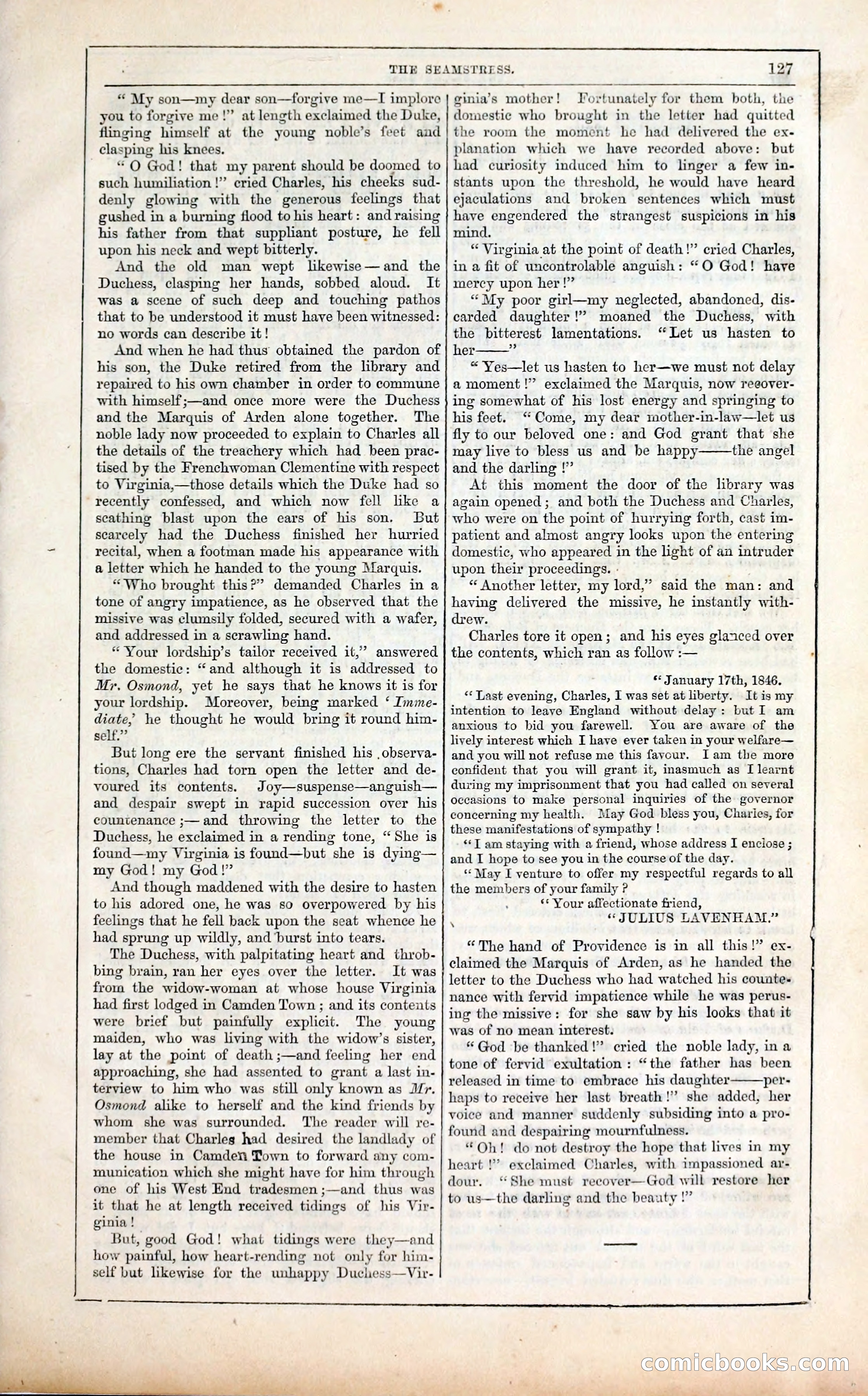
A restored page from Penny Dreadfuls, 1853. Page through the whole issue in the reader above.
📄 Transcribed text from this page (OCR, searchable)
Machine-transcribed from the original scan — historical spelling and the odd misread are preserved.
THE SEAMSTRESS. * My son—my dear son—forgive me—I implore you to forgive me!” at length exclaimed the Duke, flinging himself at the young noble’s feet and clasping his knees. “ O God! that my parent should be doomed to such humiliation!” cried Charles, his cheeks sud- denly glowing with the generous feelings that gushed in a burning flood to his heart: and raising his father from that suppliant posture, he fell upon his neck and wept bitterly. And the old man wept lkewise—and the Duchess, clasping her hands, sobbed aloud. It was a scene of such deep and touching pathos that to be understood it must have been witnessed: no words can describe it! And when he had thus obtained the pardon of his son, the Duke retired from the lhbrary and repaired to his own chamber in order to commune with himself;—and once more were the Duchess and the Marquis of Arden alone together. The noble lady now proceeded to explain to Charles all the details of the treachery which had been prac- tised by the Frenchwoman Clementine with respect to Virginia,—those details which the Duke had so recently confessed, and which now fell lke a scathing blast upon the ears of his son. But scarcely had the Duchess finished her hurried recital, when a footman made his appearance with a letter which he handed to the young Marquis. “Who brought this?’ demanded Charles in a tone of angry impatience, as he observed that the missive was clumsily folded, secured with a wafer, and addressed in a scrawling hand. “Your lordship’s tailor received it,” answered the domestic: “and although it is addressed to Mr. Osmond, yet he says that he knows it is for your lordship. Moreover, being marked ‘ Imme- diate, he thought he would bring it round him- self.” But long ere the servant finished his ,observa- tions, Charles had torn open the letter and de- voured its contents. Joy—suspense—anguish— and despair swept in rapid succession over his countenance ;— and throwing the letter to the Duchess, he exclaimed in a rending tone, “ She is found—my Virginia is found—but she is dying— my God! my God!” And though maddened with the desire to hasten to his adored one, he was so overpowered by his feelings that he fell back upon the seat whence he had sprung up wildly, and burst into tears. The Duchess, with palpitating heart and throb- bing brain, ran her eyes oyer the letter. It was from the widow-woman at whose house Virginia had first lodged in Camden Town ; and its contents were brief but painfully explicit. The young maiden, who was living with the widow’s sister, lay at the point of death ;—and feeling her end approaching, she had assented to grant a last in- terview to him who was still only known as Mr. Osmond alike to herself and the kind friends by whom she was surrounded. The reader will re- member that Charles had desired the landlady of the house in Camden Town to forward any com- munication which she might have for him through one of his West End tradesmen ;—and thus was it that he at length received tidings of his Vir- ginia ! But, good God! what tidings were they—and how painful, how heart-rending not only for him- self but likewise for the unhappy Duchess—Vir- 127 ginia’s mother! I ortunately for them both, the domestic who brought in the letter had quitted the room the moment he had delivered the ex- planation which we have recorded above: but had curiosity induced him to linger a few in- stants upon the threshold, he would have heard ejaculations and broken sentences which must have engendered the strangest suspicions in his mind. “ Virginia at the point of death!” cried Charles, in a fit of uncontrollable anguish: “O God! have mercy upon her!” “My poor girl—my neglected, abandoned, dis- carded daughter!” moaned the Duchess, with the bitterest lamentations. “Let us hasten to her 5 “ Yes—let us hasten to her—we must not delay a moment!” exclaimed the Marquis, now reeover- ing somewhat of his lost energy and springing to his feet. “Come, my dear mother-in-law—let us fly to our beloved one: and God grant that she may live to bless us and he happy the angel and the darling !” At this moment the door of the library was again opened; and both the Duchess and Charles, who were on the point of hurrying forth, cast im- patient and almost angry looks upon the entering domestic, who appeared in the ght of an intruder upon their proceedings. - . *‘ Another letter, my lord,’ said the man: and having delivered the missive, he instantly with- drew. Charles tore it open; and his eyes glanced over the contents, which ran as follow :— ** January 17th, 1846. ** Last evening, Charles, I was set at liberty. It is my intention to leaye England without delay: but I am anxious to bid you farewell. You are aware of the lively interest which I have ever taken in your welfare— and you will not refuse me this faycur. Iam the more confident that you will grant it, inasmuch as [I learnt during my imprisonment that you had called on several occasions to make personal inquiries of the governor concerning my health. May God bless you, Charies, for these manifestations of sympathy ! ‘*T am staying with a friend, whose address I enciose ; and I hope to see you in the course of the day. “May I venture to offer my respectful regards to all the members of your family ? ‘* Your affectionate friend, “JULIUS LAVENHAM,” “The hand of Providence is in all this!” ex- claimed the Marquis of Arden, as he handed the letter to the Duchess who had watched his counte- nance with fervid impatience while he was perus- ing the missive: for she saw by his looks that it was of no mean interest. * God be thanked!” cried the noble lady, in a tone of fervid exultation: “the father has been released in time to embrace his daughter per- haps to receive her last breath!” she added, her voice and manner suddenly subsiding into a pro- found and despairing mournfulness. “Oh! do not destroy the hope that lives in my heart !’’ exclaimed Charles, with impassioned ar- dour. “She must recover—God will restore her ~ |? to us—the darling and the beauty! ES Eomichboo