
Penny Dreadfuls, 1853 · page 138 of 151
The Seamstress; or, The White Slave of England — page 138: what you’re looking at
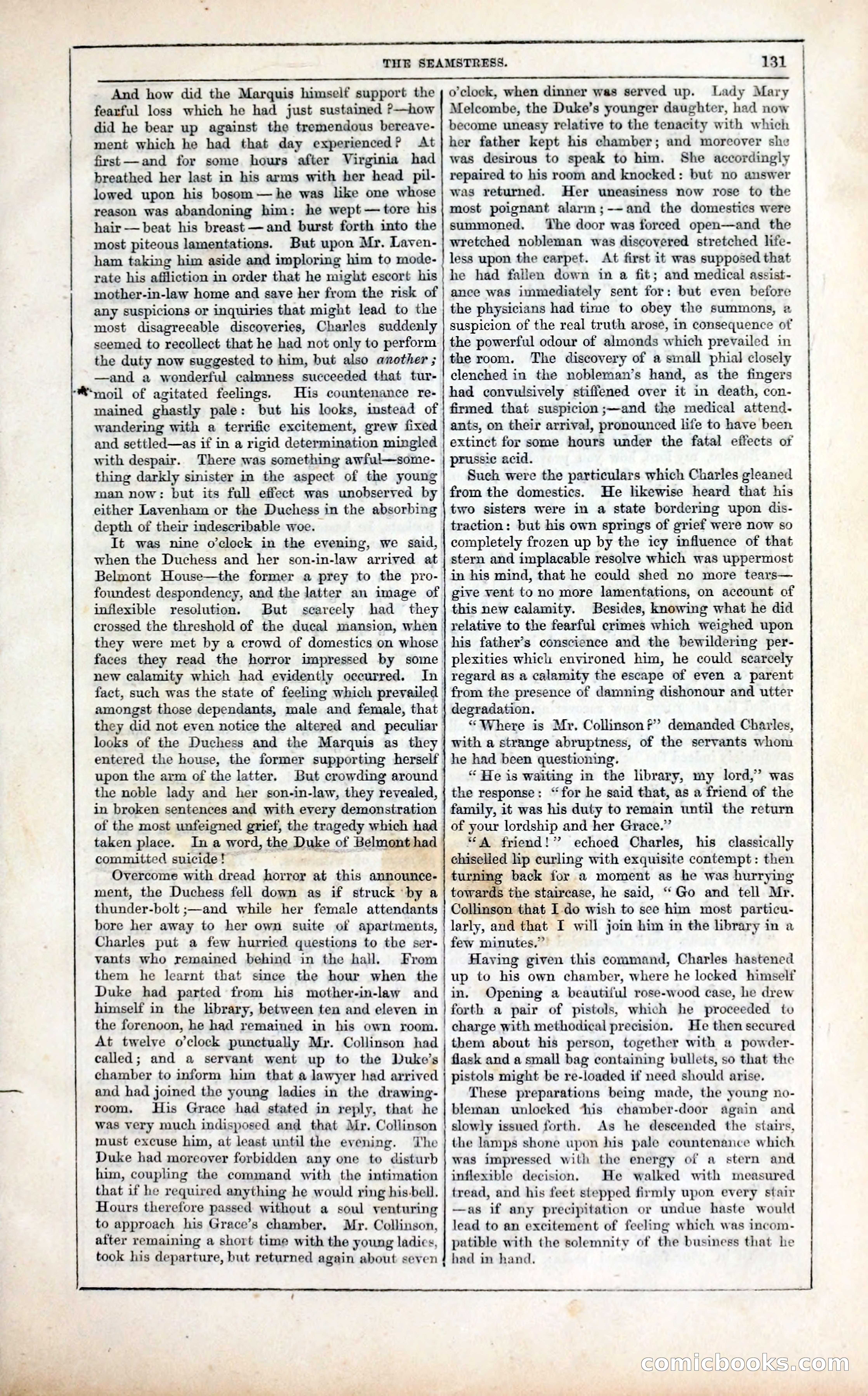
A restored page from Penny Dreadfuls, 1853. Page through the whole issue in the reader above.
📄 Transcribed text from this page (OCR, searchable)
Machine-transcribed from the original scan — historical spelling and the odd misread are preserved.
‘®moil of agitated feelings. His countenance re- THE SEAMSTRESS. 131 a ESE —_—_—_— And how did the Marquis himself support the ; o’clock, when dinner was served up. Lady Mary fearful loss which he had just sustained P—how | Melcombe, the Duke’s younger daughter, had now did he bear up against the tremendous bereave- | become uneasy relative to the tenacity with which ment which he had that day experienced? At} her father kept his chamber; and moreover she first—and for some hours after Virginia had] was desirous to speak to him. She accordingly breathed her last in his arms with her head pil-| repaired to his room and knocked: but no answer lowed upon his bosom — he was like one whose | was returned. Her uneasiness now rose to the reason was abandoning him: he wept—tore his {| most poignant alarm ;-~and the domestics were hair — beat his breast —and burst forth into the | summoned. The door was forced open—and the most piteous lamentations. But upon Mr. Laven-| wretched nobleman was discovered stretched life- ham taking him aside and imploring him to mode- } less upon the carpet. At first it was supposed that rate his afiliction in order that he might escort his} he had fallen down in a fit; and medical assist- mother-in-law home and save her from the risk of | ance was immediately sent for: but even before any suspicions or inquiries that might lead to the | the physicians had time to obey the summons, a most disagreeable discoveries, Charles suddenly | suspicion of the real truth arose, in consequence of seemed to recollect that he had not only to perform | the powerful odour of almonds which prevailed in the duty now suggested to him, but also another; |the room. The discovery of a small phial closely —and a wonderful calmness succeeded that tur-| clenched in the nobleman’s hand, as the fingers had convusively stiffened over it in death, con- firmed that suspicion ;—and the medical attend- ants, on their arrival, pronounced life to have been extinct for some hours under the fatal effects of prussic acid. Such were the particulars which Charles gleaned from the domestics. He likewise heard that his two sisters were in a state bordering upon dis- traction: but his own springs of grief were now so completely frozen up by the icy influence of that stern and implacable resolve which was uppermost in his mind, that he could shed no more tears— give vent to no more lamentations, on account of this new calamity. Besides, knowing what he did relative to the fearful crimes which weighed upon his father’s conscience and the bewildering per- plexities whic enyironed him, he could scarcely regard as a calamity the escape of even a parent from the presence of damning dishonour and utter degradation. “Where is Mr. Collinson?’ demanded Charles, with a strange abruptness, of the servants whom he had been questioning. “ He is waiting in the library, my lord,’ was the response: “for he said that, as a friend of the family, it was his duty to remain until the return of your lordship and her Grace.” “A friend!” echoed Charles, his classically chiselied lip curling with exquisite contempt: then turning back for a moment as he was hurrying towards the staircase, he said, “Go and tell Mr. Collinson that I-do wish to sce him most particu- larly, and that I will join him in the library in a few minutes.” Having given this command, Charles hastened up to his own chamber, where he locked himself in. Opening a beautiful rose-wood case, he drew mained ghastly pale: but his looks, instead of wandering with a terrific excitement, grew fixed and settled—as if in a rigid determination mingled with despair. There was something awful—some- thing darkly sinister in the aspect of the young man now: but its full effect was unobserved by either Lavenham or the Duchess in the absorbing depth of their indescribable woe. It was nine o'clock in the evening, we said, when the Duchess and her son-in-law arrived at Belmont House—the former a prey to the pro- foundest despondency, and the latter an image of inflexible resolution. But scarcely had they crossed the threshold of the ducal mansion, when | they were met by a crowd of domestics on whose faces they read the horror impressed by some new calamity which had eyidently occurred. In fact, such was the state of feeling which prevailed amongst those dependants, male and female, that they did not even notice the altered and peculiar looks of the Duchess and the Marquis as they entered the house, the former supporting herself upon the arm of the latter. But crowding around the noble lady and her son-in-law, they revealed, in broken sentences and with every demonstration of the most unfeigned grief, the tragedy which had taken place. In a word, the Duke of Belmont had committed suicide! | | Overcome with dread horroy at this annownce- ment, the Duchess fell down as if struck ‘by a thunder-bolt ;—and while her female attendants bore her away to her own suite of apartments, Charles put a few hurried questions to the ser- vants who remained behind in the hall. From them he learnt that since the hour when the Duke had parted from his mother-in-law and himself in the library, between ten and eleven in| forth a pair of pistols, which he proceeded to the forenoon, he had remained in his own room. ! charge with methodical precision. He then secured At twelve o’clock punctually My. Collinson had | them about his person, together with a powder- called; and a servant went up to the Duke’s | flask and a small bag containing bullets, so that the chamber to inform him that a lawyer had arrived | pistols might be re-loaded if need should arise. and had joined the young ladies in the drawing- These preparations being made, the young no- room. His Grace had stated in reply, that he | bleman unlocked ‘his chamber-door again and was very much indisposed and that Mr. Collinson | slowly issued forth. As he descended the stairs, must excuse him, at least until the evening. ‘The | the lamps shone upon his pale countenance which Duke had moreover forbidden any one to disturb | was impressed with the energy of a stern and him, coupling the command with the intimation | inflexible decision. He walked with measured that if he required anything he would ring his-bell. | tread, and his feet stepped firmly upon every stair Hours therefore passed without a soul venturing | —as if any precipitation or undue haste would to approach his Grace’s chamber, Mr. Collinson, | lead to an excitement of feeling which was incom- after remaining a short time with the young ladies, | patible with the solemnity of the business that he took his departure, but returned again about seven / had in hand. CORNICE OOOKS a ———————E—Eeee—e—e—————eee (SO)