
Penny Dreadfuls, 1853 · page 29 of 151
The Seamstress; or, The White Slave of England — page 29: what you’re looking at
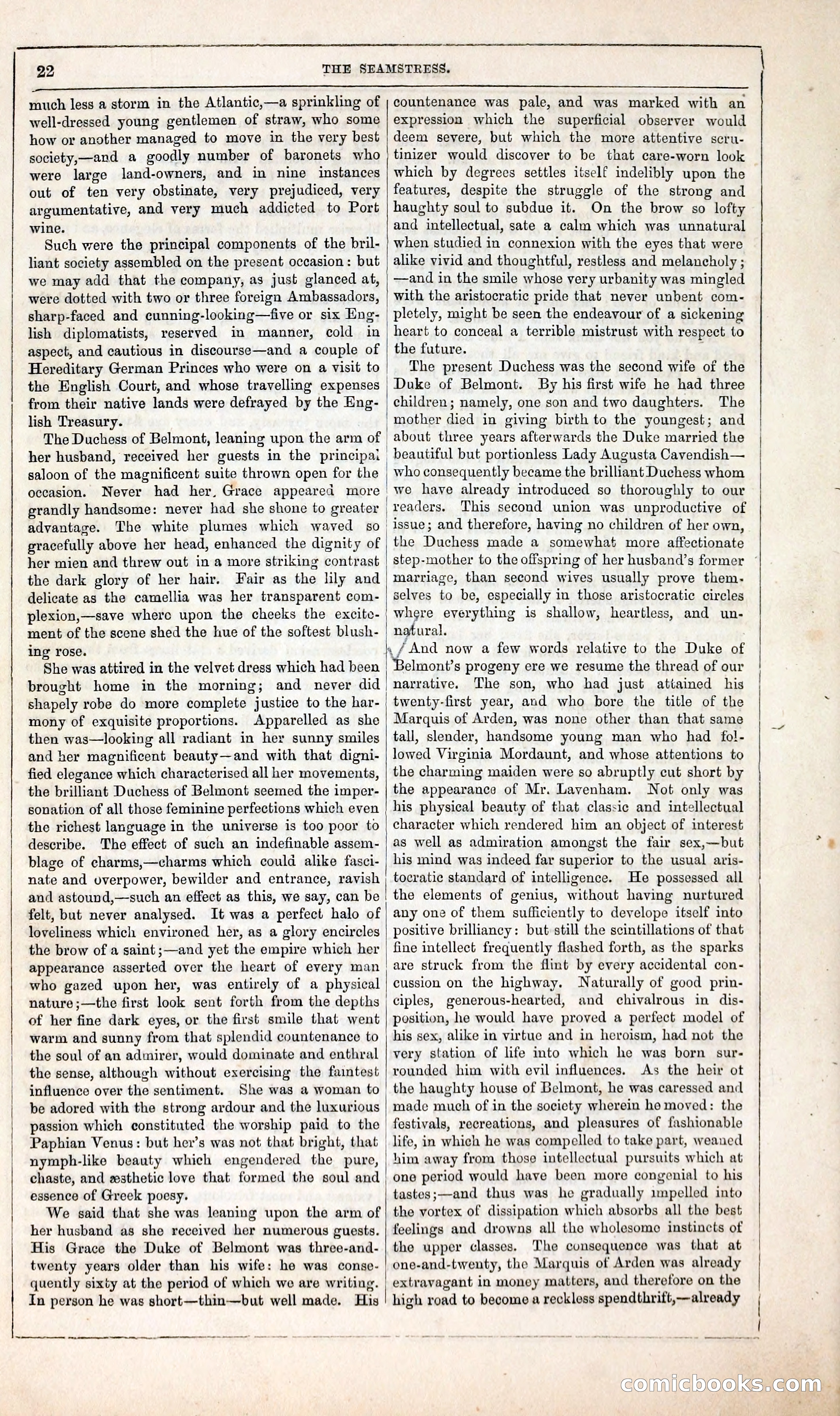
A restored page from Penny Dreadfuls, 1853. Page through the whole issue in the reader above.
📄 Transcribed text from this page (OCR, searchable)
Machine-transcribed from the original scan — historical spelling and the odd misread are preserved.
EI EI IE 22 THE SEAMSTRESS. a I ES A ET TE I ET a as ao much less a storm in the Atlantic,—a sprinkling of well-dressed young gentlemen of straw, who some how or another managed to move in the very best society,—and a goodly number of baronets who were large land-owners, and in nine instances out of ten very obstinate, very prejudiced, very argumentative, and very much addicted to Port wine. Such were the principal components of the bril- liant society assembled on the present occasion: but we may add that the company, as just glanced at, were dotted with two or three foreign Ambassadors, sharp-faced and cunning-looking—five or six Eng- lish diplomatists, reserved in manner, cold in aspect, and cautious in discourse—and a couple of Hereditary German Princes who were on a visit to the English Court, and whose travelling expenses from their native lands were defrayed by the Eng- lish Treasury. The Duchess of Belmont, leaning upon the arm of her husband, received her guests in the principai saloon of the magnificent suite thrown open for the occasion. Never had her, Grace appeared more grandly handsome: never had she shone to greater advantage. The white plumes which waved so gracefully above her head, enhanced the dignity of her mien and threw out in a more striking contrast the dark glory of her hair. Fair as the lily and delicate as the camellia was her transparent com- plexion,—save where upon the cheeks the excite- ment of the scene shed the hue of the softest blush- ing rose. She was attired in the velvet dress which had been brought home in the morning; and never did shapely robe do more complete justice to the har- mony of exquisite proportions. Apparelled as she then was—looking all radiant in her sunny smiles and her magnificent beauty—and with that digni- fied elegance which characterised all her movements, the brilliant Duchess of Belmont seemed the imper- sonation of all those feminine perfections which even the richest language in the universe is too poor to describe. The effect of such an indefinable assem- blage of charms,—charms which could alike fasci- nate and uverpower, bewilder and entrance, ravish and astound,—such an effect as this, we say, can be felt, but never analysed. It was a perfect halo of loveliness which environed her, as a glory encircles the brow of a saint;—and yet the empire which her appearance asserted over the heart of every man who gazed upon her, was entirely of a physical nature ;—the first look sent forth from the depths of her fine dark eyes, or the first smile that went warm and sunny from that splendid countenance to the soul of an admirer, would dominate and enthral the sense, although without exercising the faintest influence over the sentiment. She was a woman to be adored with the strong ardour and the luxurious passion which constituted the worship paid to the | life, in which he was compelled to take part, weaned Paphian Venus: but her’s was not that bright, that nymph-like beauty which engendered the pure, chaste, and esthetic love that formed the soul and essence of Greek poesy. We said that she was leaning upon the arm of her husband as she received her numerous guests. His Grace the Duke of Belmont was three-and- twenty years older than his wife: he was conse- quently sixty at the period of which we are writing. In person he was short—thin—but well made. His | | | ! countenance was pale, and was marked with an expression which the superficial observer would deem severe, but which the more attentive scru- tinizer would discover to be that care-worn look which by degrees settles itself indelibly upon the features, despite the struggle of the strong and haughty soul to subdue it. On the brow so lofty and intellectual, sate a calm which was unnatural when studied in connexion with the eyes that were alike vivid and thoughtful, restless and melancholy ; —and in the smile whose very urbanity was mingled with the aristocratic pride that never unbent com- pletely, might be seen the endeavour of a sickening heart to conceal a terrible mistrust with respect to the future. | The present Duchess was the second wife of the Duke of Belmont. By his first wife he had three children; namely, one son and two daughters. The mother died in giving birth to the youngest; and about three years afterwards the Duke married the beautiful but portionless Lady Augusta Cavendish— who consequently became the brilliant Duchess whom we have already introduced so thoroughly to our readers. This second union was unproductive of issue; and therefore, having no children of her own, the Duchess made a somewhat more affectionate step-mother to the offspring of her husband’s former ~ marriage, than second wives usually prove them- selves to be, especially in those aristocratic circles where everything is shallow, heartless, and un- natural. ) , / And now a few words relative to the Duke of ‘Belmont’s progeny ere we resume the thread of our narrative. The son, who had just attained his twenty-first year, and who bore the title of the Marquis of Arden, was none other than that same tall, slender, handsome young man who had fo!- lowed Virginia Mordaunt, and whose attentions to the charming maiden were so abruptly cut short by the appearance of Mr. Lavenham. Not only was his physical beauty of that classic and intellectual character which rendered him an object of interest as well as admiration amongst the fair sex,—but his mind was indeed far superior to the usual aris- tocratic standard of intelligence. He possessed all the elements of genius, without having nurtured any one of them sufficiently to develope itself into positive brilliancy: but still the scintillations of that fine intellect frequently flashed forth, as the sparks are struck from the flint by every accidental con- cussion on the highway. Naturally of good prin- ciples, generous-hearted, and chivalrous in dis- position, he would have proved a perfect model of his sex, alike in virtue and in heroism, had not the very station of life into which he was born sur- rounded him with evil influences. As the heir ot the haughty house of Belmont, he was caressed anc made much of in the society wherein ho moved: the festivals, recreations, and pleasures of fashionable him away from those intellectual pursuits which at one period would have been more congenial to his tastes;—and thus was he gradually impelled into the vortex of dissipation which absorbs all the best feelings and drowns all the wholesome instincts of the upper classes. The consequence was that at one-and-twenty, the Marquis of Arden was already extravagant in money matters, and therefore on the high road to become a reckless spendthrift,—already 160) ‘ ' 5 eee eee ee eee a