
Penny Dreadfuls, 1853 · page 33 of 151
The Seamstress; or, The White Slave of England — page 33: what you’re looking at
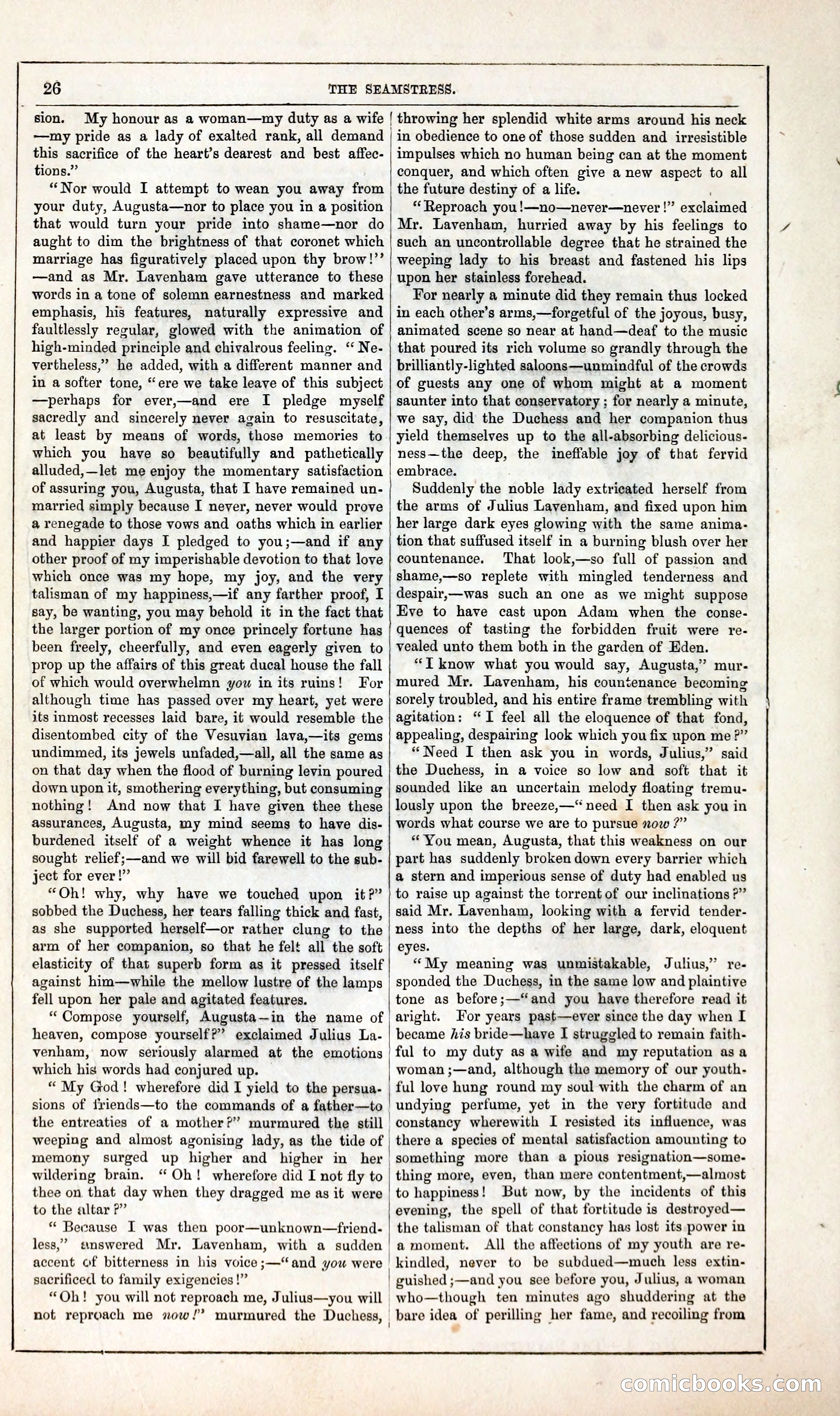
A restored page from Penny Dreadfuls, 1853. Page through the whole issue in the reader above.
📄 Transcribed text from this page (OCR, searchable)
Machine-transcribed from the original scan — historical spelling and the odd misread are preserved.
26 sion. —my pride as a lady of exalted rank, all demand | this sacrifice of the heart’s dearest and best affec- tions.” “Nor would I attempt to wean you away from your duty, Augusta—nor to place you in a position that would turn your pride into shame—nor do aught to dim the brightness of that coronet which marriage has figuratively placed upon thy brow!’ —and as Mr. Lavenham gave utterance to these words in a tone of solemn earnestness and marked emphasis, his features, naturally expressive and faultlessly regular, glowed with the animation of high-minded principle and chivalrous feeling. ‘ Ne- vertheless,” he added, with a different manner and in a softer tone, “ere we take leave of this subject —perhaps for ever,—and ere I pledge myself sacredly and sincerely never again to resuscitate, at least by means of words, those memories to which you have so beautifully and pathetically alluded,—let me enjoy the momentary satisfaction of assuring you, Augusta, that I have remained un- married simply because I never, never would prove a renegade to those vows and oaths which in earlier and happier days I pledged to you;—and if any other proof of my imperishable devotion to that love which once was my hope, my joy, and the very talisman of my happiness,—if any farther proof, I say, be wanting, you may behold it in the fact that the larger portion of my once princely fortune has been freely, cheerfully, and even eagerly given to prop up the affairs of this great ducal house the fall of which would overwhelmn yow in its ruins! For although time has passed over my heart, yet were its inmost recesses laid bare, it would resemble the disentombed city of the Vesuvian lava,—its gems undimmed, its jewels unfaded,—all, all the same as on that day when the flood of burning levin poured down upon it, smothering everything, but consuming nothing! And now that I have given thee these assurances, Augusta, my mind seems to have dis- burdened itself of a weight whence it has long sought relief;—and we will bid farewell to the sub- ject for ever!” “Oh! why, why have we touched upon it?” sobbed the Duchess, her tears falling thick and fast, as she supported herself—or rather clung to the arm of her companion, so that he felt all the soft elasticity of that superb form as it pressed itself against him—while the mellow lustre of the lamps fell upon her pale and agitated features. “Compose yourself, Augusta—in the name of heaven, compose yourself?” exclaimed Julius La- venham, now seriously alarmed at the emotions which his words had conjured up. “ My God! wherefore did I yield to the persua- sions of friends—to the commands of a father—to the entreaties of a mother?” murmured the still weeping and almost agonising lady, as the tide of memony surged up higher and higher in_ her wildering brain. ‘ Oh! wherefore did I not fly to thee on that day when they dragged me as it were to the altar P” * Berause I was then poor—unknown—friend- less,’ enswered Mr. Lavenham, with a sudden! a moment. THE SEAMSTRESS. My honour as a woman—my duty as a wife | throwing her splendid white arms around his neck in obedience to one of those sudden and irresistible impulses which no human being can at the moment conquer, and which often give a new aspect to all the future destiny of a life. *Reproach you !—no—never—never !” exclaimed Mr. Lavenham, hurried away by his feelings to such an uncontrollable degree that he strained the weeping lady to his breast and fastened his lips upon her stainless forehead. For nearly a minute did they remain thus locked in each other’s arms,—forgetful of the joyous, busy, animated scene so near at hand—deaf to the music that poured its rich volume so grandly through the brilliantly-lighted saloons—unmindful of the crowds of guests any one of whom might at a moment saunter into that conservatory ; for nearly a minute, we say, did the Duchess and her companion thus yield themselves up to the all-absorbing delicious- ness—the deep, the ineffable joy of that fervid embrace. Suddenly the noble lady extricated herself from the arms of Julius Lavenham, and fixed upon him her large dark eyes glowing with the same anima- tion that suffused itself in a burning blush over her countenance. That look,—so full of passion and shame,—so replete with mingled tenderness and despair,—was such an one as we might suppose Eve to have cast upon Adam when the conse- quences of tasting the forbidden fruit were re- vealed unto them both in the garden of Eden. “YT know what you would say, Augusta,” mur- mured Mr. Lavenham, his countenance becoming sorely troubled, and his entire frame trembling with agitation: “I feel all the eloquence of that fond, appealing, despairing look which you fix upon me ?” “Need I then ask you in words, Julius,” said the Duchess, in a voice so low and soft that it sounded like an uncertain melody floating tremu- lously upon the breeze,—“ need I then ask you in words what course we are to pursue now ?” * You mean, Augusta, that this weakness on our part has suddenly broken down every barrier which a stern and imperious sense of duty had enabled us to raise up against the torrentof our inclinations P” said Mr. Lavenham, looking with a fervid tender- ness into the depths of her large, dark, eloquent eyes. “My meaning was unmistakable, Julius,” re- sponded the Duchess, in the same low and plaintive tone as before;—“and you have therefore read it aright. For years past—ever since the day when I became his bride—haye I struggled to remain faith- ful to my duty as a wife and my reputation asa woman ;—and, although the memory of our youth- ful love hung round my soul with the charm of an undying perfume, yet in the very fortitude and constancy wherewith I resisted its influence, was there a species of mental satisfaction amounting to something more than a pious resignation—some- thing more, even, than mere contentment,—almost to happiness! But now, by the incidents of this evening, the spell of that fortitude is destroyed— the talisman of that constancy has lost ifs power in All the affections of my youth are re- accent of bitterness in his voice ;—“and you were | kindled, never to be subdued—much less extin- sacrificecl to family exigencies!” guished ;—and you see before you, Julius, a woman “Oh! you will not reproach me, Julius—you will who—though ten minutes ago shuddering at the not reproach me xow!?’ murmured the Duchess, | bare idea of perilling her fame, and recoiling from nook