
Penny Dreadfuls, 1853 · page 55 of 151
The Seamstress; or, The White Slave of England — page 55: what you’re looking at
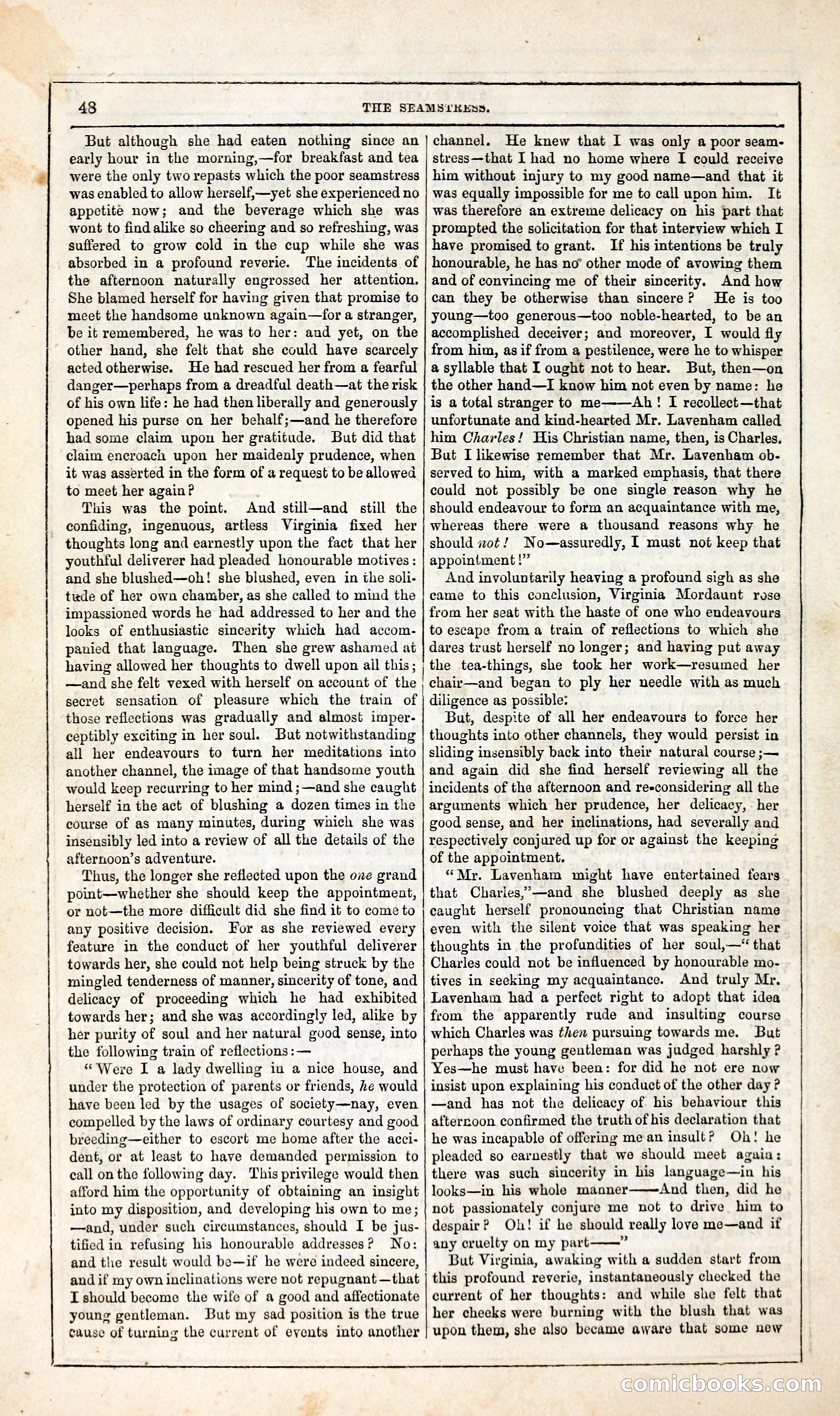
A restored page from Penny Dreadfuls, 1853. Page through the whole issue in the reader above.
📄 Transcribed text from this page (OCR, searchable)
Machine-transcribed from the original scan — historical spelling and the odd misread are preserved.
me me Se ae a ee ee BE ee Se ee ee ee 48 But although she had eaten nothing since an early hour in the morning,—for breakfast and tea were the only two repasts which the poor seamstress was enabled to allow herself,—yet she experienced no appetite now; and the beverage which she was wont to find alike so cheering and so refreshing, was suffered to grow cold in the cup while she was absorbed in a profound reverie. The incidents of the afternoon naturally engrossed her attention. She blamed herself for having given that promise to meet the handsome unknown again—for a stranger, be it remembered, he was to her: and yet, on the other hand, she felt that she could have scarcely acted otherwise. He had rescued her from a fearful danger—perhaps from a dreadful death—at the risk of his own life: he had then liberally and generously opened his purse on her behalf;—and he therefore had some claim upon her gratitude. But did that claim encroach upon her maidealy prudence, when it was asserted in the form of a request to be allowed to meet her again? This was the point. And still—and still the confiding, ingenuous, artless Virginia fixed her thoughts long and earnestly upon the fact that her youthful deliverer had pleaded honourable motives: and she blushed—oh! she blushed, even in the soli- tude of her own chamber, as she called to mind the impassioned words he had addressed to her and the looks of enthusiastic sincerity which had accom- panied that language. Then she grew ashamed at having allowed her thoughts to dwell upon ail this; —and she felt vexed with herself on account of the secret sensation of pleasure which the train of those reflections was gradually and almost imper- ceptibly exciting in her soul. But notwithstanding all her endeavours to turn her meditations into another channel, the image of that handsome youth would keep recurring to her mind ;—and she caught herself in the act of blushing a dozen times in the course of as many minutes, during which she was insensibly led into a review of all the details of the afternoon’s adventure. Thus, the longer she reflected upon the ove grand point—whether she should keep the appointment, or not—the more difficult did she find it to come to any positive decision. For as she reviewed every feature in the conduct of her youthful deliverer towards her, she could not help being struck by the mingled tenderness of manner, sincerity of tone, and delicacy of proceeding which he had exhibited towards her; and she was accordingly led, alike by her purity of soul and her natural gvod sense, into the following train of reflections :— “Were I a lady dwelling in a nice house, and under the protection of parents or friends, he would have been led by the usages of society—nay, even compelled by the laws of ordinary courtesy and good breeding—either to escort me home after the acci- dent, or at least to have demanded permission to call on the following day. This privilege would then afford him the opportunity of obtaining an insight into my disposition, and developing his own to me; —and, under such circumstances, should I be jus- tified in refusing his honourable addresses? No: and the result would bo—if he were indeed sincere, and if my own inclinations were not repugnant —that I should become the wife of a good and affectionate young gentleman. But my sad position is the true cause of turning the current of eyents into another LL LLL LS THE SEAMSYLERESS. channel. He knew that 1 was only a poor seam- stress—that I had no home where I could receive him without injury to my good name—and that it was equally impossible for me to call upon him. It was therefore an extreme delicacy on his part that prompted the solicitation for that interview which I have promised to grant. If his intentions be truly honourable, he has no’ other mode of avowing them and of convincing me of their sincerity. And how can they be otherwise than sincere? He is too young—too generous—too noble-hearted, to be an accomplished deceiver; and moreover, I would fly from him, as if from a pestilence, were he to whisper a syllable that I ought not to hear. But, then—on the other hand—I know him not even by name: he is a total stranger to me——Ah! I recollect—that unfortunate and kind-hearted Mr. Lavenham called him Charles! His Christian name, then, is Charles, But I likewise remember that Mr. Lavenham ob- served to him, with a marked emphasis, that there could not possibly be one single reason why he should endeavour to form an acquaintance with me, whereas there were a thousand reasons why he should xo¢ ! No—assuredly, I must not keep that appointment!” And involuntarily heaving a profound sigh as she came to this conclusion, Virginia Mordaunt rouse from her seat with the haste of one who endeavours to escape from a train of reflections to which she dares trust herself no longer; and having put away the tea-things, she took her work—resumed her chair—and began to ply her needle with as much diligence as possible: But, despite of all her endeavours to force her thoughts into other channels, they would persist in sliding insensibly back into their natural course ;— and again did she find herself reviewing all the incidents of the afternoon and reeconsidering all the arguments which her prudence, her delicacy, her good sense, and her inclinations, had severally and respectively conjured up for or against the keeping of the appointment. “Mr. Lavenham might have entertained fears that Charies,’—and she blushed deeply as she caught herself pronouncing that Christian name even with the silent voice that was speaking her thoughts in the profundities of her soul,—“ that Charles could not be influenced by honourable mo- tives in seeking my acquaintance. And truly Mr. Lavenham had a perfect right to adopt that idea from the apparently rude and insulting course which Charles was then pursuing towards me. But perhaps the young gentleman was judged harshly? Yes—he must have been: for did he not ere now insist upon explaining his conduct of the other day? —and has not the delicacy of his behaviour this afternoon confirmed the truth of his declaration that he was incapable of offering mean insult? Oh! he pleaded so earnestly that we should meet again: there was such sincerity in his language—in his looks—in his whole manner——And then, did he not passionately conjure me not to drive him to despair? Ol! if he should really love me—and if any cruelty on my part——” But Virginia, awaking with a sudden start from this profound reverie, instantaneously checked the current of her thoughts: and while she felt that her cheeks were burning with the blush that was upon them, she also became aware that some new ame eee eS RET LTT EOMIIGsoOOo <S (E(0) Lf