
Penny Dreadfuls, 1853 · page 65 of 151
The Seamstress; or, The White Slave of England — page 65: what you’re looking at
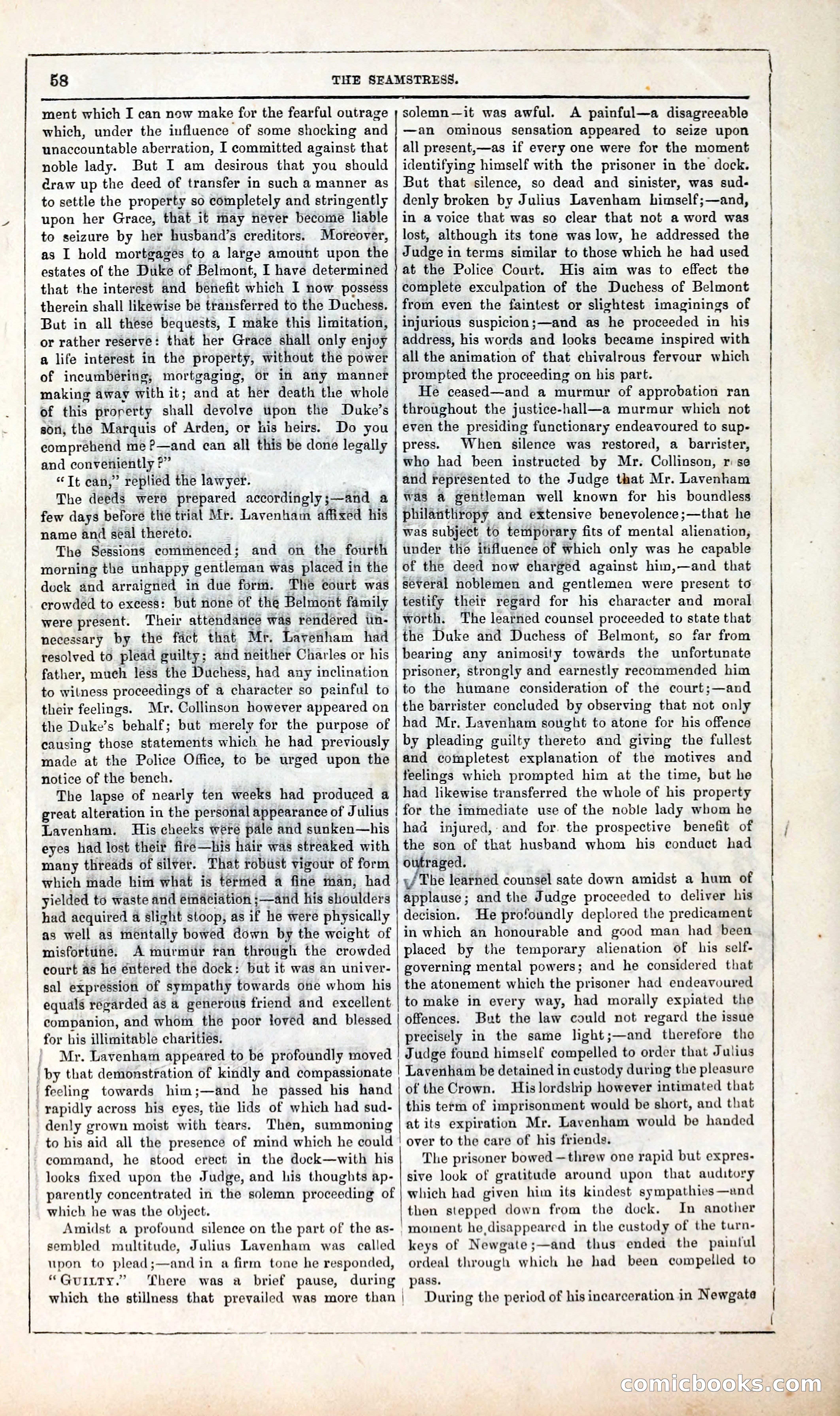
A restored page from Penny Dreadfuls, 1853. Page through the whole issue in the reader above.
📄 Transcribed text from this page (OCR, searchable)
Machine-transcribed from the original scan — historical spelling and the odd misread are preserved.
—_—_—_—_—_———— O_O ee -CO— - THE SEAMSTRESS. rm EE Te ST ment which I can now make for the fearful outrage which, under the influence of some shocking and unaccountable aberration, I committed against that noble lady. But I am desirous that you should draw up the deed of transfer in such a manner as to settle the property so completely and stringently upon her Grace, that it may never become liable to seizure by her husband’s creditors. Moreover, as I hold mortgages to a large amount upon the estates of the Duke of Belmont, I have determined that the interest and benefit which I now possess therein shall likewise be transferred to the Duchess. But in all these bequests, I make this limitation, or rather reserve: that her Grace shall only enjoy a life interest in the property, without the power of incumberitie, mortgaging, or in any manner making atway with it; and at her death the whole of this property shall devolve upon the Duke’s son, the Marquis of Arden, or his heirs. Do you comprehend me P—and can all this be done legally and conveniently?” _ “Tt can,” replied the lawyer. The deeds were prepared accordingly;—and a few days before tlie trial Mr. Lavenham affixed his name and seal thereto. The Sessions commenced; and on the fourth morning the unhappy gentleman was placed in the dock and arraigned in due form. The court was crowded to excess: but none of the Belmont family were present. Their attendatice was rendered tin- necessary by the fact that Mr. Layenham had resolved to plead guilty; and neither Charles or his father, much less the Duchess, had any inclination to wilness proceedings of a character so painful to their feelings. Mr. Collinson however appeared on the Duke’s behalf; but merely for the purpose of causing those statements which he had previously made at the Police Office, to be urged upon the notice of the bench. The lapse of nearly ten weeks had produced a great alteration in the personal appearance of Julius Lavenham. His cheeks wére pale and sunken—his eyes had lost their fire—his hair was streaked with many threads of silver. That robust vigour of form which made him what is termed a fine man, had yielded to waste and émaciation ;—and his shoulders had acquired a slight stoop, as if he were physically as well as mentally bowed down by the weight of misfortune, A murmur ran through the crowded court as he éntered the dock: but it was an univer- sal expression of sympathy towards one whom his equals régarded as a generous friend and excellent companion, and whom the poor loved and blessed for his illimitable charities. ' Mr. Lavenham appeared to be profoundly moved by that demonstration of kindly and compassionate feeling towards him;—and he passed his hand rapidly across his eyes, the lids of which had sud- denly grown moist with tears. Then, summoning to his aid all the presence of mind which he could command, he stood erect in the dock—with his looks fixed upon the Judge, and his thoughts ap- parently concentrated in the solemn proceeding of which he was the object. Amidst a profound silence on the part of the as- sembled multitude, Julius Lavenham was called upon to plead;—and in a firm tone he responded, “Guitty.”’ There was a brief pause, during which the stillness that prevailed was more than i EE eee oe | eee eae ene ee ee solemn—it was awful. A painful—a disagreeable —an ominous sensation appeared to seize upon all present,—as if every one were for the moment identifying himself with the prisoner in the dock. But that silence, so dead and sinister, was sud- denly broken by Julius Lavenham himself;—and, in a voice that was so clear that not a word was lost, although its tone was low, he addressed the Judge in terms similar to those which he had used at the Police Court. His aim was to effect the complete exculpation of the Duchess of Belmont from even the faintest or slizhtest imaginings of injurious suspicion;—and as he proceeded in his address, his words and looks became inspired with all the animation of that chivalrous fervour which prompted the proceeding on his part. He ceased—and a murmur of approbation ran throughout the justice-hall—a murmur which not even the presiding functionary endeavoured to sup- press. When silence was restored, a barrister, who had been instructed by Mr. Collinson, rise and represented to the Judge that Mr. Lavenham was a gentleman well known for his boundless philanthropy and extensive benevolence ;—that he was subject to temporary fits of mental alienation, under the itifluence of which only was he capable of the deed now charged against him,—and that several noblemen and gentlemen were present to testify their regard for his character and moral worth. The learned counsel proceeded to state that the Duke and Duchess of Belmont, so far from bearing any animosity towards the unfortunate prisoner, strongly and earnestly recommended him to the humane consideration of the court;—and the barrister concluded by observing that not only had Mr. Lavenham sought to atone for his offence by pleading guilty thereto and giving the fullest and completest explanation of the motives and feelings which prompted him at the time, but he had likewise transferred the whole of his property for the immediate use of the noble lady whom he had injured, and for. the prospective benefit of the son of that husband whom his conduct had outraged. The learned counsel sate down amidst a hum of applause; and the Judge proceeded to deliver his decision. He profoundly deplored the predicament in which an honourable and good man had been placed by the temporary alienation of his self- governing mental powers; and he considered that the atonement which the prisoner had endeavoured to make in every way, had morally expiated the offences. But the law could not regard the issue precisely in the same light;—and therefore tho Judge found himself compelled to order that Julius Lavenham be detained in custody during the pleasure of the Crown. His lordship however intimated that this term of imprisonment would be short, and that at its expiration Mr. Lavenham would be handed over to the care of his friends. The prisoner bowed—threw one rapid but expres- sive look of gratitude around upon that auditory which had given him its kindest sympathies—and then stepped down from the dock. In another moment he disappeared in the custody of the turn- keys of Newgate;—and thus ended the painful ordeal through which he had been compelled to pass. | During the period of his incarceration in Newgate (9) : 0) (0) a TTT, rT § |