
Penny Dreadfuls, 1853 · page 69 of 151
The Seamstress; or, The White Slave of England — page 69: what you’re looking at
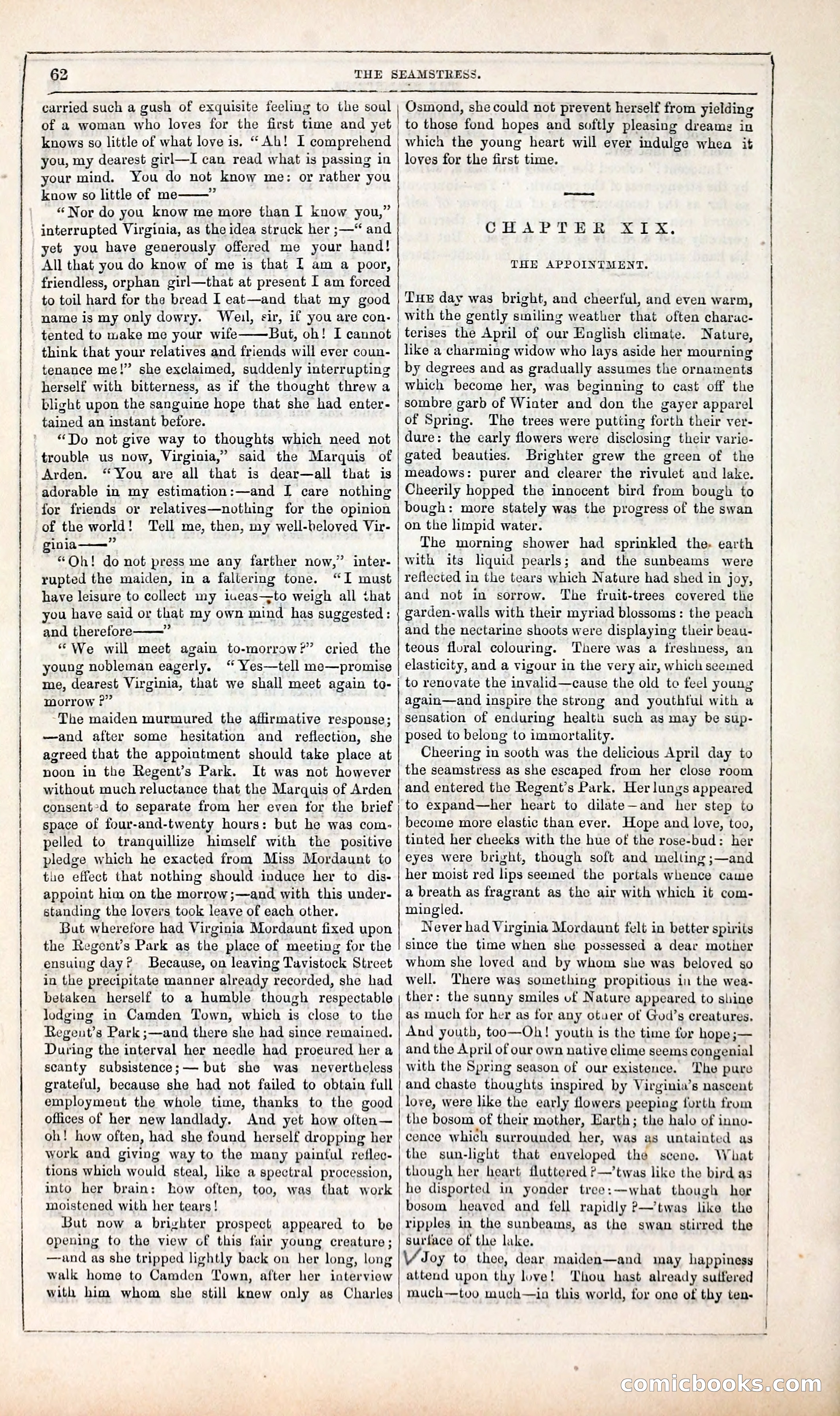
A restored page from Penny Dreadfuls, 1853. Page through the whole issue in the reader above.
📄 Transcribed text from this page (OCR, searchable)
Machine-transcribed from the original scan — historical spelling and the odd misread are preserved.
62 carried such a gush of exquisite feeling to the soul of a woman who loves for the first time and yet —— | THE SEAMSTRESS. Osmond, she could not prevent herself from yielding to those fond hopes and softly pleasing dreamg in knows so little of what love is. “Ah! 1 comprehend | which the young heart will ever indulge whea it you, my dearest girl—I can read what is passing in your mind. You do not know me: or rather you know s0 little of me 7 “Nor do you know me more than I know you,” interrupted Virginia, as the idea struck her ;—“ and yet you have generously offered me your hand! All that you do know of me is that I am a poor, friendless, orphan girl—that at present I am forced to toil hard for the bread I eat—and that my good name is my only dowry. Weil, sir, if you are con- tented to make me your wife——But, oh! I cannot think that your relatives and friends will ever coun- tenance me!” she exclaimed, suddenly interrupting herself with bitterness, as if the thought threw a blight upon the sanguine hope that she had enter- tained an instant before. “Do not give way to thoughts which need not trouble us now, Virginia,” said the Marquis of Arden. “You are all that is dear—all that is adorable in my estimation:—and I care nothing for friends or relatives—nothing for the opinion of the world! ‘Tell me, then, my well-beloved Vir- ginia ‘3 “Oh! do not press me any farther now,” inter- rupted the maiden, in a fallering tone. “I must have leisure to collect my iueas—to weigh all that you have said or that my own mind has suggested: and therefore e “We will meet again to-morrow?” cried the young nobleman eagerly. ‘“ Yes—tell me—promise me, dearest Virginia, that we shall meet again to- morrow ?” ‘The maiden murmured the affirmative response; —and after some hesitation and reflection, she agreed that the appointment should take place at noon in the Regent’s Park. It was not however without much reluctance that the Marquis of Arden consented to separate from her even tor the brief space of four-and-twenty hours: but he was com- pelled to tranquillize himself with the positive pledge which he exacted from Miss Mordaunt to tue effect that nothing should induce her to dis- appoint him on the morrow ;—and with this under- standing the loveis took leave of each other. But wherefore had Virginia Mordaunt fixed upon the Regent’s Park as the place of meeting for the ensuing day? Because, on leaving Tavistock Street in the precipitate manner already recorded, she had betaken herself to a humble though respectable lodging in Camden Town, which is close to the Regent’s Park ;—and there she had since remained. During the interval her needle had proeured her a scanty subsistence;— but she was nevertheless grateful, because she had not failed to obtain full employment the whole time, thanks to the good offices of her new landlady. And yet how often— oh! how often, had she found herself dropping her work and giving way to the many painful reflec- tions which would steal, like a spectral procession, into her brain: how often, too, was that work moistened with her tears! Gut now a brighter prospect appeared to be opening to the view of this fair young creature; —and as she tripped lightly back on her long, long walk home to Camden Town, after her interview with him whom she still knew only as Charles i i loves for the first time. 0 p66 re Wil eles gel Ed eal em Il. THE APPOINTMENT. THE day was bright, and cheerful, and even warm, with the gently smiling weather that often charac- terises the April of our English climate. Nature, like a charming widow who lays aside her mourning by degrees and as gradually assumes the ornaments which become her, was beginning to cast off the sombre garb of Winter and don the gayer apparel of Spring. The trees were putting forth their ver- dure: the early flowers were disclosing their varie- gated beauties. Brighter grew the green of the meadows: purer and clearer the rivulet and lake. Cheerily hopped the innocent bird from bough to bough: more stately was the progress of the swan on the limpid water. The morning shower had sprinkled the- earth with its liquid pearls; and the sunbeams were refiected in the tears which Nature had shed in joy, and not in sorrow. The fruit-trees covered the garden-walls with their myriad blossoms: the peach and the nectarine shoots were displaying their beau- teous flural colouring. There was a freshness, an elasticity, and a vigour in the very air, which seemed to renovate the invalid—cause the old to feel young again—and inspire the strong and youthful with a sensation of enduring healti such as may be sup- posed to belong to immortality. Cheering In sooth was the delicious April day to the seamstress as she escaped from her close room and entered the Regent’s Park. Her lungs appeared to expand—her heart to dilate—and her step to become more elastic than ever. Hope and love, too, tinted her cheeks with the hue of the rose-bud: her eyes were bright, though soft and melting ;—and her moist red lips seemed the portals whence came a breath as fragrant as the air with which it com- mingled. Never had Virginia Mordaunt felt in better spirits since the time when she possessed a dear motier whom she loved and by whom she was beloved so well. There was something propitious in the wea- ther: the sunny smiles uf Nature appeared to shine as much for her as for any otuer of God’s creatures, And youth, too—Oh! youth is the time for hope;— and the April of our own native clime seems congenial with the Spring season of our existence. The pure aud chaste thoughts inspired by Virginia’s nascent love, were like the early flowers peeping forth from the bosom of their mother, Earth; the halo of inno- cence which surrounded her, was as untainted as the sun-light that enveloped the scene. What though her heart fluttered P—’twas like the bird as he disported in yonder tree:—what though her bosom heaved and fell rapidly P—twas like the ripples in the sunbeams, as the swan stirred the surface of the lake. Joy to thee, dear maiden—and may happiness attend upon thy love! ‘Thou hast already sulfered /much—too much—in this world, for one of thy ten- iInoo ‘S