
Penny Dreadfuls, 1853 · page 74 of 151
The Seamstress; or, The White Slave of England — page 74: what you’re looking at
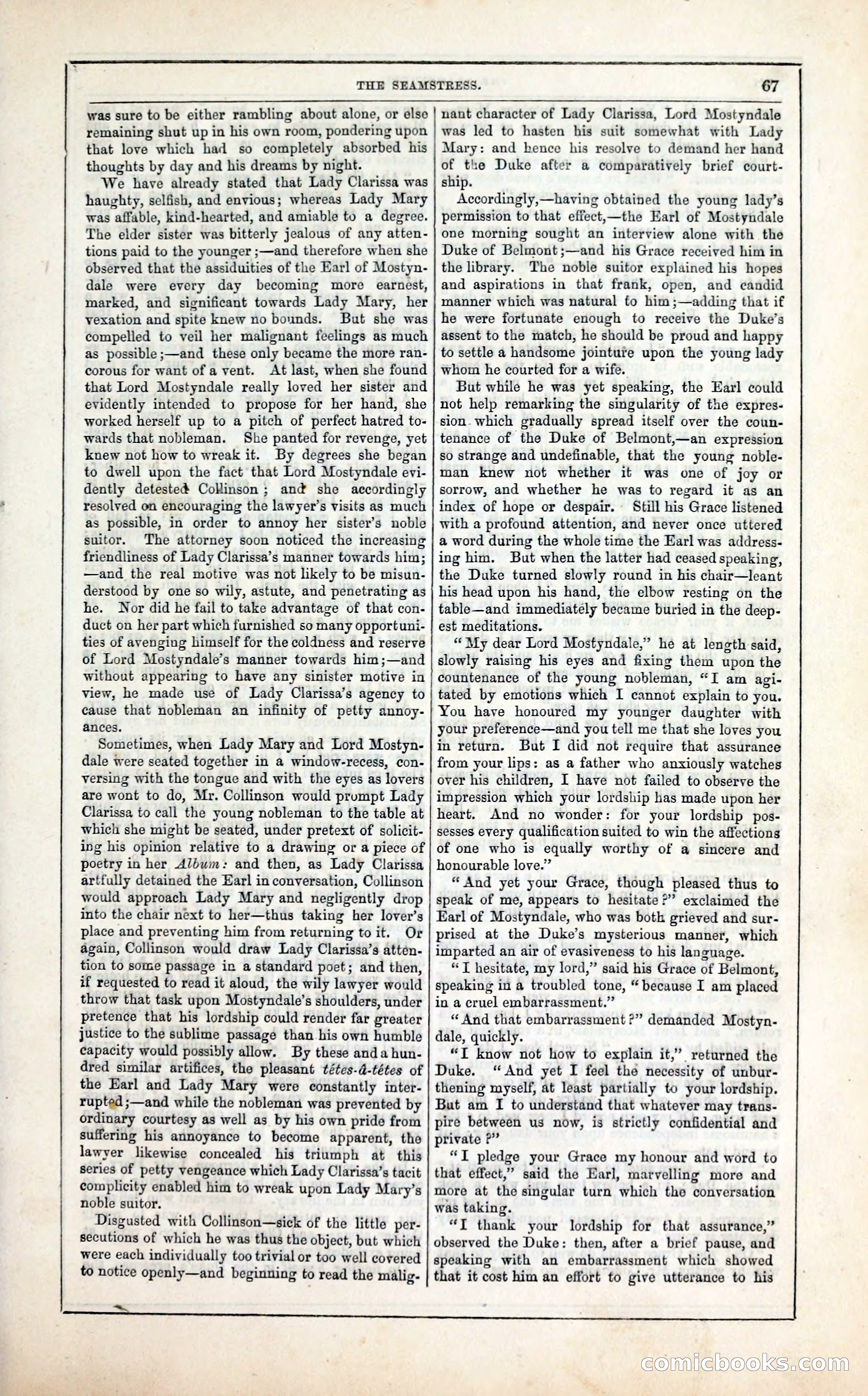
A restored page from Penny Dreadfuls, 1853. Page through the whole issue in the reader above.
📄 Transcribed text from this page (OCR, searchable)
Machine-transcribed from the original scan — historical spelling and the odd misread are preserved.
was sure to be either rambling about alone, or else remaining shut up in his own room, pondering upon that love which had so completely absorbed his thoughts by day and his dreams by night. We have already stated that Lady Clarissa was haughty, selfish, and envious; whereas Lady Mary was affable, kind-hearted, and amiable to a degree. The elder sister was bitterly jealous of any atten- tions paid to the younger ;—and therefore when she observed that the assiduities of the Earl of Mostyn- dale were every day becoming more earnest, marked, and significant towards Lady Mary, her vexation and spite knew no bounds. But she was compelled to veil her malignant feelings as much as possible ;—and these only became the more ran- corous for want of a vent. At last, when she found that Lord Mostyndale really loved her sister and evidently intended to propose for her hand, she worked herself up to a pitch of perfect hatred to- wards that nobleman. She panted for revenge, yet knew not how to wreak it. By degrees she began to dwell upon the fact that Lord Mostyndale evi- dently deteste@# Collinson; and she accordingly resolved on encouraging the lawyer’s visits as much as possible, in order to annoy her sister’s noble suitor. The attorney soon noticed the increasing friendliness of Lady Clarissa’s manner towards him; —and the real motive was not likely to be misun- derstood by one so wily, astute, and penetrating as he. Nor did he fail to take advantage of that con- duct on her part which furnished so many opportuni- ties of avenging himself for the coldness and reserve of Lord Mostyndale’s manner towards him;—and without appearing to have any sinister motive in view, he made use of Lady Clarissa’s agency to cause that nobleman an infinity of petty annoy- ances. Sometimes, when Lady Mary and Lord Mostyn- dale were seated together in a window-recess, con- versing with the tongue and with the eyes as lovers are wont to do, Mr. Collinson would prumpt Lady Clarissa to call the young nobleman to the table at which she might be seated, under pretext of solicit- ing his opinion relative to a drawing or a piece of poetry in her Album: and then, as Lady Clarissa artfully detained the Earl in conversation, Collinson would approach Lady Mary and negligently drop into the chair next to her—thus taking her lover’s place and preventing him from returning toit. Or again, Collinson would draw Lady Clarissa’s atten- tion to some passage in a standard poet; and then, if requested to read it aloud, the wily lawyer would throw that task upon Mostyndale’s shoulders, under pretence that his lordship could render far greater justice to the sublime passage than his own humble capacity would possibly allow. By these anda hun- dred similar artifices, the pleasant tétes-d-tétes of the Harl and Lady Mary were constantly inter- rupted ;—and while the nobleman was prevented by ordinary courtesy as well as by his own pride from suffering his annoyance to become apparent, the lawyer likewise concealed his triumph at this series of petty vengeance which Lady Clarissa’s tacit complicity enabled him to wreak upon Lady Mary’s noble suitor. Disgusted with Collinson—sick of the little per- secutions of which he was thus the object, but which were each individually too trivial or too well covered to notice openly—and beginning to read the malig- b- THE SEAMSTRESS. 67 nant character of Lady Clarissa, Lord Mostyndale was led to hasten his suit somewhat with Lady Mary: and hence his resolve to demand her hand of the Duke after a comparatively brief court- ship. Accordingly,—having obtained the young lady’s permission to that effect,—the Earl of Mostyndale one morning sought an interview alone with the Duke of Belmont ;—and his Grace received him in the library. The noble suitor explained his hopes and aspirations in that frank, open, and candid manner which was natural fo him ;—adding that if he were fortunate enough to receive the Duke’s assent to the match, he should be proud and happy to settle a handsome jointure upon the young lady whom he courted for a wife. But while he was yet speaking, the Earl could not help remarking the singularity of the expres- sion- which gradually spread itself over the coun- tenance of the Duke of Belmont,—an expression so strange and undefinable, that the young noble- man knew not whether it was one of joy or sorrow, and whether he was to regard it as an index of hope or despair. Still his Grace listened with a profound attention, and never once uttered a word during the whole time the Earl was address- ing him. But when the latter had ceased speaking, the Duke turned slowly round in his chair—leant his head upon his hand, the elbow resting on the table—and immediately became buried in the deep- est meditations. “My dear Lord Mostyndale,” he at length said, slowly raising his eyes and fixing them upon the countenance of the young nobleman, “I am agi- tated by emotions which I cannot explain to you. You have honoured my younger daughter with your preference—and you tell me that she loves you in return. But I did not require that assurance from your lips: as a father who anxiously watches over his children, I have not failed to observe the impression which your lordship has made upon her heart. And no wonder: for your lordship pos- sesses every qualification suited to win the affections of one who is equally worthy of a sincere and honourable love.” “And yet your Grace, though pleased thus to speak of me, appears to hesitate?” exclaimed the Earl of Mostyndale, who was both grieved and sur- prised at the Duke’s mysterious manner, which imparted an air of evasiveness to his language. “T hesitate, my lord,” said his Grace of Belmont, speaking in a troubled tone, “because I am placed in a cruel embarrassment.” “ And that embarrassment ?” demanded Mostyn- dale, quickly. “T know not how to explain it,” returned the Duke. “And yet I feel the necessity of unbur- thening myself, at least partially to your lordship. But am I to understand that whatever may trans- pire between us now, is strictly confidential and private P” “TI pledge your Grace my honour and word to that effect,” said the Earl, marvelling more and more at the singular turn which the conversation was taking. “T thank your lordship for that assurance,” observed the Duke: then, after a brief pause, and speaking with an embarrassment which showed that it cost him an effort to give utterance to his EoOmichboo (EO)