
Penny Dreadfuls, 1853 · page 9 of 151
The Seamstress; or, The White Slave of England — page 9: what you’re looking at
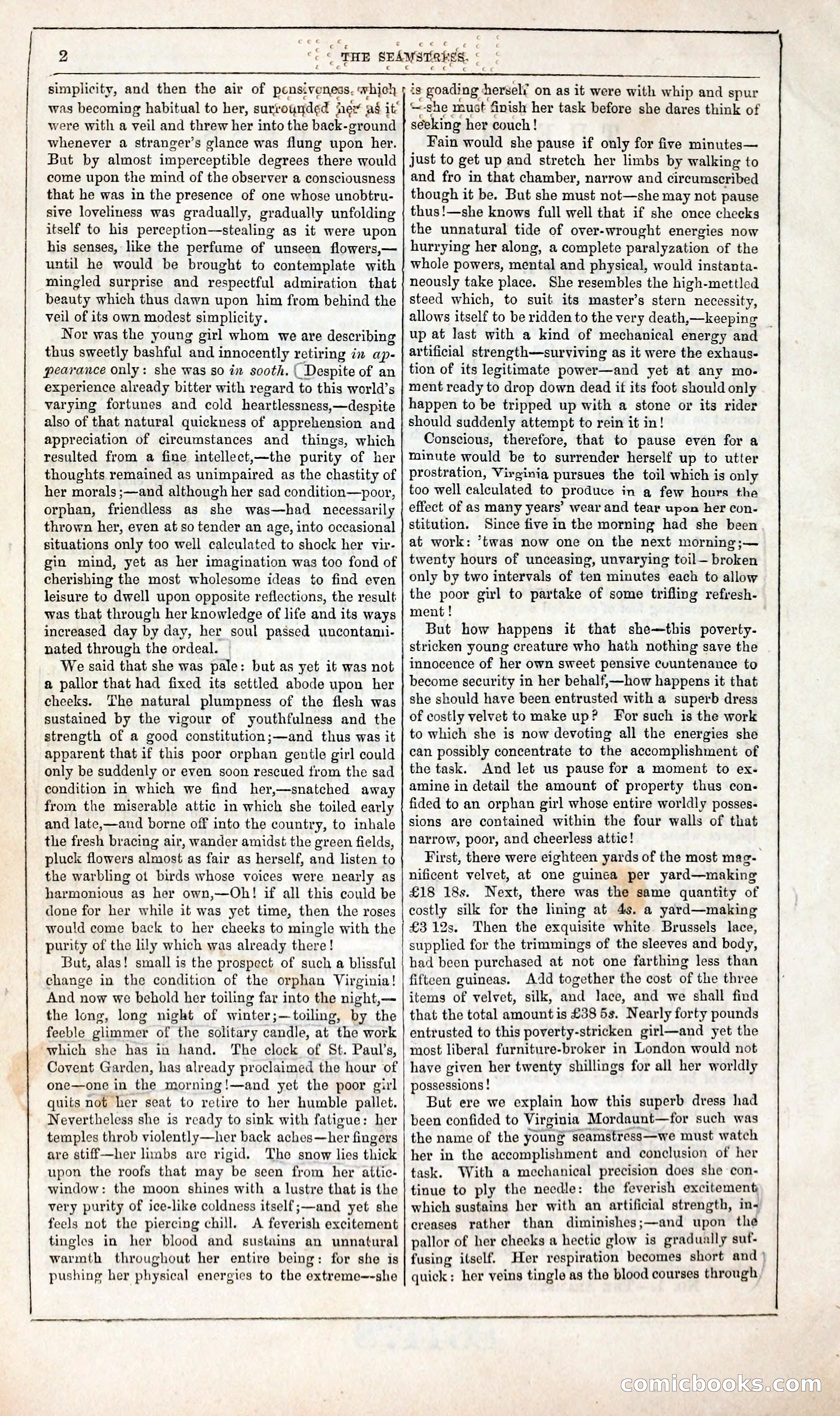
A restored page from Penny Dreadfuls, 1853. Page through the whole issue in the reader above.
📄 Transcribed text from this page (OCR, searchable)
Machine-transcribed from the original scan — historical spelling and the odd misread are preserved.
t t f « ‘ 2 é THE sninsinteies —- simplicity, and then the air of pens:voness. which was becoming habitual to her, surrounded ner ag it were with a veil and threw her into the back- ground whenever a stranger’s glance was flung upon her. But by almost imperceptible degrees there would come upon the mind of the observer a consciousness that he was in the presence of one whose unobtru- sive loveliness was gradually, gradually unfolding itself to his perception—stealing as it were upon his senses, like the perfume of unseen flowers,— until he would be brought to contemplate with mingled surprise and respectful admiration that beauty which thus dawn upon him from behind the veil of its own modest simplicity. Nor was the young girl whom we are describing thus sweetly bashful and innocently rebiring in ap- pearance only: she was so in sooth. | Despite of an experience already bitter with eecd to this world’s varying fortunes and cold heartlessness,—despite also of that natural quickness of apprehension and appreciation of circumstances and things, which resulted from a fine intellect,—the purity of her thoughts remained as unimpaired as the chastity of her morals ;—and although her sad condition—poor, orphan, friendless as she was—had necessarily thrown her, even at so tender an age, into occasional situations only too well calculated to shock her vir- gin mind, yet as her imagination was too fond of cherishing the most wholesome ideas to find even leisure to dwell upon opposite reflections, the result was that through her knowledge of life and its ways increased day by day, her soul passed uncontami- nated through the ordeal. We said that she was pale: but as yet it was not a pallor that had fixed its settled abode upon her cheeks. The natural plumpness of the flesh was sustained by the vigour of youthfulness and the strength of a good constitution;—and thus was it apparent that if this poor orphan gentle girl could only be suddenly or even soon rescued from the sad condition in which we find her,—snatched away from the miserable attic in which she toiled early and late,—and borne off into the country, to inhale the fresh bracing air, wander amidst the green fields, pluck flowers almost as fair as herself, and listen to the warbling ot birds whose voices were nearly as harmonious as her own,—Oh! if all this could be done for her while it was yet time, then the roses would come back to her cheeks to minele with the purity of the hly which was already there! But, alas! small is the prospect of such a blissful change in the condition of the orphan Virginia! And now we behold her toiling far into the night,— the long, long night of winter ;—toiling, by the feeble glimmer of the solitary candle, at the work which she has in hand. The clock of St. Paul’s, Covent Garden, has already proclaimed the hour of one—one in the morning!—and yet the poor girl quits not her seat to retire to her humble pallet. Nevertheless she is ready to sink with fatigue: her temples throb violently—her back aches—her fingers are stiff—her limbs are rigid. The snow lies thick upon the roofs that may be seen from her attic- window: the moon shines with a lustre that is the very purity of ice-like coldness itself;—and yet she feels not the piercing chill. A feverish excitement tingles in her blood and sustains an unnatural warmth throughout her entire being: for she is pushing her physical energies to the extreme--she is goading herself on as it were with whip and spur _-ghe must Anish her task before she dares think of seeking her couch! Fain would she pause if only for five minutes— just to get up and stretch her limbs by walking to and fro in that chamber, narrow and circumscribed though it be. But she must not—she may not pause thus!—she knows full well that if she once checks the unnatural tide of over-wrought energies now hurrying her along, a complete paralyzation of the whole powers, mental and physical, would instanta- neously take place. She resembles the high-mettled steed which, to suit its master’s stern necessity, allows itself to be ridden to the very death,—keeping _ up at last with a kind of mechanical energy and artificial streneth—surviving as it were the exhaus- tion of its legitimate power—and yet at any mo- ment ready to drop down dead if its foot should only happen to be tripped up with a stone or its rider should suddenly attempt to rein it in! Conscious, therefore, that to pause even for a minute would be to surrender herself up to utter prostration, Virginia pursues the toil which is only too well calculated to produce in a few hours the effect of as many years’ wear and tear upon her con- stitution. Since five in the morning had she been at work: ‘twas now one on the next morning;— twenty hours of unceasing, unvaryine toil— broken only by two intervals of ten minutes each to allow the poor girl to partake of some trifling refiresh- ment! But how happens it that she—this poverty- stricken young creature who hath nothing save the innocence of her own sweet pensive evuntenance to become security in her behalf,—how happens it that she should have been entrusted with a superb dress of costly velvet to make up? For such is the work to which she is now devoting all the energies she can possibly concentrate to the accomplishment of the task. And let us pause for a moment to ex. amine in detail the amount of property thus con- fided to an orphan girl whose entire worldly posses- sions are contained within the four walls of that narrow, poor, and cheerless attic! First, there were eighteen yards of the most mag- nificent velvet, at one guinea per yard—making £18 18s. Next, there was the same quantity of costly silk for the lining at 4s. a yard—making (£3 12s. Then the exquisite white Brussels lace, aipphed for the trimmings of the sleeves and body, had been purchased at not one farthing less than fifteen guineas. Add together the cost of the three items of velvet, silk, and lace, and we shall find that the total amount is £38 5s. Nearly forty pounds entrusted to this poverty-stricken girl—and yet the most liberal furniture-broker in London would not have given her twenty shillings for all her worldly possessions! But ere we explain how this superb dress had been confided to Virginia Mordaunt—for such was the name of the youn® seamstress—we must watch her in the accomplishment and conclusion of her task. With a mechanical precision does she con- tinue to ply the necdle: the feverish excitement which sustains her with an artificial strength, in- creases rather than diminishes;—and upon the pallor of her checks a heetie glow is gradually suf- fusing itself. Her respiration becomes short and | quick: her veins tingle as the blood courses through Ibook