
Penny Dreadfuls, 1853 · page 13 of 231
The Soldier's Wife — page 13: what you’re looking at
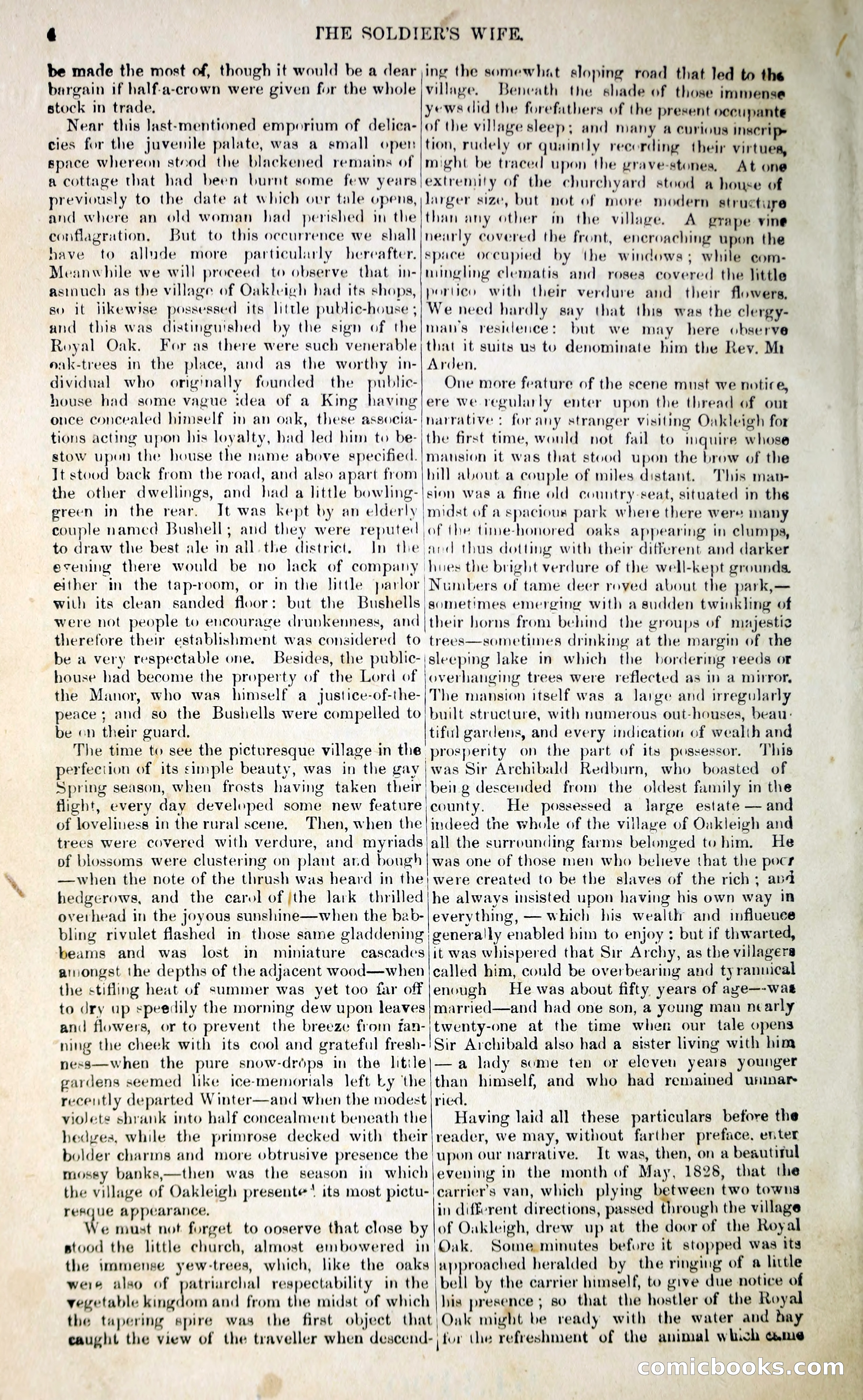
A restored page from Penny Dreadfuls, 1853. Page through the whole issue in the reader above.
📄 Transcribed text from this page (OCR, searchable)
Machine-transcribed from the original scan — historical spelling and the odd misread are preserved.
‘ THE SOLDIER'S WIFE. be made the most of, though it would be a dear bargain if half-a-crown were given for the whole stock in trade, Near this Jast-mentioned emporium of delica- cies for the juvemle palate, was a small open space whereon stood the blackened remains of a cottage that had been burnt some few years previously to the date at which our tale opens, and where an old woman had perished in the conflagration, But to this occurrence we shall have to allude more particularly hereafter, Meanwhile we will proceed to observe that in- asinuch as the village of Oakleigh had its shops, so it likewise possessed its little public-house ; and this was distinguished by the sign of the Royal Oak, For as there were such venerable aak-trees in the place, and as the worthy in- dividual who origmally founded the public- house had some vague idea of a King having once concealed himself in an oak, these associa- tions acting upon his loyalty, bad led him to be- stow upon the house the name above specified. It stood back from the road, and also apart from the other dwellings, and had a little bowling- 2 ee ing the somewhat sloping road that led to the villaye. Beneath the shade of those immense yews did the forefathers of the present oceupante of the village sleep; and many a evrious Insc p tion, rudely or quaintly recording their virtues, might be traced upon the grave-stones, At one extremity of the churchyard stood a house of larger size, but not of more modern structure than any other m the village. A grape vine nearly covered the front, eneroaching upon the space oceupied by the windows; while eom- mingling clematis and roses covered the little portico with their verdure and their flowers, We need hardly say that this was the clergy- mans residence: but we may here observe that it suits us to denominate him the Rey. Ma Arden. One more feature of the scene must we notice, ere we regularly enter upon the thread of our narrative: for any stranger visiting Oakleigh for the first time, would not fail to imquire whose mansion it was that stood upon the brow of the hill about a couple of miles distant. This man- sion was a fine old country-seat, situated in the erecn in the rear. It was kept by an elderly | midst of a spacious park where there were any couple named Bushell; and they were reputed of the time-honored oaks appearing in clumps, to draw the best ale in all the district. In the and thus dotting with their different and darker esening there would be no lack of company jues the bright verdure of the well-kept grounds. either in the tap-room, or in the little parlor Numbers of tame deer royed about the park,— with its clean sanded floor: but the Bushells sometimes emerging with a sudden twinkling of were not people to encourage drunkenness, and|their horns from behind the groups of majestic therefore their establishment was considered to trees—sometimes drinking at the margin of the be a very respectable one. Besides, the public-jsleeping lake in which the bordering reeds or house had become the property of the Lord of joverhanging trees were reflected as in a mirror, the Manor, who was himself a justice-of-the-;}The mansion itself was a Jarge and irregularly peace ; and so the Bushells were compelled to/ built structure, with numerous out-houses, beau: be on their guard. tif) gardens, and every indication of wealth and The time to see the picturesque village in the prosperity on the part of its possessor. This perfection of its simple beauty, was in the gay jwas Sir Archibald Redburn, who boasted of Spring season, when frosts having taken their) being descended from the oldest family in the flight, every day developed some new feature; county. He possessed a large estate — and of loveliness in the rural scene, Then, when the|indeed the whole of the villave of Oakleigh and trees were covered with verdure, and myriads|all the surrounding farms belonged to him, He of blossoms were clustering on plant and bough|was one of those men who believe that the pocr —when the note of the thrush was heard in the) were created to be the slaves of the rich; avd hedgerows, and the carol of |the Jark thrilled|he always insisted upon having his own way in overhead in the joyous sunshine—when the bab-|everything, — which his wealth and influeuee bling rivulet flashed in those same gladdening | genera!ly enabled bim to enjoy : but if thwarted, beams and was lost in miniature cascades|it was whispered that Sir Archy, as the villagers amongst the depths of the adjacent wood—when |ealled him, could be overbearing and ty rannical the stifling heat of summer was yet too far off |enough He was about fifty years of age—-was to dry up speedily the morning dew upon leaves |married—and had one son, a young man nearly and flowers, or to prevent the breeze from fan- twenty-one at the time when our tale opens ———— ning the cheek with its cool and grateful fresh- ness—when the pure snow-drops in the litile gardens seemed like ice-memorials left Ly ‘the recently departed Winter—and when the modest violets shrank into half concealment beneath the hedyes, while the primrose decked with their bolder charms and more obtrusive presence the mossy banks,—then was the season in which the village of Oakleigh presente? its most pictu- resque appearance. W e must not forget to ooserve that close by stood the little church, almost embowered in) the immense yew-trees, which, like the oaks wee also of patriarchal respectability in the vyevetable a a and from the midst of which SES SE eS Sir Archibald also had a sister living with him —a lady some ten or eleven years younger than himself, and who had remained uninar ried, Having laid all these particulars before the reader, we may, without farther preface, enter upon our narrative. It was, then, on a besutirul evening in the month of May, 1828, that the carrier's van, which plying heres two towns in different directions, passed through the village of Oakleigh, drew up at the door of the Royal Oak. Some minutes before it stopped was its approached heralded by the ringing of a little bell by the carrier himself, to give due notice of his presence; so that the hostler of the Royal the tapering spire was the first object that) Onk might be ready with the water and hay caught the view of the traveller when descend: | for the refreshment of the animal which eme Comicbooks.com