
Penny Dreadfuls, 1853 · page 133 of 231
The Soldier's Wife — page 133: what you’re looking at
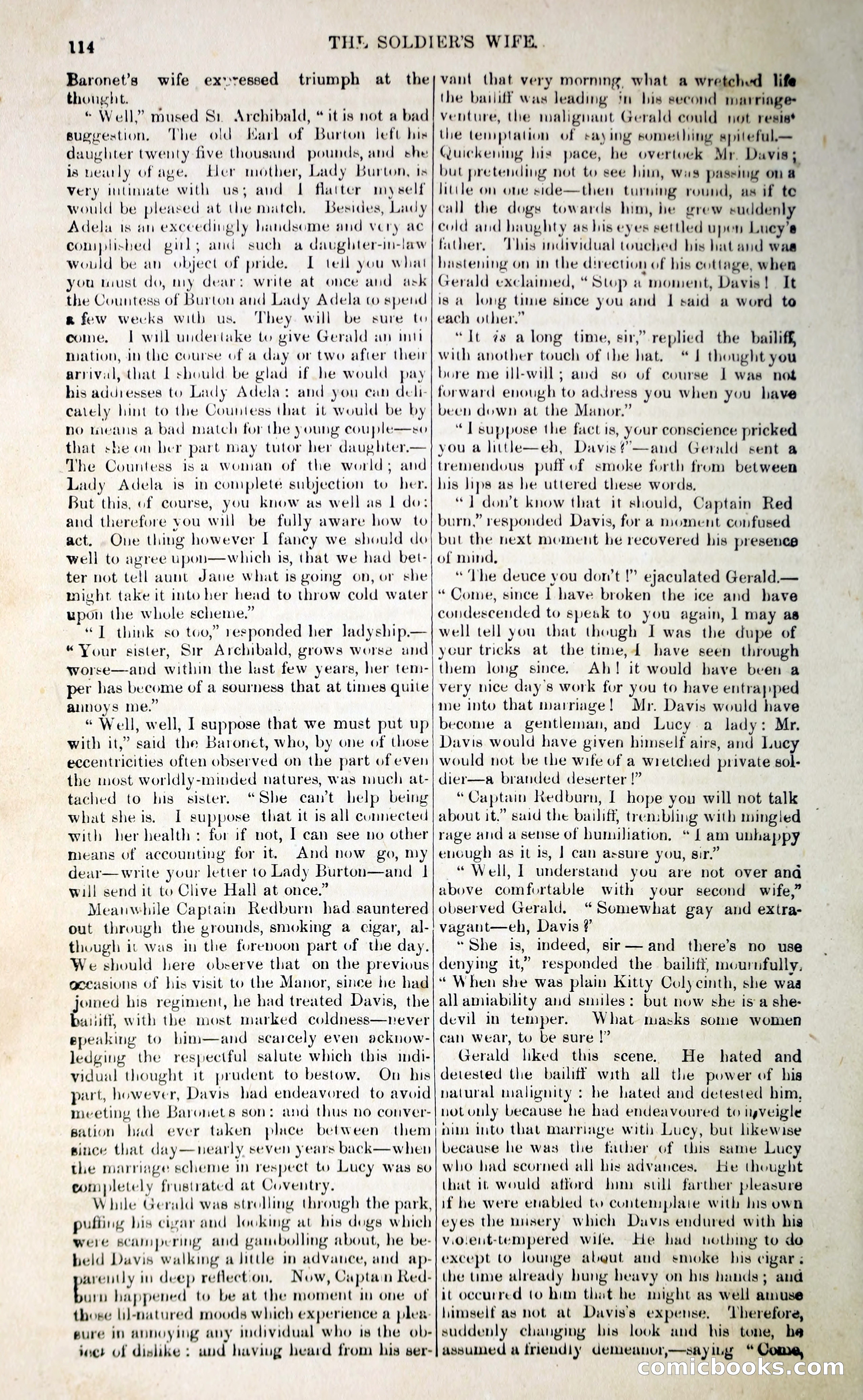
A restored page from Penny Dreadfuls, 1853. Page through the whole issue in the reader above.
📄 Transcribed text from this page (OCR, searchable)
Machine-transcribed from the original scan — historical spelling and the odd misread are preserved.
114 Baronet’s wife ex-ressed thought. * Well,” mused Si Archibald, “ it is not a bad suggestion. The old Marl of Burton left his daughter twenty five thousand pounds, and she Is nearly of age. Her mother, Lady Burton, ts very intimate with us; and 1 flatter myself would be pleased at the match, Besides, Lady Adela is an exccedingly handsome and very ac complished gil; and such a daughter-in-law would be an object of pride. I tell you what you tiust do, my dear: write at once and ask the Countess of Burton and Lady Adela co spend afew weeks with us. They will be sure to come. | will undertake to give Gerald an int mation, in the course of a day or two after then arrival, that L should be glad if he would) pay his addresses to Lady Adela: and you can deli calely hint to the Countess that it would be by no means a bad match for the young couple—so that she ou ber part may tutor her daughter,— The Countess is a woman of the world; and Lady Adela is in complete subjection to her. But this, of course, you know as well as I do: and therefore vou will be fully aware how to act. One thing however I faney we should do well to agree upou—which 1s, that we had bet- ter not tell aunt Jane what is going on, or she might take it into her head to throw cold water upon the whole scheme.” “JT think so too,” responded her ladyship.— “Your sister, Sir Archibald, grows worse and worse—and within the last few years, her tem- per has become of a sourness that at times quite annoys me.” “Well, well, I suppose that we must put up with it,” said the Baronet, who, by one of those eccentricities often observed on the part of even the most worldly-minded natures, was much at- tached to his sister, “She can’t help being what she is. I suppose that it is all connected with her health: for if not, I can see no other means of accounting for it, And now go, my dear—write your letter to Lady Burton—and | will send it to Clive Hall at once.” Meanwhile Captain Redburn had sauntered out through the grounds, smoking a cigar, al- though it was in the forenoon part of the day. We should here observe that on the previous oceasions of his visit to the Manor, since he had joimed his regiment, he had treated Davis, the baniff, with the most marked coldness—rever epeaking to him—and scarcely even acknow- ledging the respectful salute which this mdi- vidual thought it prudent to bestow. On his part, however, Davis had endeavored to avoid meeting the Baronets son: and thus no conver- gation had ever taken place between them since that day—nearly seven years back—when the marriage scheme in respect to Lucy was so wmpletely frustrated at Coventry. While Gerald was strolling through the park, puffing bis ciyar and looking at his dogs which were scampering and gaubolling about, he be- beld Davis walking a little in advance, and ap- yarenily in deep reflection, Now, Captain Red- aed happened to be at the moment in one of those lil-natured moods which experience a ples. gure in annoying any individual who is the ob- inet Of divlike : und having heard from his ser- triumph at the THE SOLDIERS WIFE,. vant that very morning, what a wr the bailiff was leading in bis second marriage venture, the malignant Gerald could not resis* the temptation of saying something spiteful (Juickenmyg his pace, he overtuek Mr. Davis; but pretending not to see hin, Wis passing On 4 litile on one side—then turning round, as if te call the dogs towards him, he grew suddenly cold and haughty as his eyes settled upen Luey’s father, This individual touched his hat and waa hastening on in the direction of his cottage, when Gerald exclaimed, “ Stop a moment, Davis! It isa long time since you and I said a word to each other.” “It ds along time, sir,” replied the bailiff, with another touch of the hat. “ J thought you bore me ill-will; and so of course | was not forward enough to address you when you have becn down at the Manor,” “T suppose the fact is, your conscience pricked you a litthe—eh, Davis ?’—and Gerald sent a tremendous puff of smoke forth from between his Jips as he uttered these words. “J don’t know that it should, Captain Red burn,” responded Davis, for a moment confused but the next moment he recovered his presences of mind, “The deuce you don’t !” ejaculated Gerald.— “ Come, since | have broken the ice and have coudescended to speak to you again, ] may as well tell you that though I was the dupe of yeur tricks at the time,d have seen through them long since. Ah! it would have been a very nice day's work for you to have entrapped me Into that marriage! Mr. Davis would have become a gentleman, and Lucy a lady: Mr, Davis would have given himself airs, and Luey would not be the wife of a wretched private sol- dier—a branded deserter !” “Captain Redburn, I hope you will not talk about it.” said the bailiff, trembling with mingled rage and a sense of humiliation, “ {am unhappy enough as it 1s, |] can assure you, sir.” “Well, 1 understand you are not over and above comfortable with your second wife,” observed Gerald. “Somewhat gay and extra- vagant—eh, Davis? “She is, indeed, sir— and there’s no use denying it,” responded the. bailiff, mournfully, “When she was plain Kitty Colycinth, she waa all amiability and smiles: but now she isa she- devil in temper. What masks some women can Wear, to be sure !” Gerald lked this scene. He hated and detested the bailiff with all the power of his palural malignity : he hated and detested him, not only because he had endeavoured to iyveigle ni into that marriage with Luey, but likewise because he was the father of this same Luey who had scorned all his advances, He thought (that it would afford him sull farther pleasure if he were enabled to contemplate with lis own eyes the nusery which Davis endured with his v.iolent-tempered wile. He had nothing to do except to lounge abeut and smoke his cigar ; the ime already bung heavy on his hands; and it occurred (o him that he might as well amuse himself as not at Davis's expense, ‘Therefore, suddenly changing bis look and his tone, he assumed a friendly demeanor,—saying “ etched life <S) (eo payiicel exeye) rae)