
Penny Dreadfuls, 1853 · page 148 of 231
The Soldier's Wife — page 148: what you’re looking at
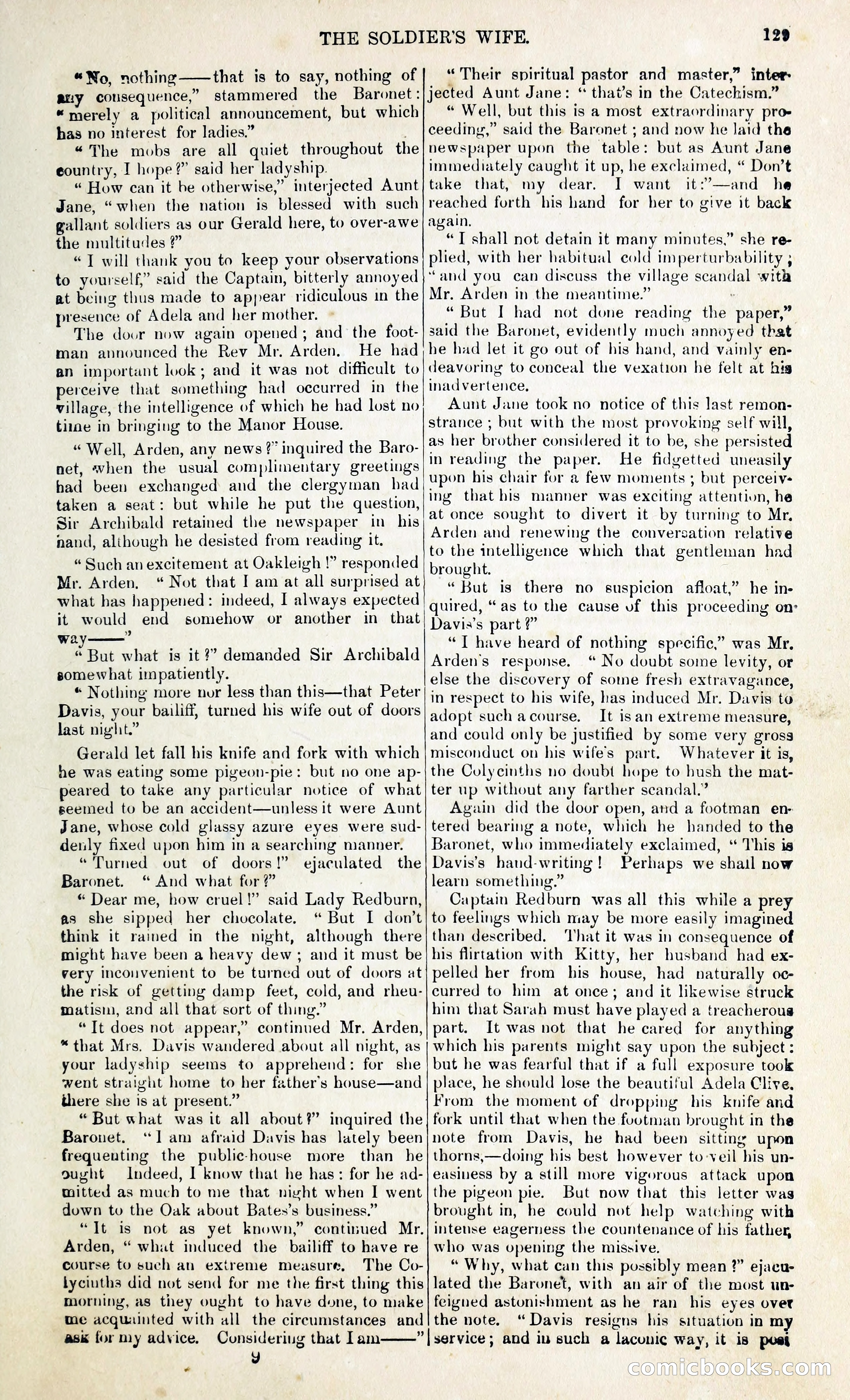
A restored page from Penny Dreadfuls, 1853. Page through the whole issue in the reader above.
📄 Transcribed text from this page (OCR, searchable)
Machine-transcribed from the original scan — historical spelling and the odd misread are preserved.
THE SOLDIER'S WIFE. “Wo, nothing——that is to say, nothing of ary cousequence,” stammered the Baronet: “merely a political announcement, but which has no interest for ladies.” 3 “The mobs are all quiet throughout the country, I hope?’ said her ladyship. “ How can it be otherwise,” interjected Aunt Jane, “when the nation is blessed with such gallant soldiers as our Gerald here, to over-awe the multitudes ?” «JT will thank you to keep your observations to yourself,” said the Captain, bitterly annoyed at being thus made to appear ridiculous in the presence of Adela and her mother. The door now again opened; and the foot- man announced the Rev Mr. Arden, He had an important look; and it was not difficult to erceive that something had occurred in the village, the intelligence of which he had lost no time in bringing to the Manor House. “Well, Arden, any news ?” inquired the Baro- net, when the usual complimentary greetings had been exchanged and the clergyman had taken a seat: but while he put the question, Sir Archibald retained the newspaper in his nand, although he desisted from reading it. “Such an excitement at Oakleigh !” responded Mr. Arden, “ Not that I am at all surprised at what has happened: indeed, I always expected it would end somehow or another in that way ‘ “But what is it?’ demanded Sir Archibald somewhat impatiently. “ Nothing more nor less than this—that Peter Davis, your bailiff, turned his wife out of doors last night.” Gerald let fall his knife and fork with which he was eating some pigeon-pie: but no one ap- peared to take any particular notice of what seemed to be an accident—unless it were Aunt Jane, whose cold glassy azure eyes were sud- denly fixed upon him in a searching manner. “Turned out of doors!” ejaculated the Baronet. “ And what for?” ) “ Dear me, how cruel!” said Lady Redburn, as she sipped her chocolate. “ But I don’t think it rained in the night, although there might have been a heavy dew; and it must be very inconvenient to be turned out of doors at the risk of getting damp feet, cold, and rheu- matisi, and all that sort of thing.” “Tt does not appear,” continued Mr. Arden, “that Mrs. Davis wandered about all night, as your ladyship seems to apprehend: for she went straight home to her father’s house—and there she is at present.” “But what was it all about?’ inquired the Barouet. “1am afraid Davis has lately been frequenting the public-house more than he ought Indeed, I know that he has: for he ad- mitted as much to me that night when I went down to the Oak about Bates’s business.” “Tt is not as yet known,” continued Mr. Arden, “ whut induced the bailiff to have re course to such an exireme measure, The Co- lyciuths did not send for me the first thing this morning, as they ought to have done, to make me acquainted with all the circumstances and ask for my advice. Cunsideriug that lam i J * 129 “Their spiritual pastor and master,” inter- jected Aunt Jane: “ that’s in the Catechism.” “ Well, but this is a most extraordinary pro- ceeding,” said the Baronet ; and now he laid the newspaper upon the table: but as Aunt Jane immediately caught it up, he exclaimed, “ Don’t take that, my dear. JT want it:’—and he reached furth his hand for her to give it back again, “T shall not detain it many minutes,” she re- plied, with her habitual cold imperturbability ; “and you can discuss the village scandal with Mr. Arden in the meantime.” . “But I had not done reading the paper,” said the Baronet, evidently much annoyed that he had let it go out of his hand, and vainly en- deavoring to conceal the vexation he felt at bis inadvertence, Aunt Jane took no notice of this last remon- strance ; but with the most provoking self will, as her brother considered it to be, she persisted in reading the paper. He fidgetted uneasily upon his chair for a few moments ; but perceiv- Ing that his manner was exciting attention, he at once sought to divert it by turning to Mr, Arden and renewing the conversation relative to the intelligence which that gentleman had brought. “But is there no suspicion afloat,” he in- quired, “as to the cause vf this proceeding on Davis’s part ?” “| have heard of nothing specific,” was Mr. Arden’s response. “ No doubt some levity, or else the discovery of some fresh extravagance, In respect to his wife, has induced Mr. Davis to adopt such acourse. It isan extreme measure, and could only be justified by some very gross misconduct on his wifes part. Whatever it is, the Colycinths no doubt hope to hush the mat- ter up without any farther scandal.” Again did the door open, and a footman en- tered bearing a note, which he handed to the Baronet, who immediately exclaimed, “ This is Davis’s hand-writing! Perhaps we shail now learn something.” Captain Redburn was all this while a prey to feelings which may be more easily imagined than described, That it was in consequence of his flirtation with Kitty, her husband had ex- pelled her from his house, had naturally oe- curred to him at once; and it likewise struck him that Sarah must have played a treacherous part. It was not that he cared for anything which his parents might say upon the subject : but he was fearful that if a full exposure took place, he should lose the beautiful Adela Clive. From the moment of dropping his knife and fork until that when the footman brought in the note from Davis, he had been sitting upon thorns,—doing his best however to-veil his un- easiness by a still more vigorous attack upon the pigeon pie. But now that this letter was brought in, he could not help watching with Intense eagerness the countenance of his father, who was opening the missive. “Why, what can this possibly mean ?” ejacu- lated the Baronet, with an air of the most un- feigned astonishment as he ran his eyes over the note. “Davis resigns his situation in my service; and iu such a laconic way, it is poss x” <S CORNICE OOOKS sO) >