
Penny Dreadfuls, 1853 · page 150 of 231
The Soldier's Wife — page 150: what you’re looking at
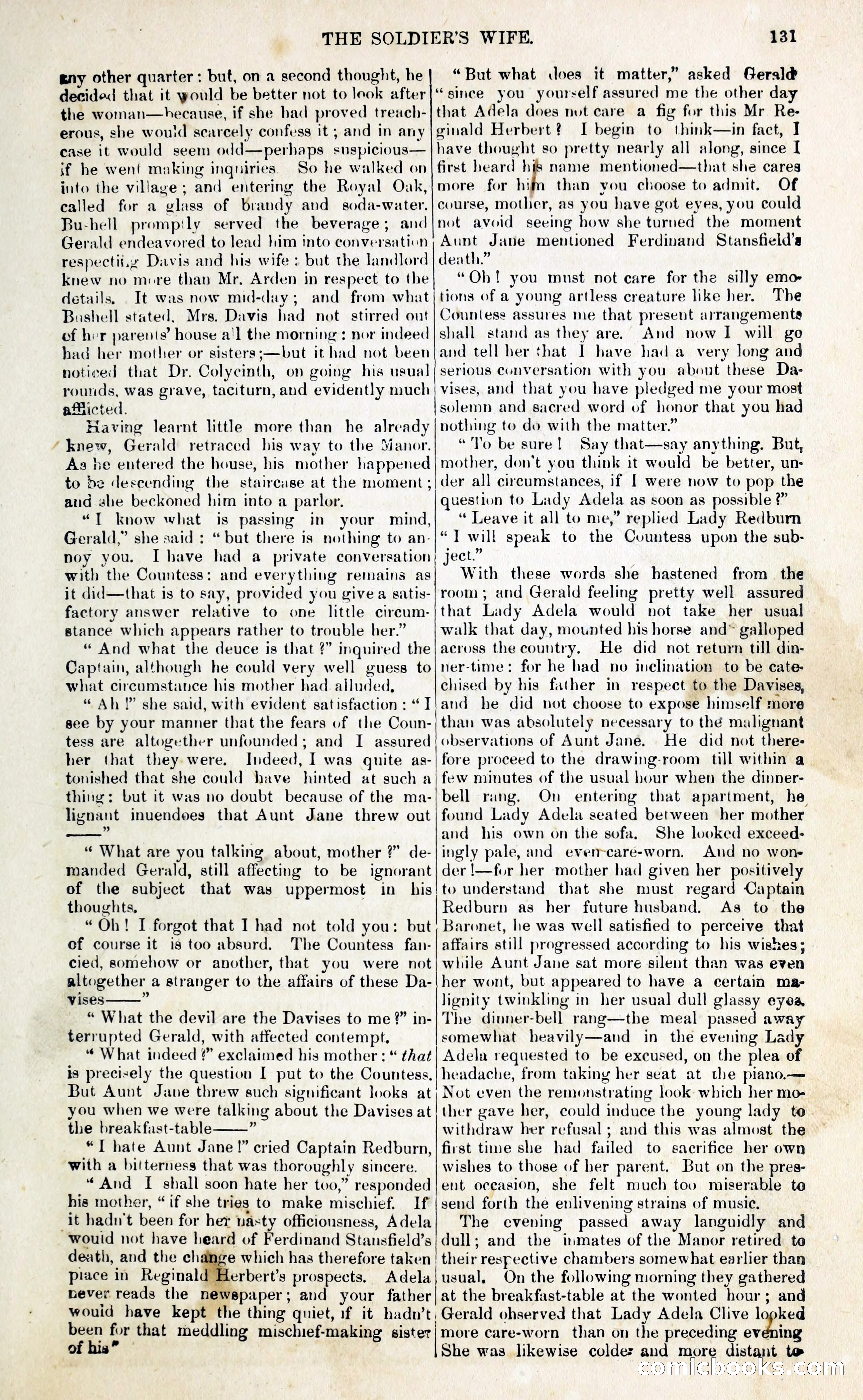
A restored page from Penny Dreadfuls, 1853. Page through the whole issue in the reader above.
📄 Transcribed text from this page (OCR, searchable)
Machine-transcribed from the original scan — historical spelling and the odd misread are preserved.
THE SOLDIER'S WIFE. gny other quarter : but, on a second thought, he decided that it would be better not to look after the woman—hecause, if she had proved treach- erous, she would scarcely confess it ; and in any case it would seem odd—perhaps suspicious— if he went making inquiries. So he walked on into the village; and entering the Royal Oak, called for a glass of brandy and soda-water. Bu-hell prompily served the beverage; and Gerald endeavored to lead him into conversation respectiiie Davis and his wife : but the landlord knew no more than Mr, Arden in respect to the details. It was now mid-day; and from what Bushell stated, Mrs. Davis had not. stirred out of her parents’ house a'l the morning : nor indeed had her mother or sisters;—but it had not been noticed that Dr. Colycinth, on going his usual rounds, was grave, taciturn, and evidently much afficted. Having learnt little more than he already ‘knew, Gerald retraced bis way to the Manor. As he entered the house, his mother happened to be descending the staircase at the moment ; and she beckoned him into a parlor. “T know what is passing in your mind, Gerald,” she said: “but there is nothing to an- noy you. [have had a private conversation with the Countess: and everything remains as it did—that is to say, provided you givea satis- factory answer relative to one little circum- stance which appears rather to trouble her.” “ And what the deuce is that ?” inquired the Captain, although he could very well guess to what circumstance his mother had alluded, “ Ah!” she said, with evident satisfaction : “ I see by your manner that the fears of the Coun- tess are altogether unfounded ; and I assured her that they were. Indeed, I was guite as- tonished that she could have hinted at such a thing: but it was no doubt because of the ma- lignant inuendoes that Aunt Jane threw out ” “ What are you talking about, mother ?” de- manded Gerald, still affecting to be ignorant of the subject that was uppermost in his thoughts, “Ob! I forgot that I had not told you: but of course it is too absurd. The Countess fan- cied, somehow or another, that you were not altogether a stranger to the affairs of these Da- vises 4 “ What the devil are the Davises to me 2” in- terrupted Gerald, with atfected contempt. “ What indeed ? exclaimed his mother: “ that is precisely the question I put to the Countess. But Aunt Jane threw such significant looks at you when we were talking about the Davises at the break fast-table——” “I hate Aunt Jane!” cried Captain Redburn, with a bitterness that was thoroughly sincere. “And I shall soon hate her too,” responded his mother, “if she tries to make mischief. If it hadn't been for her nasty officionsness, Adela would not have heard of Ferdinand Stansfield’s death, and the ald which has therefore taken piace in Reginald Herbert’s prospects. Adela never reads the newspaper; and your father wouid have kept the thing quiet, if it hadn’t; Gerald ohserved that Lady Adela Clive lopked been for that meddling mischef-making sistet| more care-worn than on the preceding oa of his” question to Lady Adela as soon as possible ¢” 131 “But what «oes it matter,” asked Gerald “since you yourself assured me the other day that Adela does nut care a fig for this Mr Re- ginald Herbert? I begin to think—in fact, I have thought so pretty nearly all along, since I first heard his name mentioned—that she cares more for bike than you choose to admit. Of course, mother, as you have got eyes, you could not avoid seeing bow she turned the moment Aunt Jane mentioned Ferdinand Stansfield’s death.” “Oh! you must not care for the silly emo tions of a young artless creature like her. The Countess assures me that present arrangements shall stand as they are. And now I will go and tell her that I have had a very Jong and serious conversation with you about these Da- vises, and that you have pledged me your most solemn and sacred word of honor that you had nothing to do with the matter.” “To be sure! Say that—say anything. But, mother, don’t you think it would be better, un- der all circumstances, if | were now to pop the “ Leave it all to me,” replied Lady Redburn “T will speak to the Cvuntess upon the sub- ject.” With these words she hastened from. the room; and Gerald feeling pretty well assured that Lady Adela would not take her usual walk that day, mounted his horse and* galloped across the country. He did not return till din- ner-time: for he had no inclination to be cate- chised by his father in respect to the Davises, and he did not choose to expose himself more than was absolutely necessary to thé malignant observations of Aunt Jane. He did not there- fore proceed to the drawing-room till within a few minutes of the usual hour when the dinner- bell rang. On entering that apartment, he found Lady Adela seated between her mother and his own on the sofa. She looked exceed: ingly pale, and even-care-worn. And no wone der !—for her mother had given her positively to understand that she must regard Captain Redburn as her future husband. As to the Baronet, he was well satisfied to perceive that affairs still progressed according to his wishes; while Aunt Jane sat more silent than was even her wont, but appeared to have a certain ma- hignity twinkling in her usual dull glassy eyea, The dinner-bell rang—the meal passed away somewhat heavily—and in the evening Lady Adela requested to be excused, on the plea of headache, from taking her seat at the piano.— Not even the remonstrating look which her mo- ther gave her, could induce the young lady to. withdraw her refusal; and this was almost the first time she had failed to sacrifice her own wishes to those of her parent. But on the pres- ent oceasion, she felt much too miserable to send forth the enlivening strains of music. The evening passed away languidly and dull; and the inmates of the Manor retired to their respective chambers somewhat earlier than usual, On the following morning they gathered at the breakfast-table at the wonted hour; and ing She was likewise colder and more distant te GOMIGDoOoks (C(O)