
Penny Dreadfuls, 1853 · page 186 of 231
The Soldier's Wife — page 186: what you’re looking at
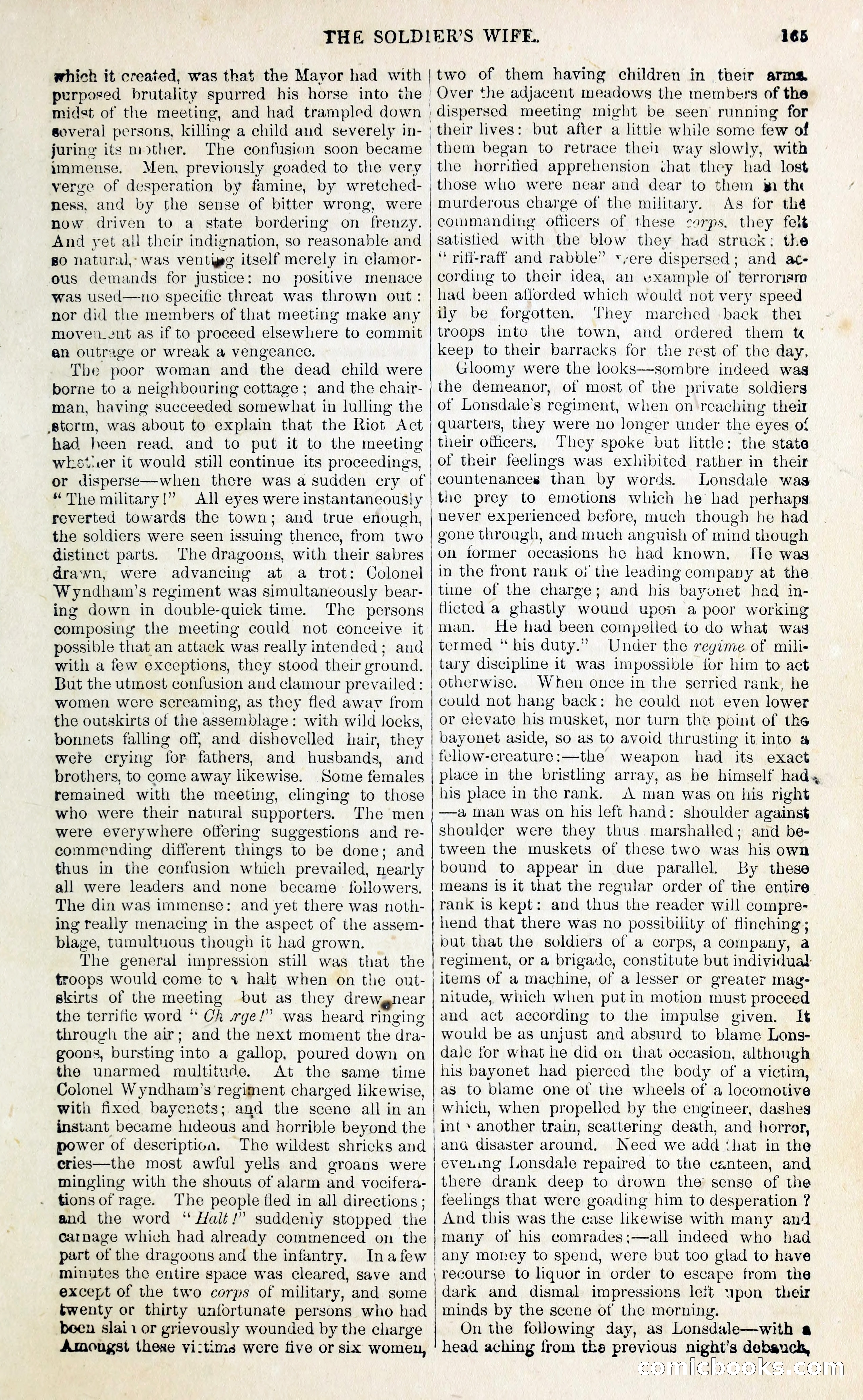
A restored page from Penny Dreadfuls, 1853. Page through the whole issue in the reader above.
📄 Transcribed text from this page (OCR, searchable)
Machine-transcribed from the original scan — historical spelling and the odd misread are preserved.
THE SOLDIER’S WIFE. which it created, was that the Mavor had with purposed brutality spurred his horse into the midst of the meeting, and had trampled down Boveral persons, killing a child and severely in- juring its mother. The confusion soon became immense. Men, previously goaded to the very verge of desperation by famine, by wretched- mess, and by the sense of bitter wrong, were now driven to a state bordering on frenzy. And yet all their indignation, so reasonable and Bo natural, was ventige itself merely in clamor- ous demands for justice: no positive menace was used—no specific threat was thrown out: nor did tle members of that meeting make any movei_sut as if to proceed elsewhere to commit an outrage or wreak a vengeance. The poor woman and the dead child were borne to a neighbouring cottage ; and the chair- man, having succeeded somewhat in lulling the storm, was about to explain that the Riot Act had heen read. and to put it to the meeting wketiuer it would still continue its proceedings, or disperse—when there was a sudden cry of “The military!” All eyes were instantaneously reverted towards the town; and true enough, the soldiers were seen issuing thence, from two distinct parts. The dragoons, with their sabres drawn, were advancing at a trot: Colonel Wyndham’s regiment was simultaneously bear- ing down in double-quick time. The persons composing the meeting could not conceive it possible that an attack was really intended; and with a few exceptions, they stood their ground. But the utmost confusion and clamour prevailed: women were screaming, as they fled away from the outskirts of the assemblage: with wild locks, bonnets falling off, and dishevelled hair, they were crying for fathers, and husbands, and brothers, to come away likewise. Some females remained with the meeting, clinging to those who were their natural supporters. The men were everywhere offering suggestions and re- commending different things to be done; and thus in the confusion which prevailed, nearly all were leaders and none became foilowers. The din was immense: and yet there was noth- ing really menacing in the aspect of the assem- blage, tumultuous though it had grown. The general impression still was that the troops would come to x halt when on the out- slarts of the meeting but as they drewgnear the terrific word “ Ck wrge!” was heard ringing through the air; and the next moment the dra- goons, bursting into a gallop, poured down on the unarmed multitude. At the same time Colonel Wyndham’s regiment charged likewise, with fixed baycnets; and the scene all in an instant became hideous and horrible beyond the power of descriptioa. The wildest shrieks and cries—the most awful yells and groans were mingling with the shouts of alarm and vocifera- tionsof rage. The people fled in all directions ; and the word “ Halt!” suddenly stopped the carnage which had already commenced on the part of the dragoons and the infantry. Inafew minutes the entire space was cleared, save and except of the two corps of military, and some twenty or thirty unfortunate persons who had been slaii or grievously wounded by the charge Amongst there vi-tims were five or six women, they were uo longer under the eyes of — ee oe ee EEE ee EEEEEEEEEEEEEEEEEEEE 165 two of them having children in their arms Over the adjacent meadows the members of the dispersed meeting might be seen running for their lives: but after a little while some few of them began to retrace thei way slowly, with the horrified apprehension chat they had lost those who were near and dear to them jn the murderous charge of the military. As for the commanding officers of these carps, they felt satistied with the blow they had struck: the ‘ rill-raff and rabble” +,ere dispersed; and ac- cording to their idea, an example of terrorism had been afforded which would not very speed ily be forgotten. They marched back thei troops into the town, and ordered them t keep to their barracks for the rest of the day, Gloomy were the looks—sombre indeed was the demeanor, of most of the private soldiers of Lonsdale’s regiment, when on reaching theil their othcers, They spoke but little: the state of their feelings was exhibited rather in their countenances than by words. Lonsdale was the prey to emotions which he had perhaps uever experienced before, much though he had gone through, and much anguish of mind though on former occasions he had known. He was in the front rank oy the leading company at the time of the charge; and his bayonet had in- flicted a ghastly wound upon a poor working man. He had been compelled to do what was termed ‘his duty.” Under the regime of mili- tary discipline it was impossible for him to act otherwise. When once in the serried rank, he could not hang back: he could not even lower or elevate his musket, nor turn the point of the bayonet aside, so as to avoid thrusting it into 4 fellow-creature:—the weapon had its exact place in the bristling array, as he himself had. his place in the rank. A man was on his right —a man was on his left hand: shoulder against shoulder were they thus marshalled; and be- tween the muskets of these two was his own bound to appear in due parallel. By these means is it that the regular order of the entire rank is kept: and thus the reader will compre- hend that there was no possibility of flinching ; but that the soldiers of a corps, a company, a regiment, or a brigade, constitute but individual: items of a machine, of a lesser or greater mag- nitude, which when putin motion must proceed and act according to the impulse given. It would be as unjust and absurd to blame Lons- dale tor what he did on that occasion, although his bayonet had pierced the body of a victim, as to blame one ot the wheels of a locomotive which, when propelled by the engineer, dashes int » another train, scattering death, and horror, and disaster around. Need we add ‘hat in the evening Lonsdale repaired to the canteen, and there drank deep to drown the’ sense of the feelings that were goading him to desperation ? And this was the case likewise with many and many of his comrades;—all indeed who had any money to spend, were but too glad to have recourse to liquor in order to escape from the dark and dismal impressions left upon their minds by the scene of the morning. On the folowing day, as Lonsdale—with a head aching from tks previous night’s debauch, CONMICIOOKS (C(O)