
Penny Dreadfuls, 1853 · page 223 of 231
The Soldier's Wife — page 223: what you’re looking at
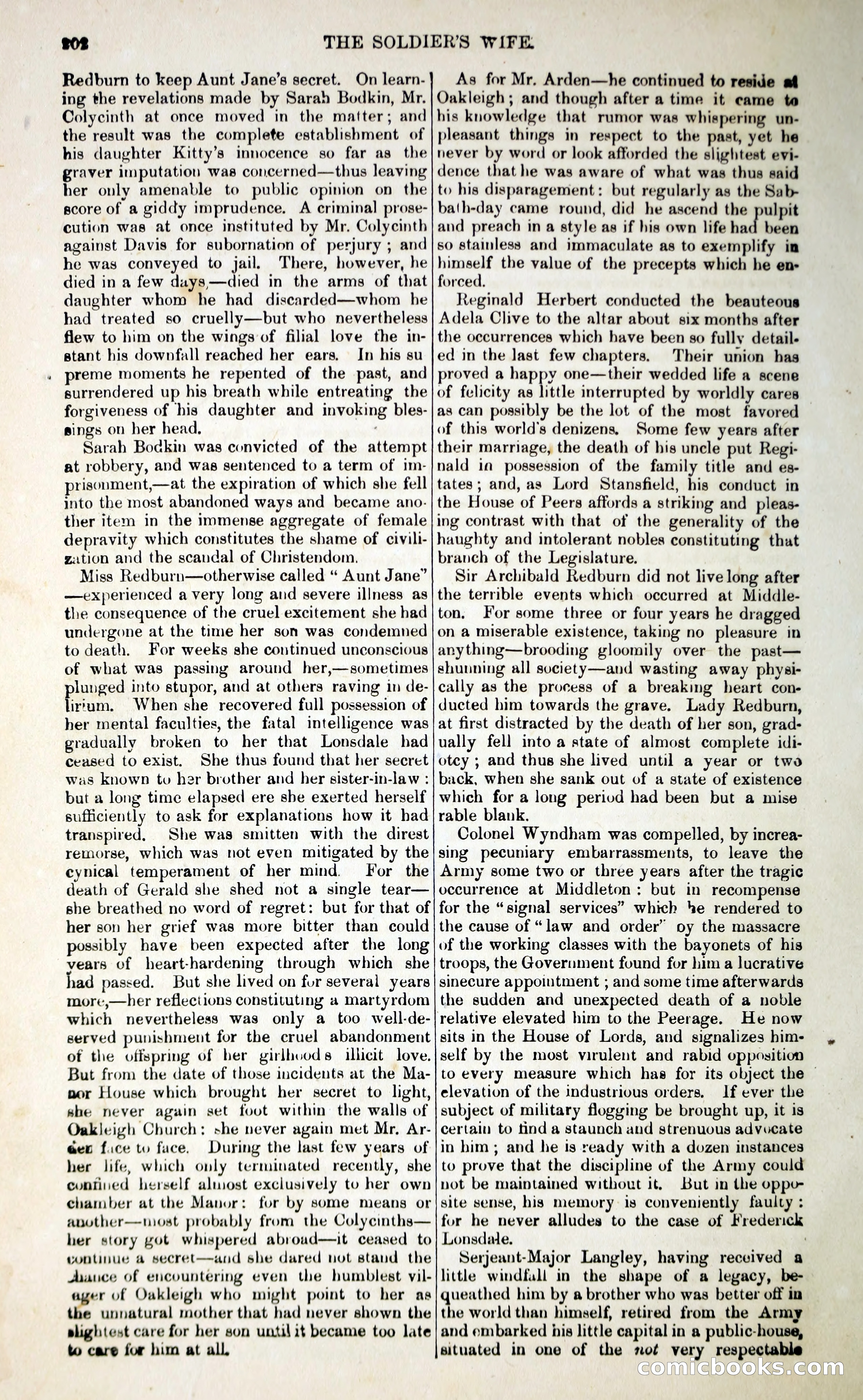
A restored page from Penny Dreadfuls, 1853. Page through the whole issue in the reader above.
📄 Transcribed text from this page (OCR, searchable)
Machine-transcribed from the original scan — historical spelling and the odd misread are preserved.
Redburn to keep Aunt Jane’s secret. On learn- ing the revelations made by Sarah Bodkin, Mr. Colycinth at once moved in the matter; and the result was the complete establishment of his daughter Kitty’s innocence so far as the graver imputation was concerned—thus leaving her only amenable to public opinion on the score of a giddy imprudence. A criminal prose- cution was at once instituted by Mr. Colycinth against Davis for subornation of perjury ; and he was conveyed to jail. There, however, he died in a few days—died in the arms of that daughter whom he had discarded—whom he had treated so cruelly—but who nevertheless flew to him on the wings of filial love the in- stant his downfall reached her ears. In his su preme moments he repented of the past, and surrendered up his breath while entreating the forgiveness of his daughter and invoking bles- sings on her head. Sarah Bodkin was convicted of the attempt at robbery, and was sentenced to a term of im- prisonment,—at the expiration of which she fell into the most abandoned ways and became ano. ther item in the immense aggregate of female depravity which constitutes the shame of civili- gtion and the scandal of Christendom. Miss Redburn—otherwise called “ Aunt Jane” —experienced a very long and severe illness as the consequence of the cruel excitement she had undergone at the time her son was condemned to death. For weeks she coutinued unconscious of what was passing around her,—sometimes lunged into stupor, and at others raving in de- Fea When she recovered full possession of her mental faculties, the fatal intelligence was gradually broken to her that Lonsdale had ceased to exist. She thus found that her secret was known to her brother and her sister-in-law : but a long time elapsed ere she exerted herself sufficiently to ask for explanations how it had transpired. She was smitten with the direst remorse, which was not even mitigated by the cynical temperament of her mind. For the death of Gerald she shed not a single tear— THE SOLDIER'S WIFE. As for Mr. Arden—he continued to reside af Oakleigh; and though after a time it came te his knowledge that rumor was whispering un- pleasant things in respect to the past, yet he never by word or look afforded the slightest evi- dence that he was aware of what was thus said to his disparagement: but regularly as the Sab- bath-day came round, did he ascend the pulpit and preach in a style as if his own life bad heat so stainless and immaculate as to exemplify im himself the value of the precepts which he en- forced. Reginald Herbert conducted the beauteous Adela Clive to the altar about six months after the occurrences which have been so fully detail- ed in the last few chapters. Their union has proved a rT one—their wedded life a scene of felicity as little interrupted by worldly cares as can possibly be the lot of the most favored of this world’s denizens, Some few years after their marriage, the death of his uncle put Regi- nald in possession of the family title and es- tates; and, as Lord Stansfield, his conduct in the House of Peers affords a striking and pleas- ing contrast with that of the generality of the haughty and intolerant nobles constituting that branch of the Legislature. Sir Archibald Redburn did not live long after the terrible events which occurred at Middle- ton, For some three or four years he dragged on a miserable existence, taking no pleasure in anything—brooding gloomily over the past— shunning all society—and wasting away physi- cally as the process of a breaking heart con- ducted him towards the grave. Lady Redburn, at first distracted by the death of her son, grad- ually fell into a state of almost complete idi- otcy ; and thus she lived until a year or two back, when she sank out of a state of existence which for a long perivd had been but a mise rable blank. Colonel Wyndham was compelled, by increa- sing pecuniary embarrassments, to leave the Army some two or three years after the tragic occurrence at Middleton: but in recompense she breathed no word of regret: but for that of|for the “signal services” which he rendered to her son her grief was more bitter than could possibly have been expected after the long vears of heart-hardening through which she iad passed. But she lived on fur several years more,—her reflections constituting a martyrdom which nevertheless was only a too well-de- served punishment for the cruel abandonment of the offspring of ber girlhoods illicit love. But from the date of those incidents at the Ma- por House which brought her secret to light, she never again set foot within the walls of Oakleigh Church: she never again met Mr, Ar- ger fice to face. During the last few years of her life, which only terminated recently, she cuntined herself almost exclusively to her own chamber at the Manor: for by some means or apother—most probably from the Colycinths— her story got whispered abroud—it ceased to voouunue @ secret—and she dared not stand the shauce of encountering even the humblest vil- er of Oakleigh who might point to her as the unnatural mother that had never shown the slightest care for her son untilit became too late to care for him at all, the cause of “law and order’ oy the massacre of the working classes with the bayonets of his troops, the Government found for him a lucrative sinecure appointment ; and some time afterwards the sudden and unexpected death of a noble relative elevated him to the Peerage. He now sits in the House of Lords, and signalizes him- self by the most virulent and rabid opposition to every measure which has for its object the — elevation of the industrious orders. If ever the subject of military flogging be brought up, it is certain to find a staunch and strenuous advocate in him; and he is ready with a dozen instances to prove that the discipline of the Army could pot be maintained without it, But in the oppo- site sense, his memvury is conveniently faulty ; for he never alludes to the case of Frederick Lonsdale. Serjeant-Major Langley, having received a little windfall in the shape of a legacy, be- ueathed him by a brother who was better off in the world than himself, retired from the Army and embarked his little capital in a public-house, situated in one of the not very respectable Eomicbooks (Ele)