
Penny Dreadfuls, 1853 · page 53 of 231
The Soldier's Wife — page 53: what you’re looking at
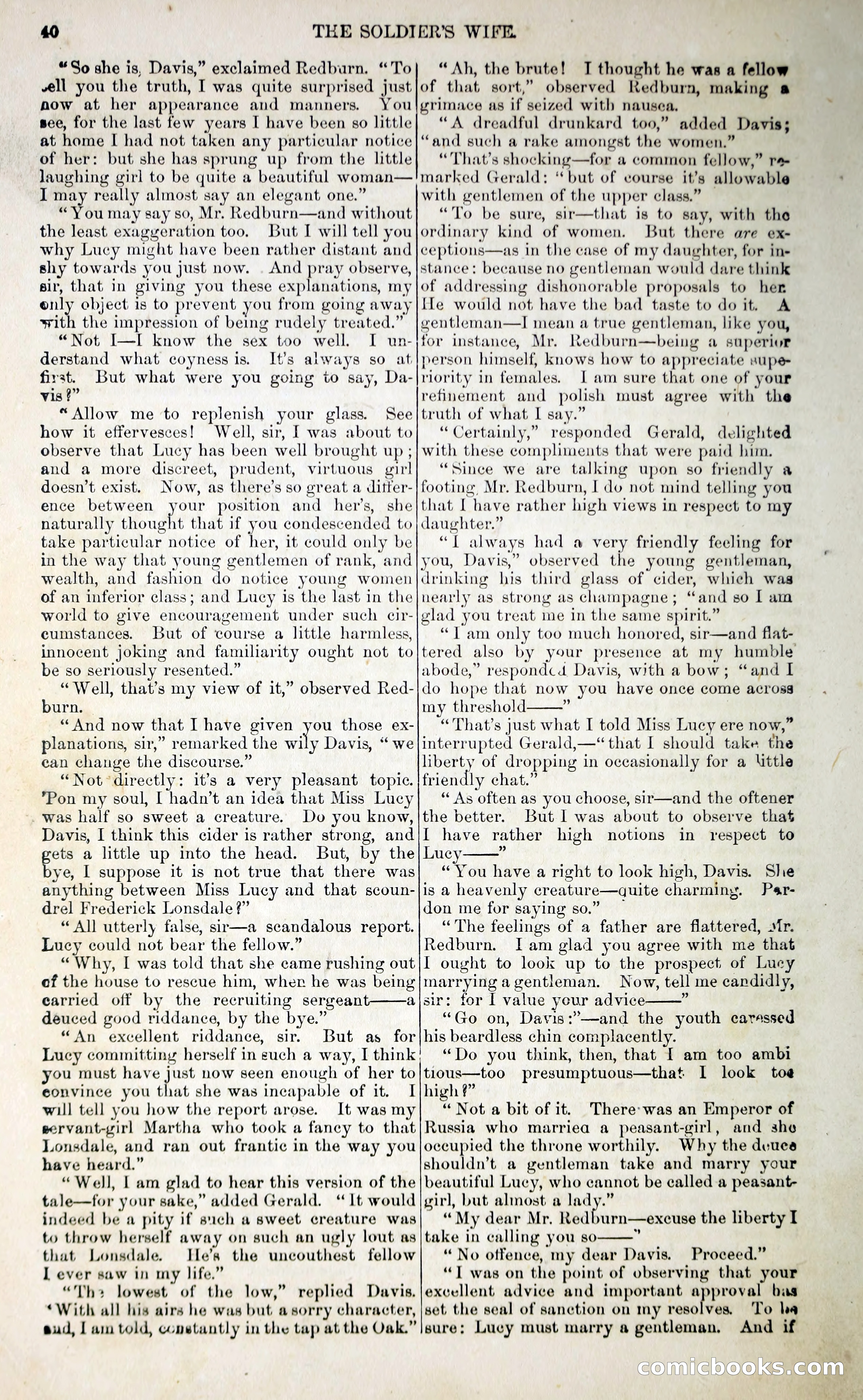
A restored page from Penny Dreadfuls, 1853. Page through the whole issue in the reader above.
📄 Transcribed text from this page (OCR, searchable)
Machine-transcribed from the original scan — historical spelling and the odd misread are preserved.
40 “So she is, Davis,” exclaimed Redburn. “To vell you the truth, I was quite surprised just pow at her appearance and manners. You see, for the last few years I have been so little at home I had not taken any particular notice |‘ of her: but she has sprung up from the little laughing girl to be quite a beautiful woman— I ae really almost say an elegant one.” ou may say so, Mr. Redburn—and without the least exaggeration too. But I will tell you why Lucey might have been rather distant and shy towards you just now. . And pray observe, sir, that in giving you these explanations, my only object is to prevent you from going : away with the impression of being rudely treated.” “Not I—I know the sex too well. I un- derstand what coyness is. It’s always so at first. But what were you going to say, Da- vis ?” “Allow me to replenish your glass. See how it effervesces! Well, sir, I was about to observe that Lucy has been well brought up ; and a more discreet, prudent, virtuous virl doesn’t exist. Now, as there’s so great a ditfer- ence between your position and her’s, she naturally thought that if you condese ended to take particular notice of her, it could only be in the way that young gentlemen of rank, and wealth, and fashion do notice young women of an inferior class; and Lucy 1s the last 1n the world to give encouragement under such eir- cumstances. But of course a little harmless, innocent joking and familiarity ought not to be so seriously resented.” “Well, that’s my view of it,” observed Red- burn. — “And now that I have given you those ex- planations, sir,” remar ked the wily Davis, “we ean change the discourse.’ “Not directly: it’s a very pleasant topic. "Pon my soul, [ hadn’t an idea that Miss Lucy was half so sweet a creature. Do you know, Davis, I think this cider is rather strong, and “aes a little up into the head. But, by the ye, | suppose it is not true that there was anything between Miss Lucy and that scoun- drel Frederick Lonsdale?” “All utterly false, sir—a scandalous report. Lucy could not bear the fellow.” “Why, I was told that she came rushing out of the house to rescue him, wher he was being carried off by the recruiting sergeant——a deuced good riddance, by the bye.” “An excellent riddance, sir. But as for Lucy committing herself in euch a way, I think you must have just now seen enough of her to eonvince you that she was incapable of it. I will tell you how the report arose. It was my servant-virl Martha who took a faney to that Lonsdale, and ran out frantic in the way you have heard.” “Well, | am glad to hear this version of the tale—for your sake,” added Gerald. “It would indeed be a pity if such a sweet creature was to throw herself away on such an ugly lout as that Lonsdale. Ile’s the uncouthest fellow l ever saw in my life.” “Ths lowest of the low,” replied Davis. ‘With all his airs he was but asorry character, gud, I am told, constantly in the tap at the Oak.” THE SOLDIER'S WIFE. “Ah, the brute! I thought he was a fellow of that sort,” observed Redburn, making @ grimace as if seized with nausea. “A dreadful drunkard too,” added Davis; ‘and such a rake amongst the women.” “That’s shocking—for a common fellow,” ra marked Gerald: ‘but of course it’s allowable with gentlemen of the upper class.” “To be sure, sir—that is to say, with the ordinary kind of women. But there are @X- ceptionus—as in the case of my daughter, for in- stance: because no gentleman would dare think of addressing dishonorable proposals to her {fe would not have the bad taste to do it. A gventleman—I mean a true gentleman, like you, for instance, Mr. Redburn—being a superior person himself, enowa how to appreciate supe riority 1n females. I am sure that one of your refinement and polish must agree with the truth of what I say.’ “Certainly,” responded Gerald, delighted with these compliments that were paid him. “Since we are talking upon so friendly a footing, Mr. Redburn, I do not mind telling you that I have rather high views in respect to my daughter.” “T always had a very friendly feeling for you, Davis,” observed the young gentleman, drinking his third glass of cider, which was nearly as strong as champagne ; “and so I am glad you treat me in the same spirit.” “J am only too much honored, sir—and flat- tered also by your presence at my humble abode,” respondcd Davis, with a bow; “and I do hope that now you have once come across my threshold “That’s just what I told Miss Lucy ere now,” interrupted Gerald,—“ that I should take the liberty of dropping i in occasionally for a little friendly chat.” “ As often as you choose, sir—and the oftener the better. But Il was about to observe that I have rather high notions in respect to Lucy ‘ “You have a right to look high, Davis. She is a heavenly creature—quite charming. Par- don me for saying so.’ “The feelings of a father are flattered, »fr. Redburn. Iam glad you agree with me that I ought to look up to the prospect of Lucy marrying agentleman. Now, tell me candidly, sir: for I value yeur advice——” “Go on, Davis:’—and the youth caressed his beardless chin complacently. “Do you think, then, that I am too ambi tious—too presumptuous—that I look toe high ?” “Not a bit of it. There-was an Emperor of Russia who marriea a peasant-girl, and she occupied the throne worthily. Why the duucs shouldn't a gentleman take and marry your beautiful Lucy, who cannot be called a peasant- girl, but almost a lady. “My dear Mr, Redburn—excuse the liberty I take in calling you so x “No offence, my dear Davis. Proceed.” “T was on the point of observing that your excellent advice and important mF bas set the seal of sanction on my resolves. To ha sure: Lucy must marry a gentleman, And if aT a’ a e. J& ® ee (E(0) oKefe) MULE cS; €O