
Penny Dreadfuls, 1853 · page 81 of 231
The Soldier's Wife — page 81: what you’re looking at
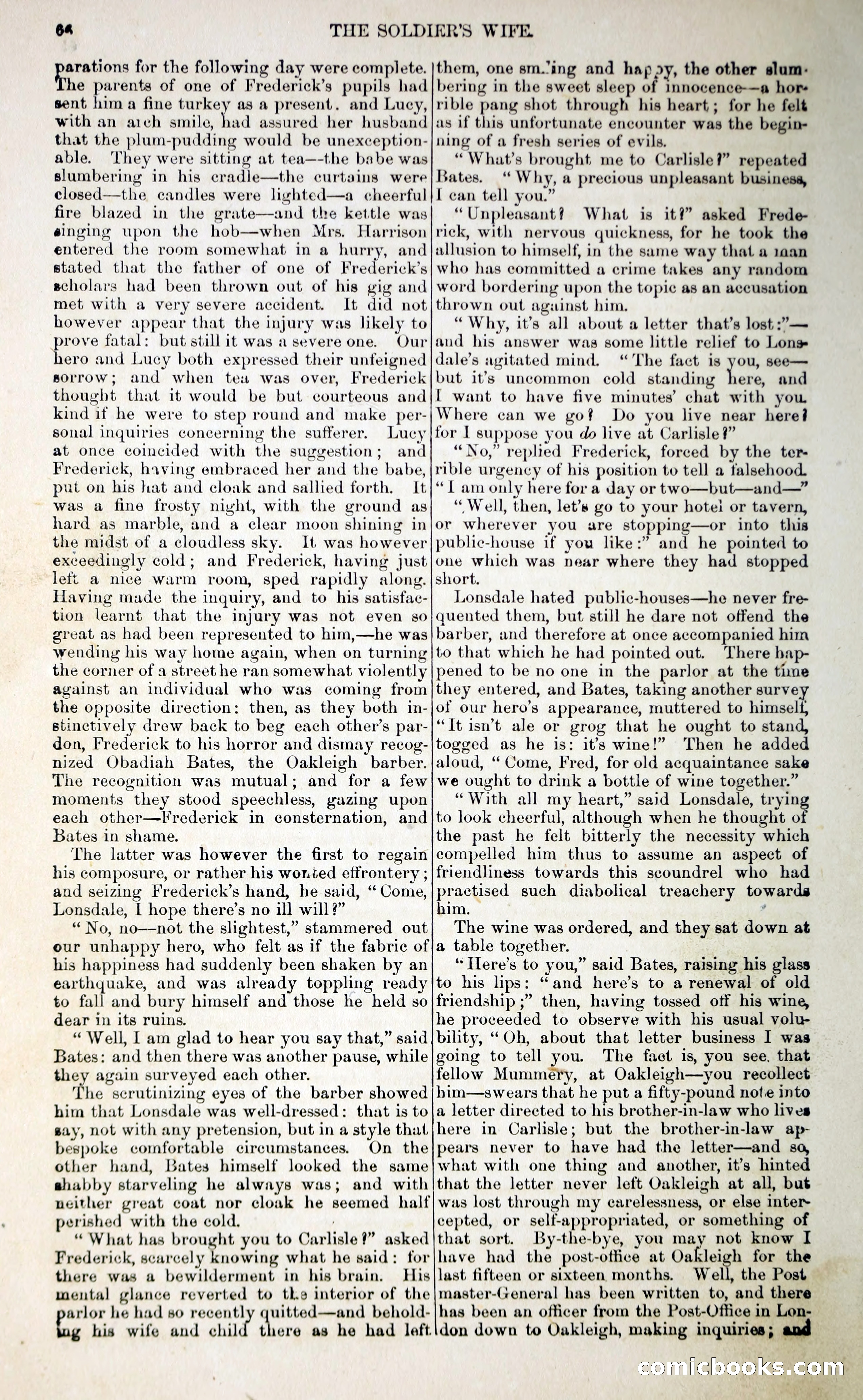
A restored page from Penny Dreadfuls, 1853. Page through the whole issue in the reader above.
📄 Transcribed text from this page (OCR, searchable)
Machine-transcribed from the original scan — historical spelling and the odd misread are preserved.
64 arations for the following day were complete. he parents of one of Frederick’s pupils had sent hima fine turkey as a present. and Luey, with an aich smile, had assured her husband that the plum-pudding would be unexception- able. They were sitting at tea—-the babe was slumbering in his cradle—the curtains were closed—the candles were lighted—a cheerful fire blazed in the grate—and the kettle was ainging upon the hob—when Mrs. Harrison entered the room somewhat in a hurry, and stated that the father of one of Frederick’s echolars had been thrown out of his gig and met with a very severe accident. It did not however appear that the injury was likely to prove fatal: but still it was a severe one. Our hero and Lucey both expressed their unfeigned sorrow; and when tea was over, Frederick thought that it would be but courteous and kind if he were to step round and make per- sonal inquiries concerning the sufferer. Lucy at once coimcided with the suggestion; and Frederick, having embraced her and the babe, put on his hat and cloak and sallied forth. — It was a fine frosty night, with the ground as hard as marble, and a clear moon shining in the midst of a cloudless sky. It was however exceedingly cold; and Frederick, having just left a nice warm room, sped rapidly along. Having made the inquiry, and to his satisfac- tion learnt that the injury was not even go great as had been represented to him,—he was wending his way home again, when on turning the corner of a street he ran somewhat violently against an individual who was coming from the opposite direction: then, as they both in- stinctively drew back to beg each other’s par- don, Frederick to his horror and dismay recog- nized Obadiah Bates, the Oakleigh barber. The recognition was mutual; and for a few moments they stood speechless, gazing upon each other—Frederick in consternation, and Bates in shame. The latter was however the first to regain his composure, or rather his wonted effrontery ; and seizing Frederick’s hand, he said, “ Come, Lonsdale, I hope there’s no ill will?” “No, no—not the slightest,” stammered out THE SOLDIRER'’S WIFE them, one sm.’ing and hap Dy, the other slum- bering in the sweet sleep of Innocence-—a hors rible pang shot through his heart; for he felt as if this unfortunate encounter was the begin- ning of a fresh series of evils. “What’s brought me to Carlisle?” repeated Bates. “ Why, a precious unpleasant business, I can tell you.” “Unpleasant? What is it?” asked Frede- rick, with nervous quickness, for he took the allusion to himself, in the same way that a 1aan who has committed a crime takes any random word bordering upon the topic as an accusation thrown out against him, “Why, it’s all about a letter that’s lost :”’— and his answer was some little relief to Long dale’s agitated mind. “The fact is you, see— but it’s uncommon cold standing Lave and [ want to have five minutes’ chat with you Where can we go? Do you live near here? for | suppose you do live at Carlisle?” “No,” replied Frederick, foreed by the ter- rible urgency of his position to tell a talsehood. “| am only here for a day or two—but—and—” “Well, then, let’s go to your hotel or tavern, or wherever you are stopping—or into this public-house if you like:” and he pointed to one which was near where they had stopped short. Lonsdale hated public-houses—he never fre- quented them, but still he dare not offend the barber, and therefore at once accompanied him to that which he had pointed out. There bap- pened to be no one in the parlor at the time they entered, and Bates, taking another survey of our hero’s appearance, muttered to himself, “It isn’t ale or grog that he ought to stand, togged as he is: it’s wine!” Then he added aloud, ‘“ Come, Fred, for old acquaintance sake we ought to drink a bottle of wine together.” “With all my heart,” said Lonsdale, trying to look cheerful, although when he thought of the past he felt bitterly the necessity which compelled him thus to assume an aspect of friendliness towards this scoundrel who had practised such diabolical treachery towards him. — , The wine was ordered, and they sat down at our unhappy hero, who felt as if the fabric of|a table together. his happiness had suddenly been shaken by an “ Here’s to you,” said Bates, raising his glass earthquake, and was already toppling ready|to his lips: “and here’s to a renewal of old to fall and bury himself and those he held so|friendship ;” then, having tossed off his wine, dear in its ruins. he proceeded to observe with his usual volu- “ Well, 1 am glad to hear you say that,” said| bility, ““Oh, about that letter business I was Bates: and then there was another pause, while|going to tell they again surveyed each other. ou. The fact 1s, you see, that fellow Mummery, at Oakleigh—you recollect The scrutinizing eyes of the barber showed |him—swears that he put a fifty-pound note into him that Lonsdale was well-dressed: that is to gay, not with any pretension, but in a style that bespoke comfortable circumstances. On the other hand, Bates himself looked the same shabby starveling he always was; and with neither great coat nor cloak he seemed half perished with the cold. , “What has brought you to Carlisle?” asked Frederick, scarcely knowing what he said: tor there was a bewilderment in his brain. His mental glance reverted to the interior of the arlor he had 80 recently quitted—and behold- te his wife and chil , a letter directed to his brother-in-law who lives here in Carlisle; but the brother-in-law ap- pears never to have had the letter—and so, what with one thing and another, it’s hinted that the letter never left Oakleigh at all, but was lost through my earelessness, or else inter- cepted, or self-appropriated, or something of that sort. By-the-bye, you may not know I have had the post-othce at Oakleigh for the last fifteen or sixteen months. master-General has been written to, and there has been an officer from the Post-Office in = 1ere as he had leftldon down to Oakleigh, making inquiries; and — Well, the Post © ? Gomiecboo (E CS aa * “« 4 * ! We i :