
Penny Dreadfuls, 1844 · page 21 of 399
The Steam-Packet: A Tale of the River and the Ocean — page 21: what you’re looking at
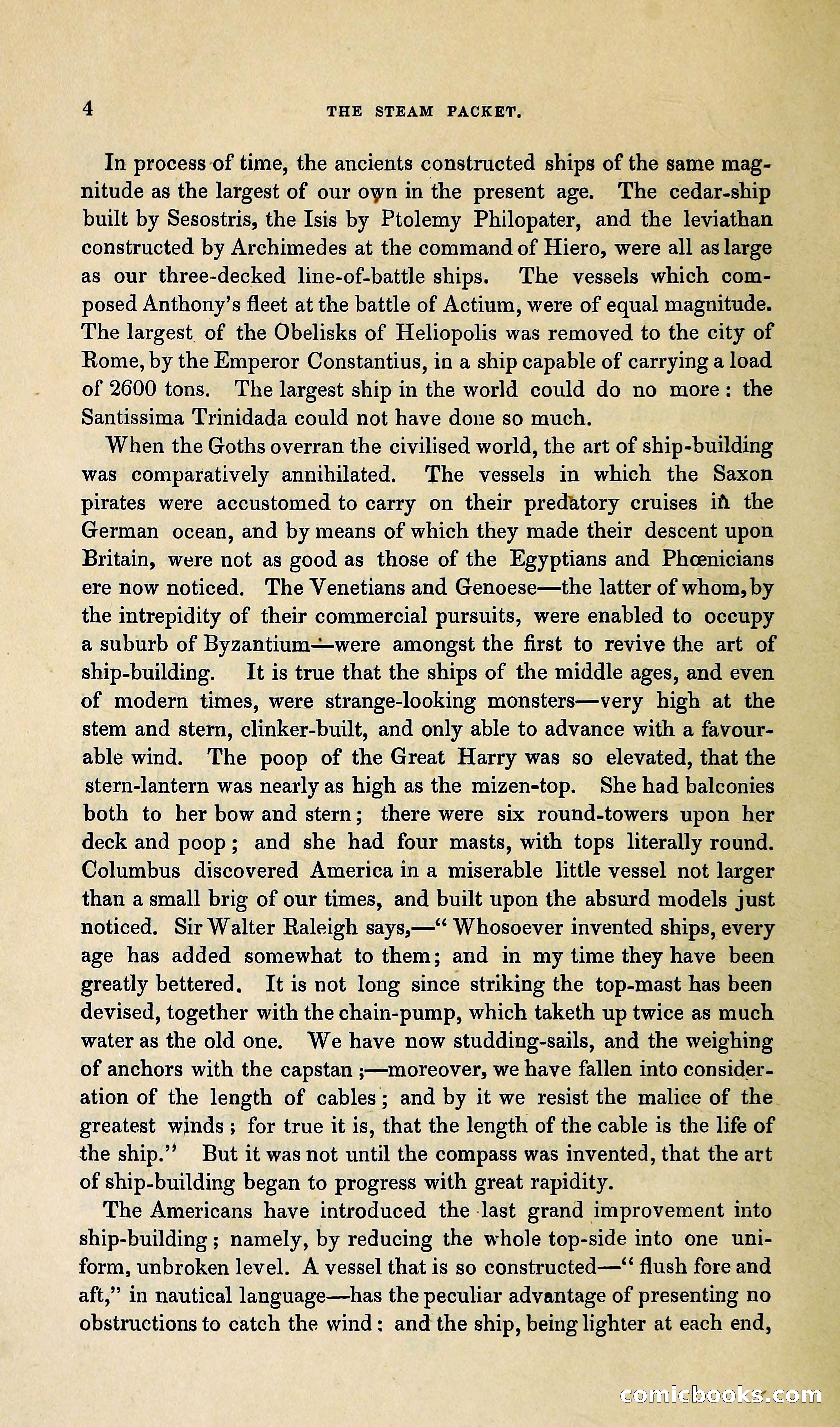
A restored page from Penny Dreadfuls, 1844. Page through the whole issue in the reader above.
📄 Transcribed text from this page (OCR, searchable)
Machine-transcribed from the original scan — historical spelling and the odd misread are preserved.
4 THE STEAM PACKET. In process of time, the ancients constructed ships of the same mag- nitude as the largest of our own in the present age. The cedar-ship built by Sesostris, the Isis by Ptolemy Philopater, and the leviathan constructed by Archimedes at the command of Hiero, were all as large as our three-decked line-of-battle ships. The vessels which com- posed Anthony’s fleet at the battle of Actium, were of equal magnitude. The largest of the Obelisks of Heliopolis was removed to the city of Rome, by the Emperor Constantius, in a ship capable of carrying a load of 2600 tons. The largest ship in the world could do no more: the Santissima Trinidada could not have done so much. When the Goths overran the civilised world, the art of ship-building was comparatively annihilated. The vessels in which the Saxon pirates were accustomed to carry on their predatory cruises if the German ocean, and by means of which they made their descent upon Britain, were not as good as those of the Egyptians and Phoenicians ere now noticed. The Venetians and Genoese—the latter of whom, by the intrepidity of their commercial pursuits, were enabled to occupy a suburb of Byzantium—were amongst the first to revive the art of ship-building. It is true that the ships of the middle ages, and even of modern times, were strange-looking monsters—very high at the stem and stern, clinker-built, and only able to advance with a favour- able wind. The poop of the Great Harry was so elevated, that the stern-lantern was nearly as high as the mizen-top. She had balconies both to her bow and stern; there were six round-towers upon her deck and poop; and she had four masts, with tops literally round. Columbus discovered America in a miserable little vessel not larger than a small brig of our times, and built upon the absurd models just noticed. Sir Walter Raleigh says,—‘*‘ Whosoever invented ships, every age has added somewhat to them; and in my time they have been ereatly bettered. It is not long since striking the top-mast has been devised, together with the chain-pump, which taketh up twice as much water as the old one. We have now studding-sails, and the weighing of anchors with the capstan ;—moreover, we have fallen into consider- ation of the length of cables; and by it we resist the malice of the greatest winds; for true it is, that the length of the cable is the life of the ship.”’ But it was not until the compass was invented, that the art of ship-building began to progress with great rapidity. The Americans have introduced the last grand improvement into ship-building ; namely, by reducing the whole top-side into one uni- form, unbroken level. A vessel that is so constructed—“‘ flush fore and aft,” in nautical language—has the peculiar advantage of presenting no obstructions to catch the wind: and the ship, being lighter at each end, GEomicbooks:co