
Penny Dreadfuls, 1844 · page 388 of 399
The Steam-Packet: A Tale of the River and the Ocean — page 388: what you’re looking at
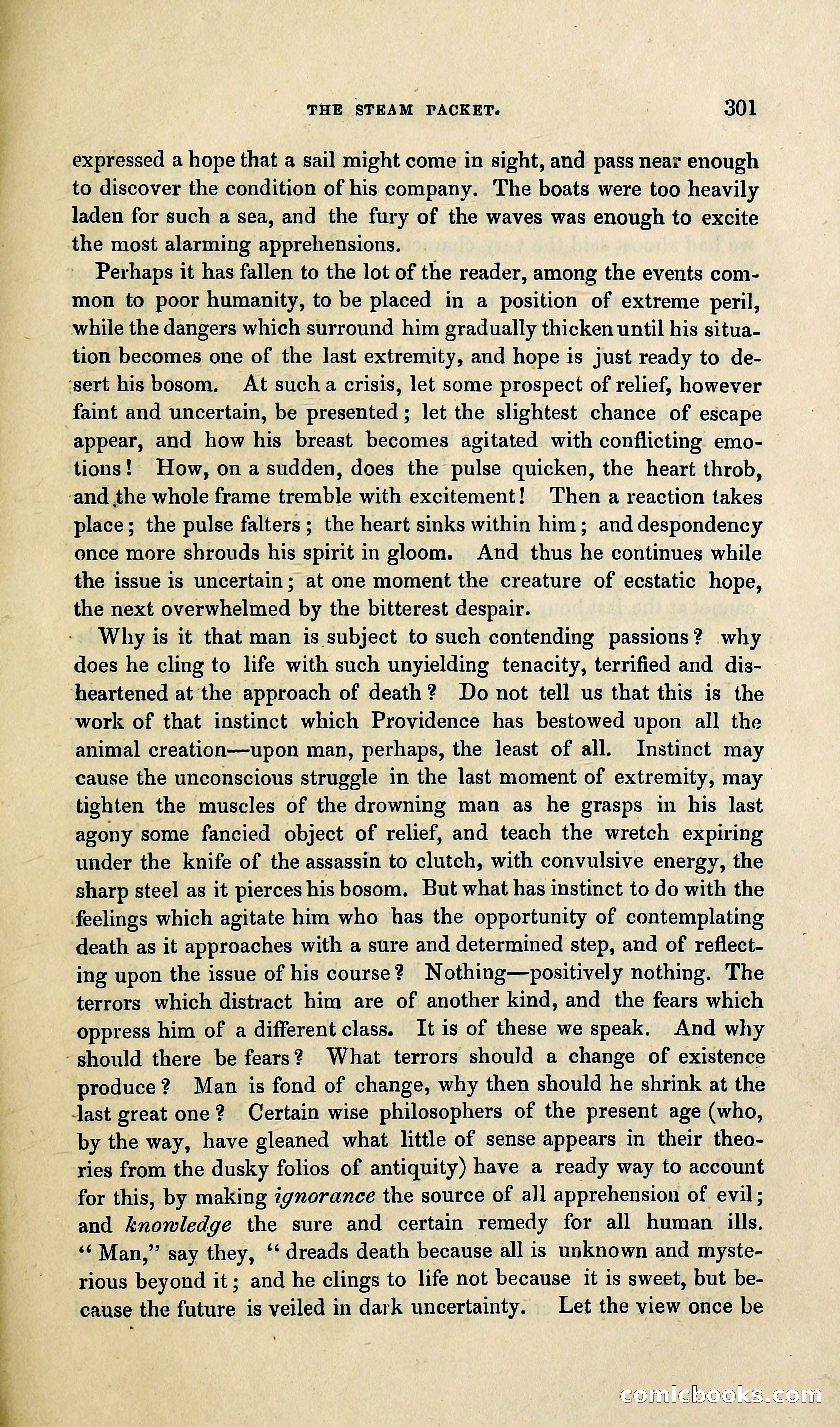
A restored page from Penny Dreadfuls, 1844. Page through the whole issue in the reader above.
📄 Transcribed text from this page (OCR, searchable)
Machine-transcribed from the original scan — historical spelling and the odd misread are preserved.
j : , | : THE STEAM PACKET. 301 expressed a hope that a sail might come in sight, and pass near enough to discover the condition of his company. The boats were too heavily laden for such a sea, and the fury of the waves was enough to excite the most alarming apprehensions. Perhaps it has fallen to the lot of the reader, among the events com- mon to poor humanity, to be placed in a position of extreme peril, while the dangers which surround him gradually thicken until his situa- tion becomes one of the last extremity, and hope is just ready to de- ‘sert his bosom. At sucha crisis, let some prospect of relief, however faint and uncertain, be presented; let the slightest chance of escape appear, and how his breast becomes agitated with conflicting emo- tions! How, on a sudden, does the pulse quicken, the heart throb, ‘and the whole frame tremble with excitement! Then a reaction takes place; the pulse falters; the heart sinks within him; and despondency once more shrouds his spirit in gloom. And thus he continues while the issue is uncertain; at one moment the creature of ecstatic hope, the next overwhelmed by the bitterest despair. Why is it that man is subject to such contending passions? why does he cling to life with such unyielding tenacity, terrified and dis- heartened at the approach of death? Do not tell us that this is the work of that instinct which Providence has bestowed upon all the animal creation—upon man, perhaps, the least of all. Instinct may cause the unconscious struggle in the last moment of extremity, may tighten the muscles of the drowning man as he grasps in his last agony some fancied object of relief, and teach the wretch expiring under the knife of the assassin to clutch, with convulsive energy, the sharp steel as it pierces his bosom. But what has instinct to do with the feelings which agitate him who has the opportunity of contemplating death as it approaches with a sure and determined step, and of reflect- ing upon the issue of his course? Nothing—positively nothing. The terrors which distract him are of another kind, and the fears which oppress him of a different class. It 1s of these we speak. And why ‘should there be fears? What terrors should a change of existence produce? Man is fond of change, why then should he shrink at the last great one? Certain wise philosophers of the present age (who, by the way, have gleaned what little of sense appears in their theo- ries from the dusky folios of antiquity) have a ready way to account for this, by making zgnorance the source of all apprehension of evil; and knowledge the sure and certain remedy for all human ills. ‘¢ Man,” say they, ‘‘ dreads death because all is unknown and myste- rious beyond it; and he clings to life not because it is sweet, but be- cause the future is veiled in dark uncertainty. Let the view once be Gomicbooks (E(0)