
Penny Dreadfuls, 1890 · page 199 of 233
That Girl of Johnson's — page 199: what you’re looking at
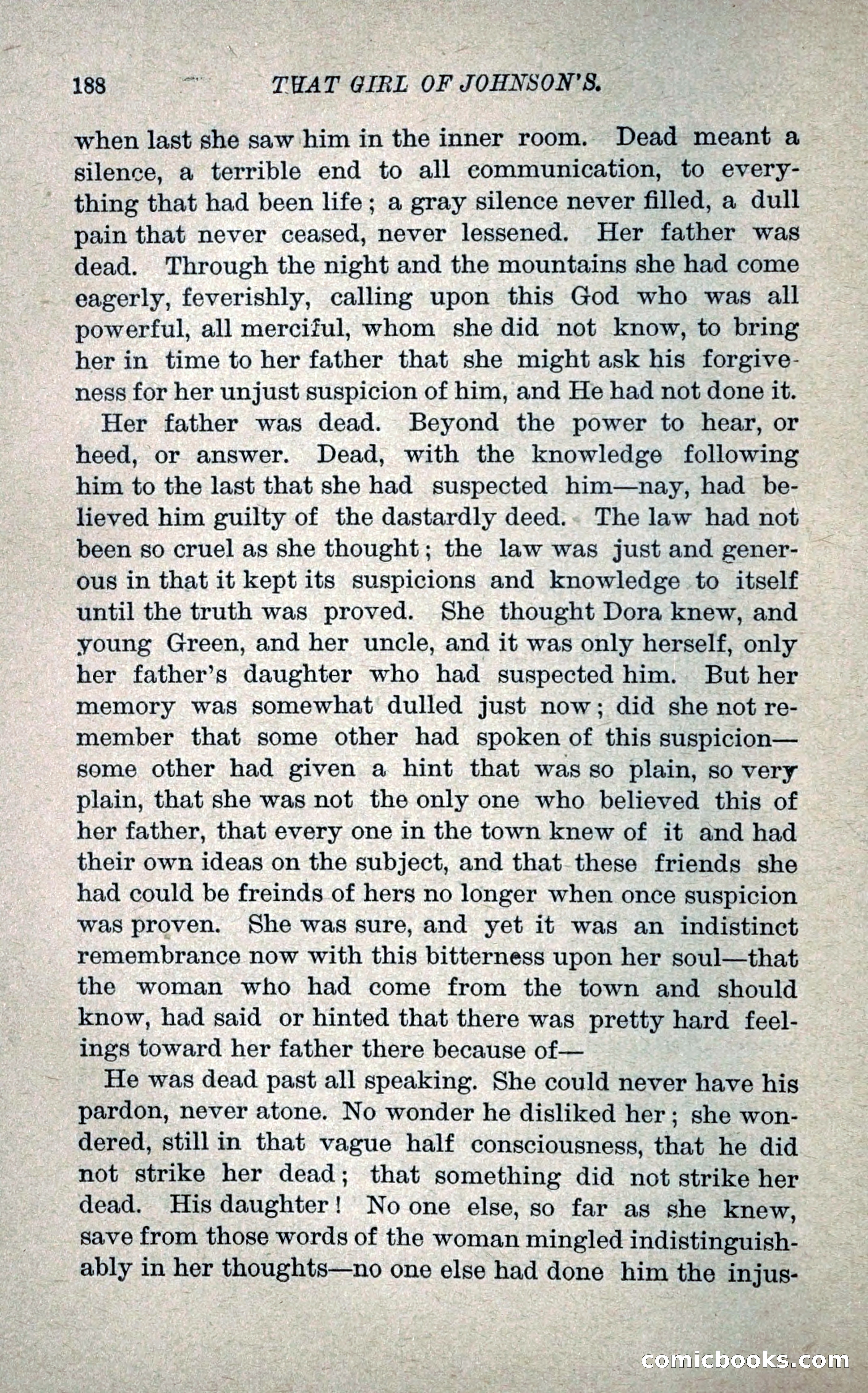
A restored page from Penny Dreadfuls, 1890. Page through the whole issue in the reader above.
📄 Transcribed text from this page (OCR, searchable)
Machine-transcribed from the original scan — historical spelling and the odd misread are preserved.
188 oe THAT GIRL OF JOHNSON’S. when last she saw him in the inner room. Dead meant a silence, a terrible end to all communication, to every- thing that had been life; a gray silence never filled, a dull pain that never ceased, never lessened. Her father was dead. Through the night and the mountains she had come eagerly, feverishly, calling upon this God who was all powerful, all merciful, whom she did not know, to bring her in time to her father that she might ask his forgive- ness for her unjust suspicion of him, and He had not done it. Her father was dead. Beyond the power to hear, or heed, or answer. Dead, with the knowledge following him to the last that she had suspected him—nay, had be- lieved him guilty of the dastardly deed.. The law had not been so cruel as she thought; the law was just and gener- — ous in that it kept its suspicions and knowledge to itself until the truth was proved. She thought Dora knew, and young Green, and her uncle, and it was only herself, only her father’s daughter who had suspected him. But her memory was somewhat dulled just now; did she not re- member that some other had spoken of this suspicion— some other had given a hint that was so plain, so very plain, that she was not the only one who believed this of her father, that every one in the town knew of it and had their own ideas on the subject, and that these friends she had could be freinds of hers no longer when once suspicion was proven. She was sure, and yet it was an indistinct remembrance now with this bitterness upon her soul—that the woman who had come from the town and should know, had said or hinted that there was pretty hard feel- ings toward her father there because of — He was dead past all speaking. She could never have his pardon, never atone. No wonder he disliked her; she won- dered, stillin that vague half consciousness, that he did not strike her dead; that something did not strike her dead. His daughter! Noone else, so far as she knew, save from those words of the woman mingled indistinguish- ably in her thoughts—no one else had done him the injus- ee