
Penny Dreadfuls, 1901 · page 26 of 37
The Golden Harpoon — page 26: what you’re looking at
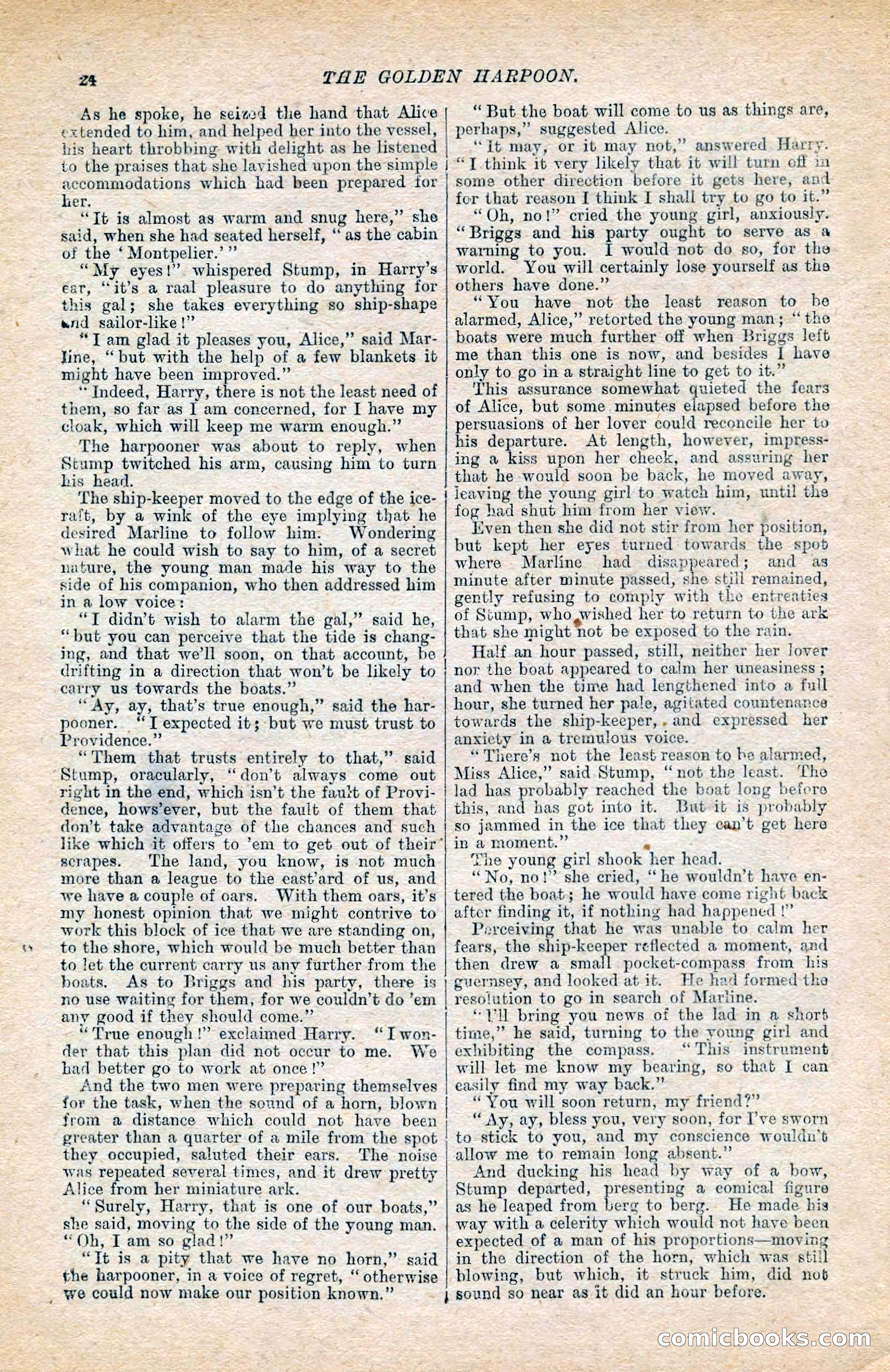
A restored page from Penny Dreadfuls, 1901. Page through the whole issue in the reader above.
📄 Transcribed text from this page (OCR, searchable)
Machine-transcribed from the original scan — historical spelling and the odd misread are preserved.
As he spoke, he sei#ed the hand that Alice extended to him, and helped her into the vessel, his heart throbbing with delight as he listened to the praises that she lavished upon the simple accommodations which had been prepared tor her. “Tt is almost as warm and snug here,” she said, when she had seated herself, “as the cabin of the ‘ Montpelier.’ ”’ “My eyes!” whispered Stump, in Harry’s ear, “it’s a raal pleasure to do anything for this gal; she takes everything so ship-shape wnd sailor-lke!” *T am glad it pleases you, Alice,” said Mar- Iine, “but with the help of a few blankets it might have been improved.” “Indeed, Harry, there is not the least need of them, so far as 1 am concerned, for I have my cloak, which will keep me warm enough.” The harpooner was about to reply, when Stump twitched his arm, causing him to turn his head. The ship-keeper moved to the edge of the ice- raft, by a wink of the eye implying that he desired Marline to follow him: Wondering what he could wish to say to him, of a secret nature, the young man made his way to the side of his companion, who then addressed him in a low voice: “T didn’t wish to alarm the gal,” said he, “but you can perceive that the tide is chang- ing, and that we'll soon, on that account, be drifting in a direction that won’t be likely to carry us towards the boats.” | ‘Ay, ay, that’s true enough,” said the har- pooner. “T expected it; but we must trust to Providence.” “Them that trusts entirely to that,” said ‘Stump, oracularly, ‘don’t always come out right in the end, which isn’t the fautt of Provi- denee, hows’ever, but the fault of them that don’t take advantage of the chances and such like which it offers to ’em to get out of their scrapes. The land, you know, is not much more than a league to the east’ard of us, and we have a couple of oars. With them oars, it’s my honest opinion that we might contrive to work this block of ice that we are standing on, to the shore, which would be much better than to let the current carry us any further from the hoats. As to Briggs and his party, there is no use waiting for them, for we couldn’t do ’em any good if they should come.” “True enough!” exclaimed Harry. der that this plan did not occur to me. had better go to work at once!” And the two men were preparing themselves for the task, when the sound of a horn, blown from a distance which could not have been greater than a quarter of a mile from the spot they occupied, saluted their ears. The noise was repeated several times, and it drew pretty Alice from her miniature ark. “Surely, Harry, that is one of our boats,” she said, moving to the side of the young man. “Oh, Iam so glad!” “Tt is a pity that we have no horn,” said the harpooner, in a voice of regret, “ otherwise *T won- We _ we could now make our position known.” | j THE GOLDEN H ARPOON,. “ But the boat will come to us as things are, perhaps,” suggested Alice. “it may, or it may not,” answered Harry. “J think it very likely that it will turn off in some other direction before it gets here, and for that reason I think I shall try to go to it.” “Oh, no!” cried the young girl, anxiously. “Briggs and his party ought to serve as a warning to you. I would not do so, for the world. You will certainly lose yourself as the others have done.” “You have not the least reason to he alarmed, Alice,” retorted the young man; “the boats were much further off when Briggs left me than this one is now, and besides I have only to go in a straight line to get to it.” This assurance somewhat quieted the fears of Alice, but some minutes elapsed before the persuasions of her lover could reconcile her to his departure. At length, however, impress- ing a kiss upon her check, and assuring her that he would soon be back, he moved away, leaving the young girl to watch him, until the og had shut him from her view. Even then she did not stir from her position, but kept her eyes turned towards the spot where Marline had See ee and as minute after minute passed, she still remained, gently refusing to comply with the entreaties of Stump, who wished her to return to the ark that she might not be exposed to the rain. Half an hour passed, still, neither her lover nor the boat appeared to calm her uneasiness ; and when the time had lengthened into a full hour, she turned her pale, agitated countenance towards the ship-kecper,, and expressed her anxiety in a tremulous voice. “There’s not the least reason to be alarmed, Miss Alice,” said Stump, “not the least. The lad has probably reached the boat long before this, and has got into it. But it is probably so jammed in the ice that they can’t get here in a moment.” ra The young girl shook her head. ‘No, no!” she cried, “ he wouldn’t have en- tered the boat; he would have come right back after finding it, if nothing had happened !” Pareeiving that he was unable to calm her r reflected a moment, and then drew a small pocket-compass from his guernsey, and looked at it. He had formed tha resolution to go in search of Martine. “Vil bring you news of the lad in a short time,” he said, turning to the young girl and exhibiting the compass. “This instrument will let me know my bearing, so that I can easily find my way back.” “You will soon return, my friend?” “ Ay, ay, bless you, very soon, for I've sworn to stick to you, and my conscience wouldn't allow me to remain long absent.” And ducking his head by way of a bow, Stump departed, presenting a comical figure as he leaped from berg to berg. He made his way with a celerity which would not have been expected of a man of his proportions—moving in the direction of the horn, which was still fears, the ship-kee blowing, but which, it struck him, did not sound so near as it did an hour before. COMMGEOOOKSaEO©